VOCALOID 5 is Yamaha's singing voice synthesis software, a powerful tool for creating vocal tracks freely in your music productions. Full support for the AU format used by Logic Pro and the VST format used by Cubase enables seamless integration with your DAW. From entering notes and lyrics to choosing among eight voicebanks, over 100 STYLE presets, ATTACK/RELEASE effects, and more than 2,000 phrase presets, its extensive features support everyone from beginners to advanced users in creating high-quality vocal tracks.
VOCALOID 5 Takes Another Step Forward

In this article, we explore techniques and explain how to use Yamaha's VOCALOID 5.
As many music producers already know, VOCALOID uses recordings of real human voices, synthesized with VOCALOID technology, to sing melodies.
- Add subtle pitch nuances and vibrato
- Adjust volume and expression
- Fine-tune rhythm and timing, and more
You can freely control these elements to suit your song.
You can also enter lyrics for each note, making it a useful tool for creating vocal tracks for original songs.
Let's begin with an overview of VOCALOID and the many new features introduced since previous versions.
Video: GarageBand/Logic Support! An Overview of VOCALOID and Its New Features
Selected Questions and Answers from YouTube

I do not hear a preview sound when I click the piano roll. Could you explain how to enable it?

If the piano roll does not produce sound, a VOCALOID part may not be selected, or the track volume may have been turned down. Also, this product cannot be played from your DAW's piano roll, so please check that as well.
Can I use Hatsune Miku and similar voices in VOCALOID 5?
Hatsune Miku V4 works, although it sounds less realistic than the VOCALOID 5 libraries. According to this response, the newer version attracting attention and scheduled for release that year would not work.
Can I perform the same operations in FL Studio 20 as in Logic and Cubase?
It supports VST, so you can use it in FL Studio and perform similar operations.
Can I use it in Studio One? Also, are all existing voicebanks compatible with VOCALOID 5?
You can use it in Studio One. Some voicebanks reportedly are not compatible, depending on the product, so we recommend contacting support for the product you use to confirm that it will work. Thank you.
This was a great video. Is it impossible to create two or more VOCALOID 5 tracks in a DAW? I thought it would be nice to create rich, layered harmonies with VOCALOID.
You cannot run two instances in your DAW, but you can create multiple tracks inside VOCALOID 5. We will cover this in a follow-up!
Full AU Support for Logic Pro

Starting with this version, VOCALOID offers full support for the AU plug-in format used by Apple's Logic Pro.
Launching VOCALOID and integrating it with your DAW is very straightforward.
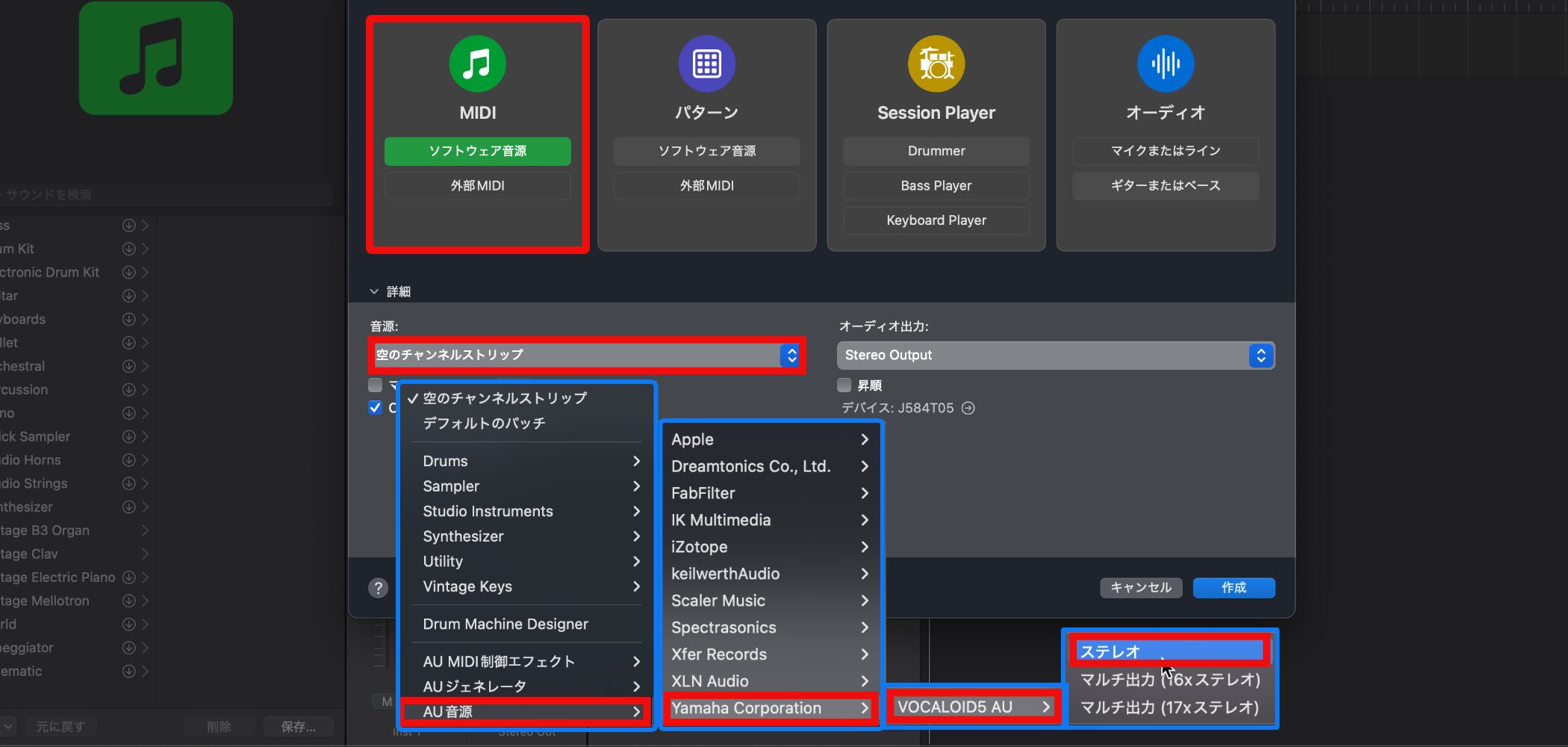
Simply create a Software Instrument track and load VOCALOID 5 AU as the software instrument.
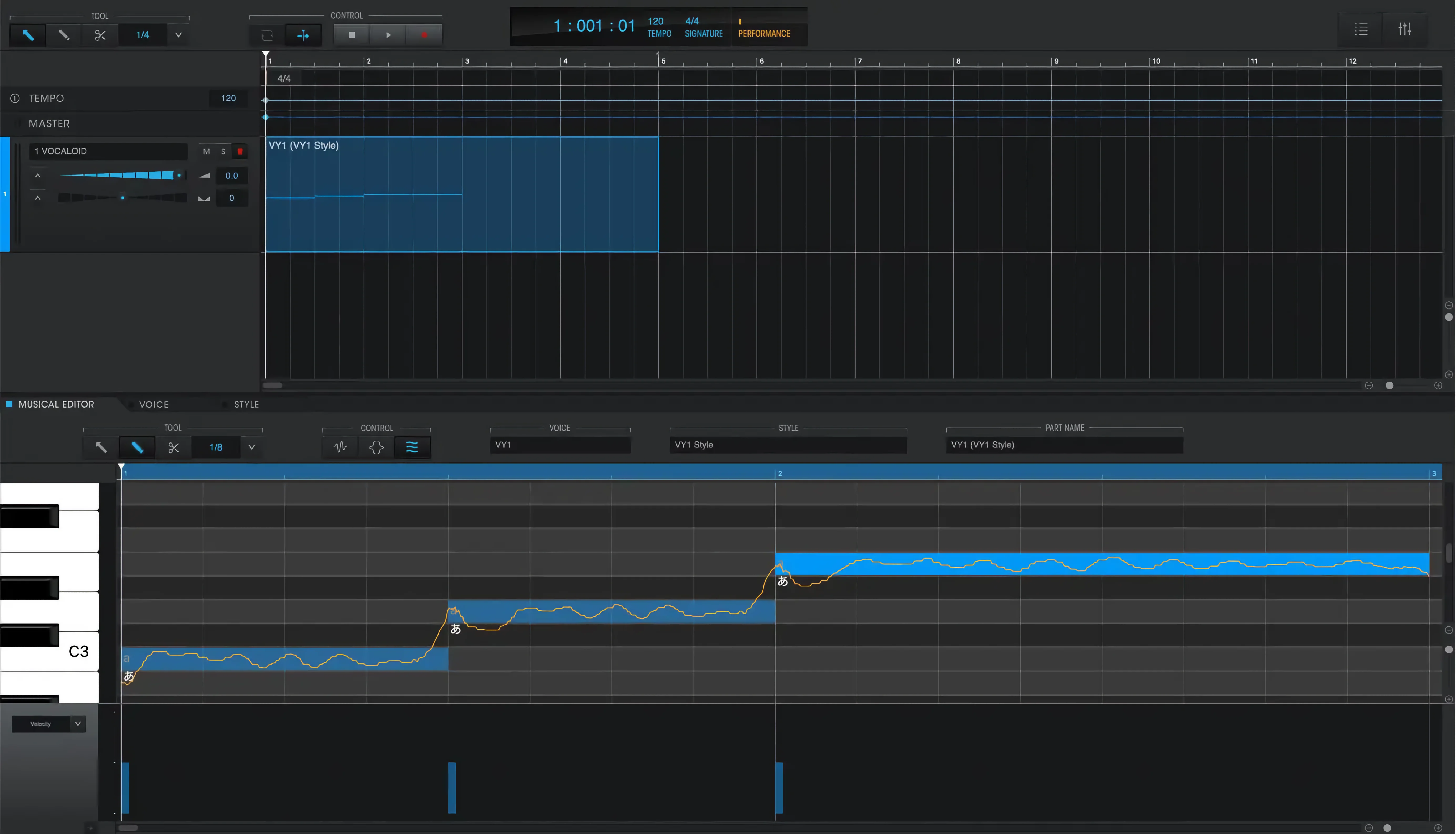
The VOCALOID Editor opens as shown, so you can start producing immediately.
It follows DAW playback seamlessly, including the selected bar position.
Of course, it also supports the VST format used by hosts such as Cubase.

As with Logic Pro, simply load VOCALOID as a software instrument.
Note that you can load only one instance of VOCALOID 5 in a project.
Multiple vocal tracks are managed inside the VOCALOID Editor.
Entering Vocal Phrases
Once VOCALOID is open, let's enter a phrase.
Managing Parts
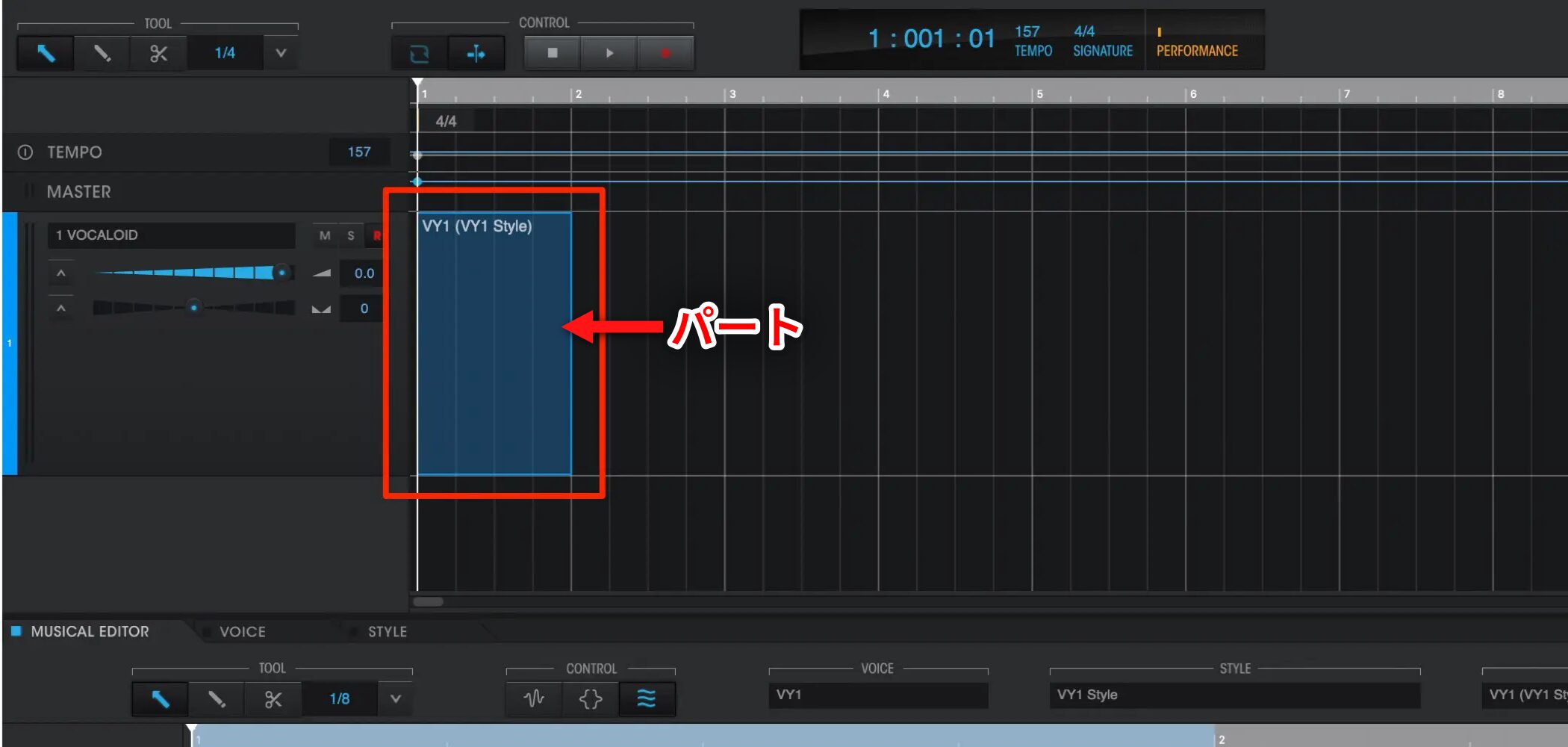
The container created in advance is called a part.
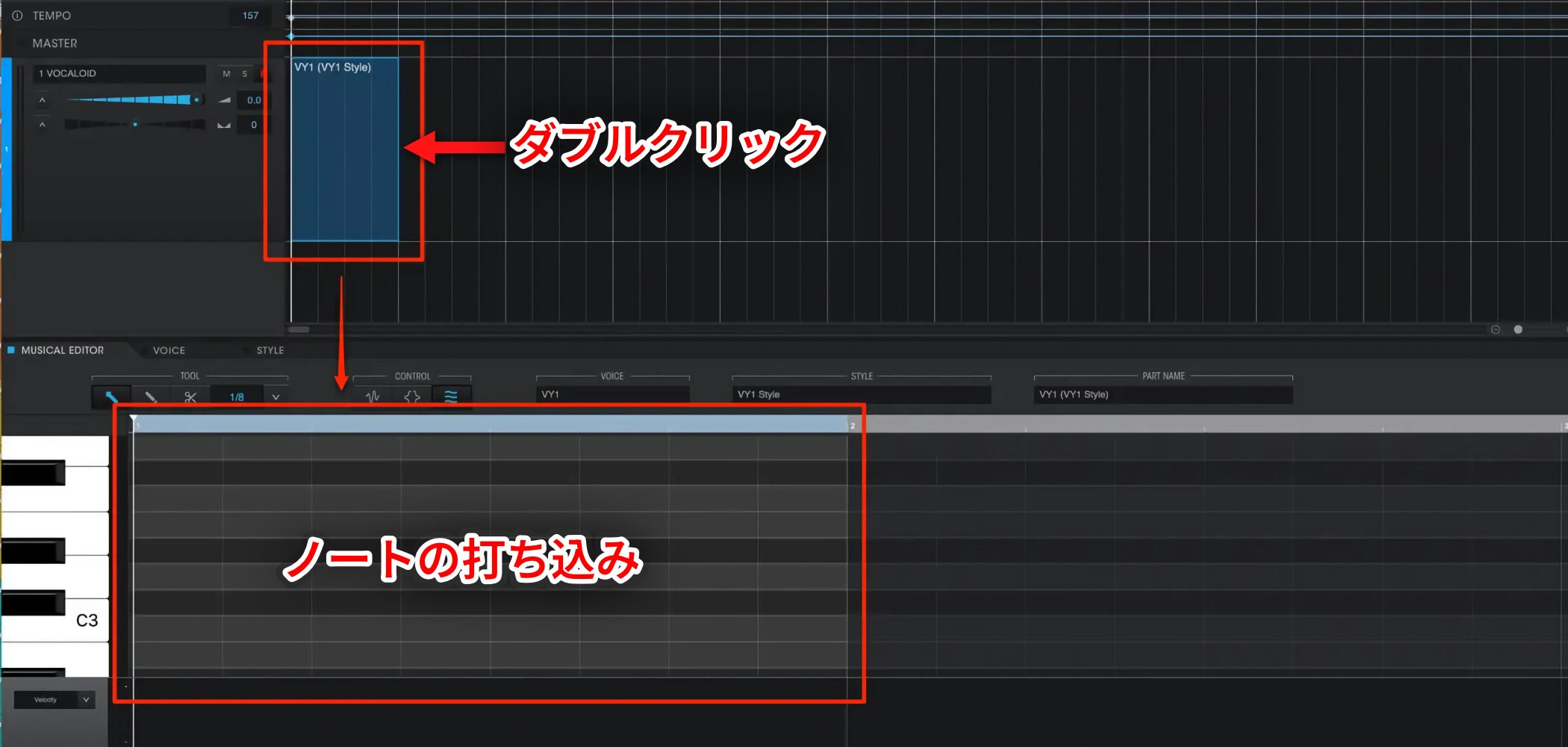
Double-click a part to open its contents.
This is where you enter notes.
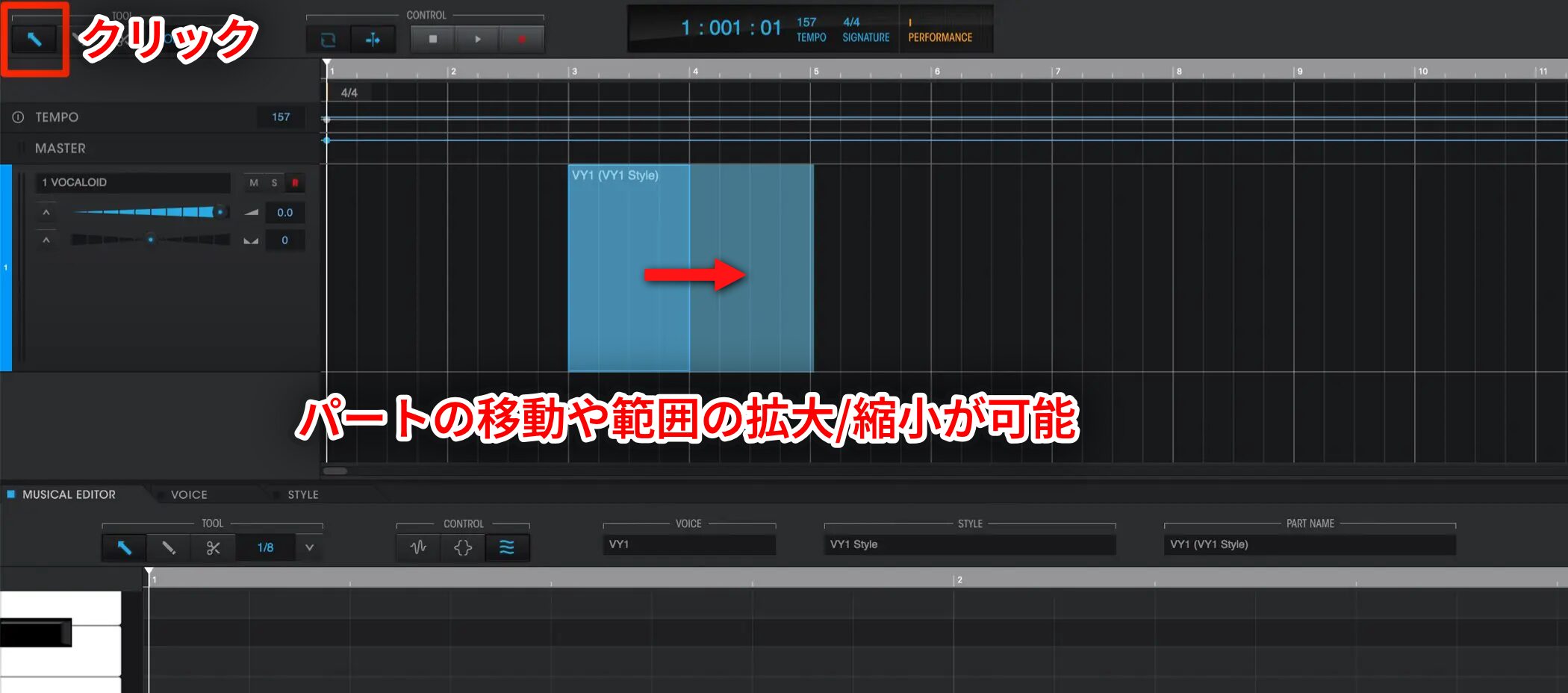
Use the Arrow tool to move a part and extend or shorten its range, adjusting it to the desired bar position and phrase length.
To delete a part, select it and press Delete.
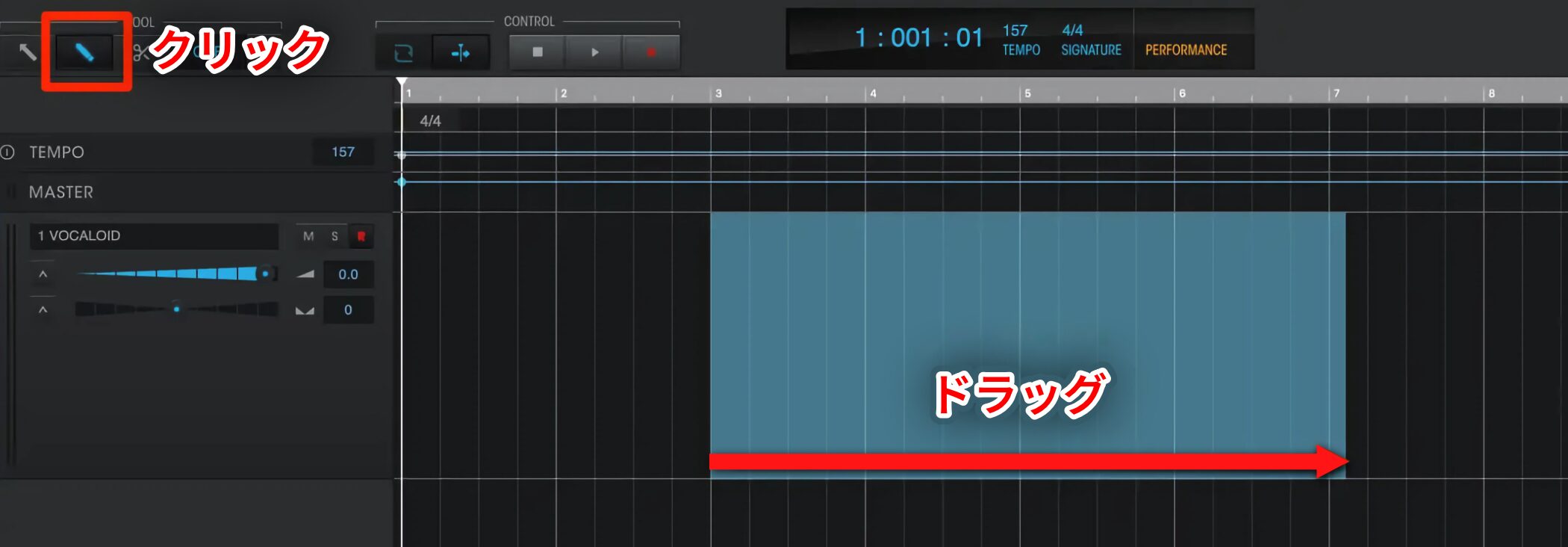
To create a new part, select the Pencil tool and drag over the desired area of the timeline.
Entering Notes
Let's enter some notes in the part.
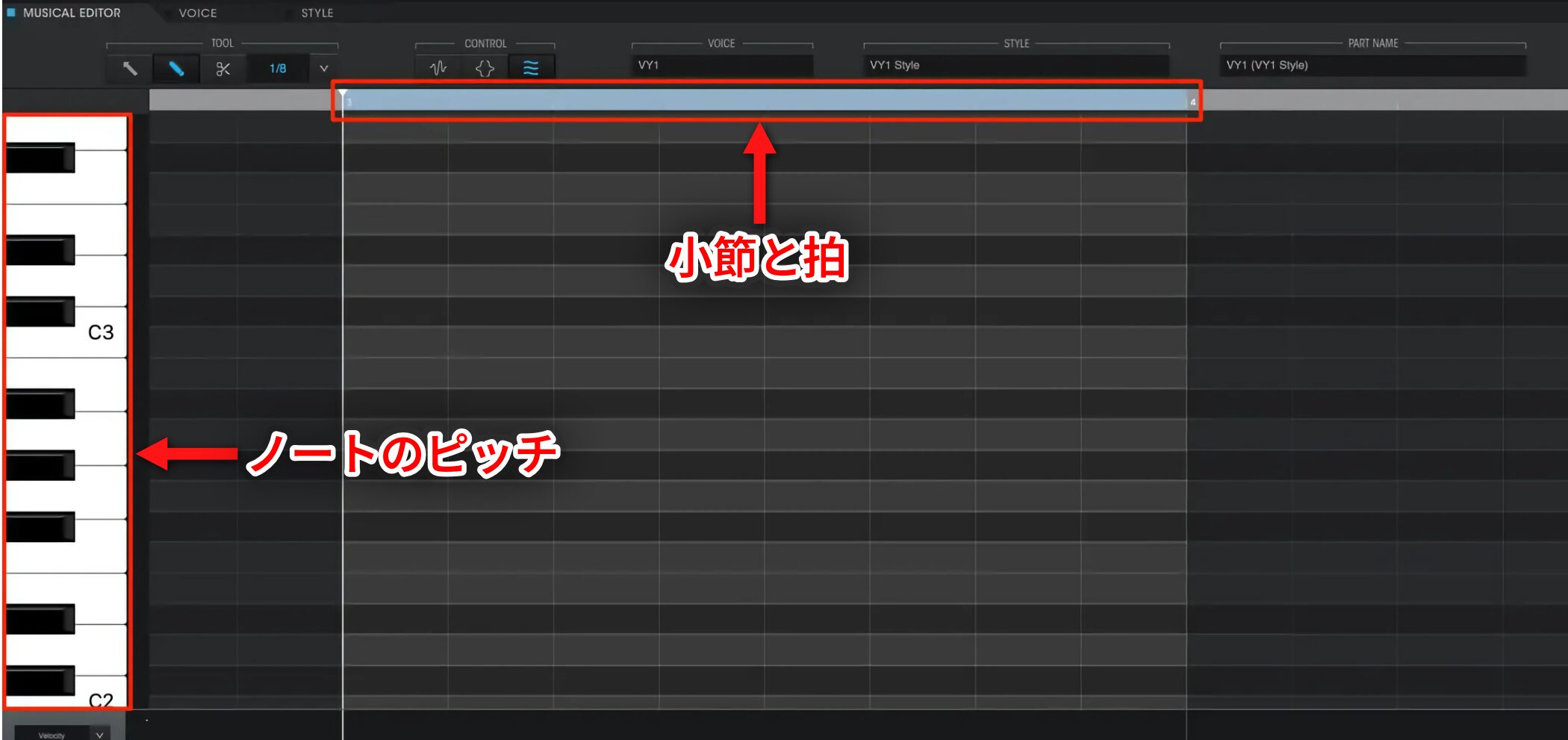
The keyboard runs vertically and indicates the pitches of the notes you enter.
The horizontal axis represents timing. Enter notes on the beats you want.
The layout is similar to a DAW's piano roll, so you should find it familiar.
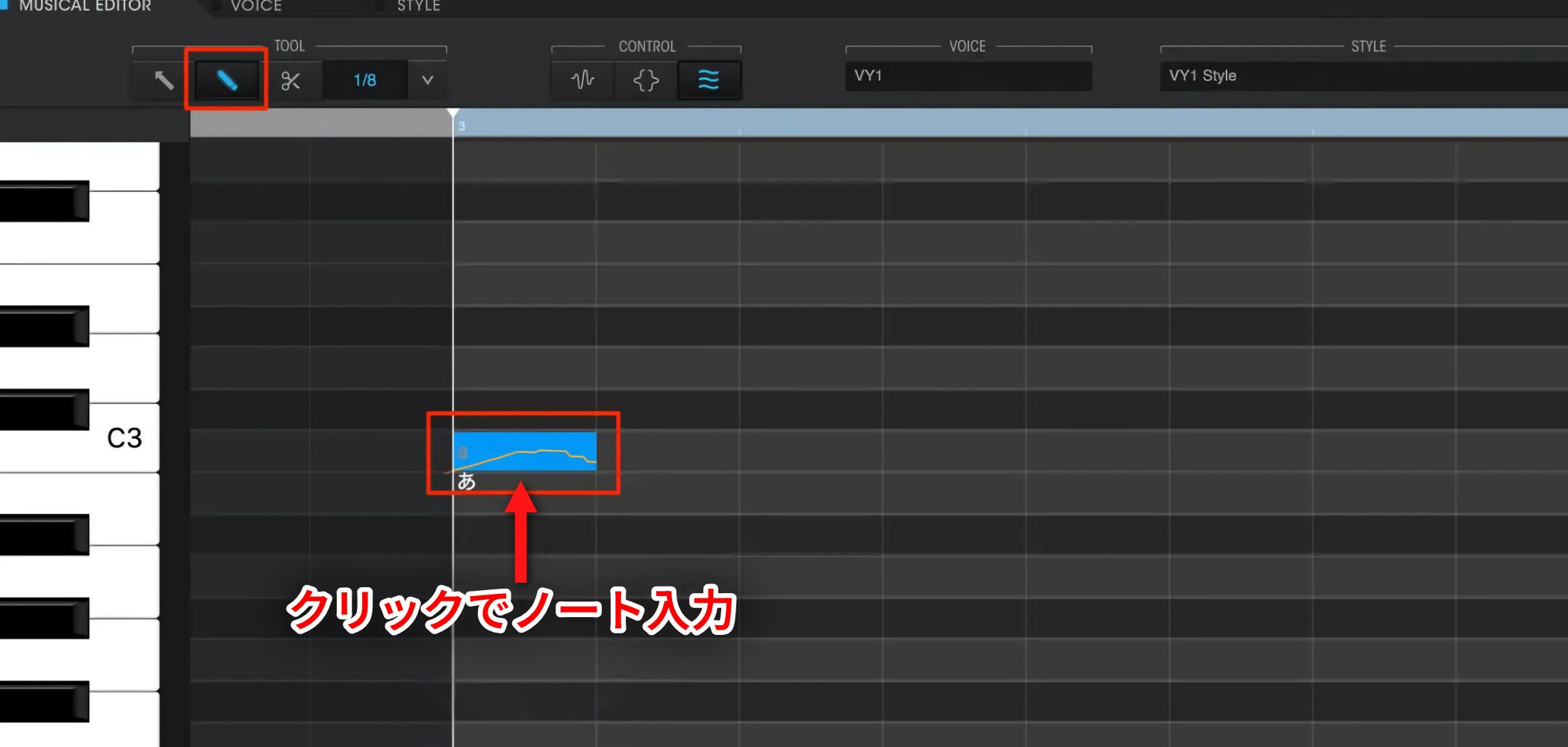
Switch to the Pencil tool and click where you want to enter a note.
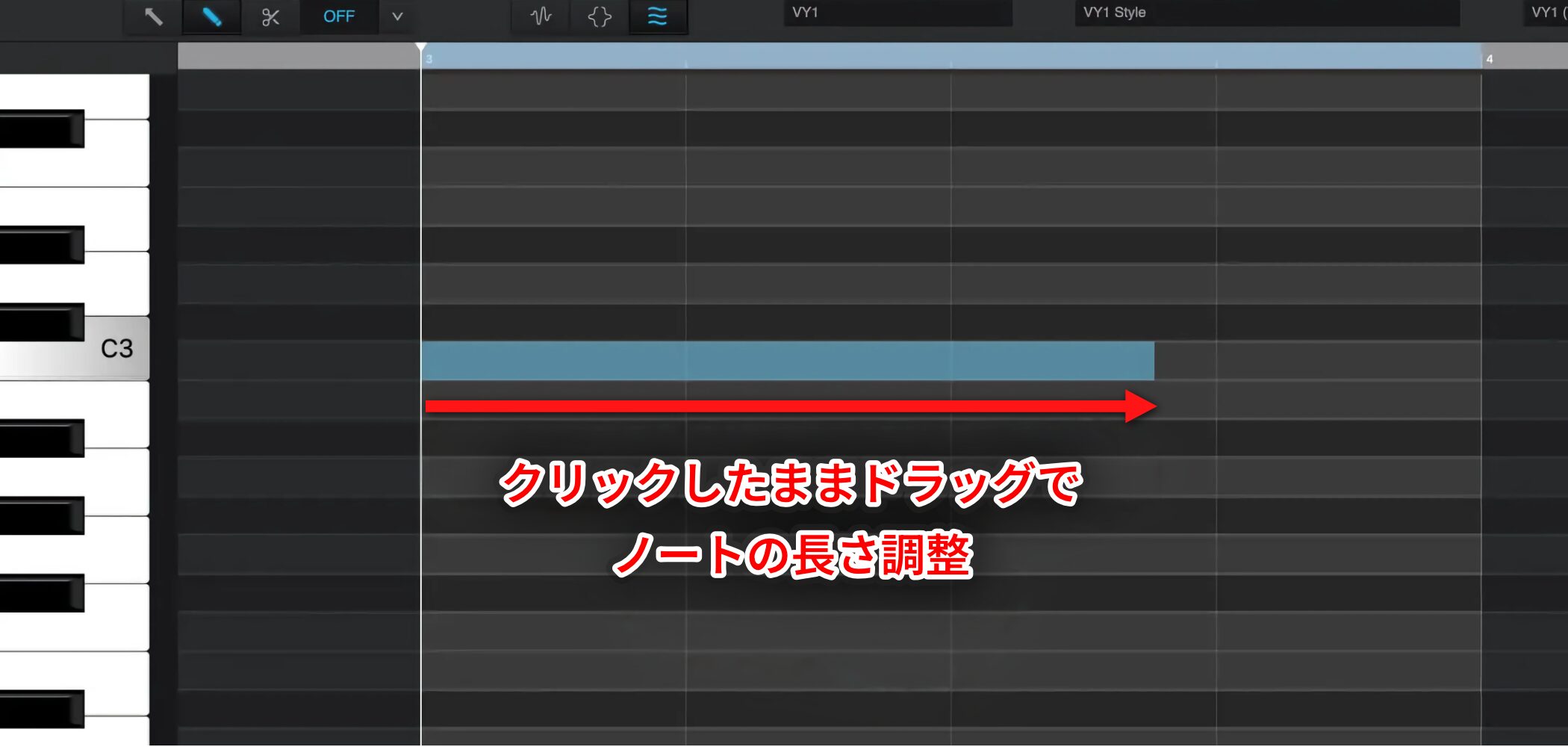
Keep the mouse button held down and drag to adjust the length of the note you are entering.
You can also change the length of an existing note by dragging its edge.
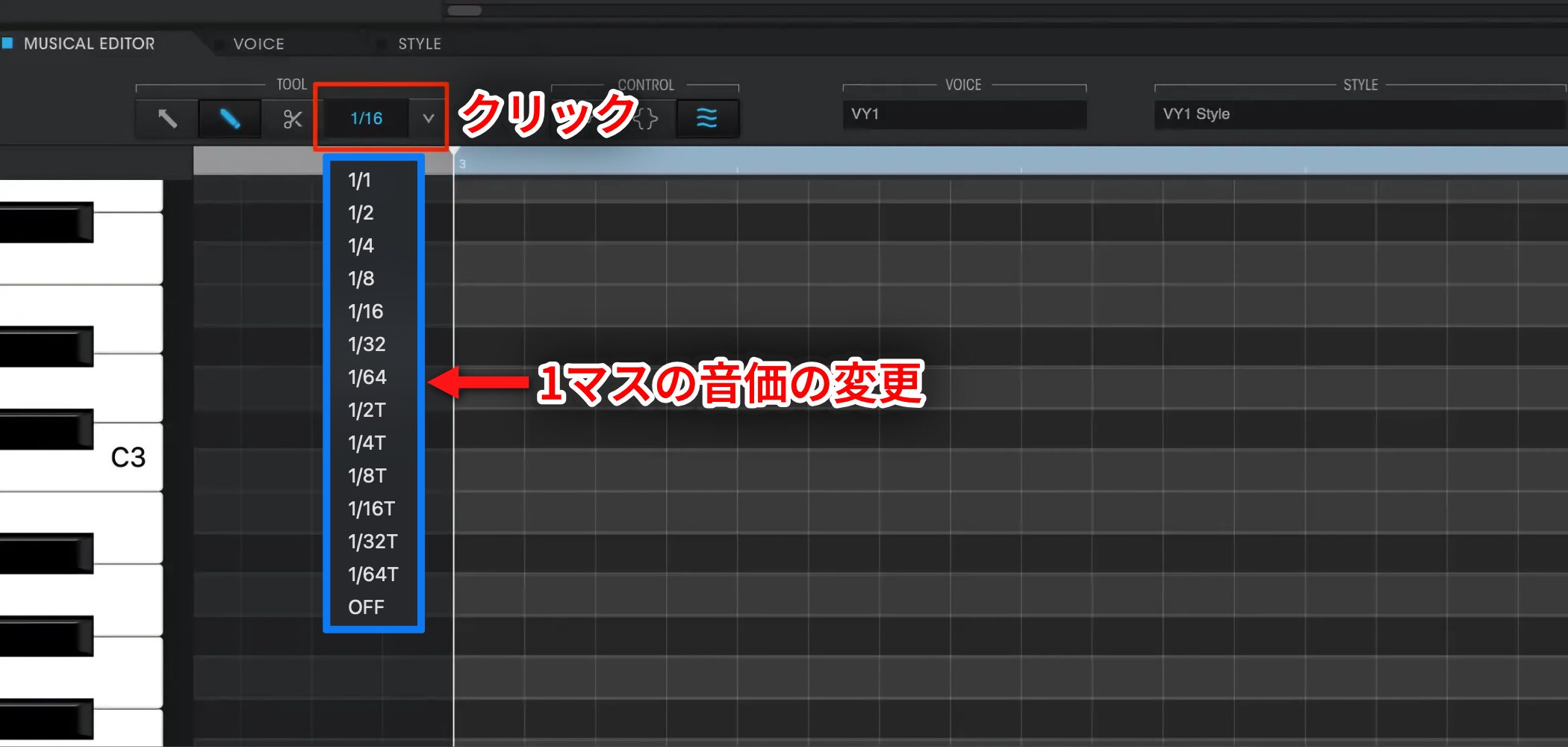
Changing the note value represented by each grid division lets you enter finer rhythmic values.
Use the control to the right of TOOL to select the desired note value.
Adjusting the Zoom
While entering notes, you may want to zoom in or out on a particular area.
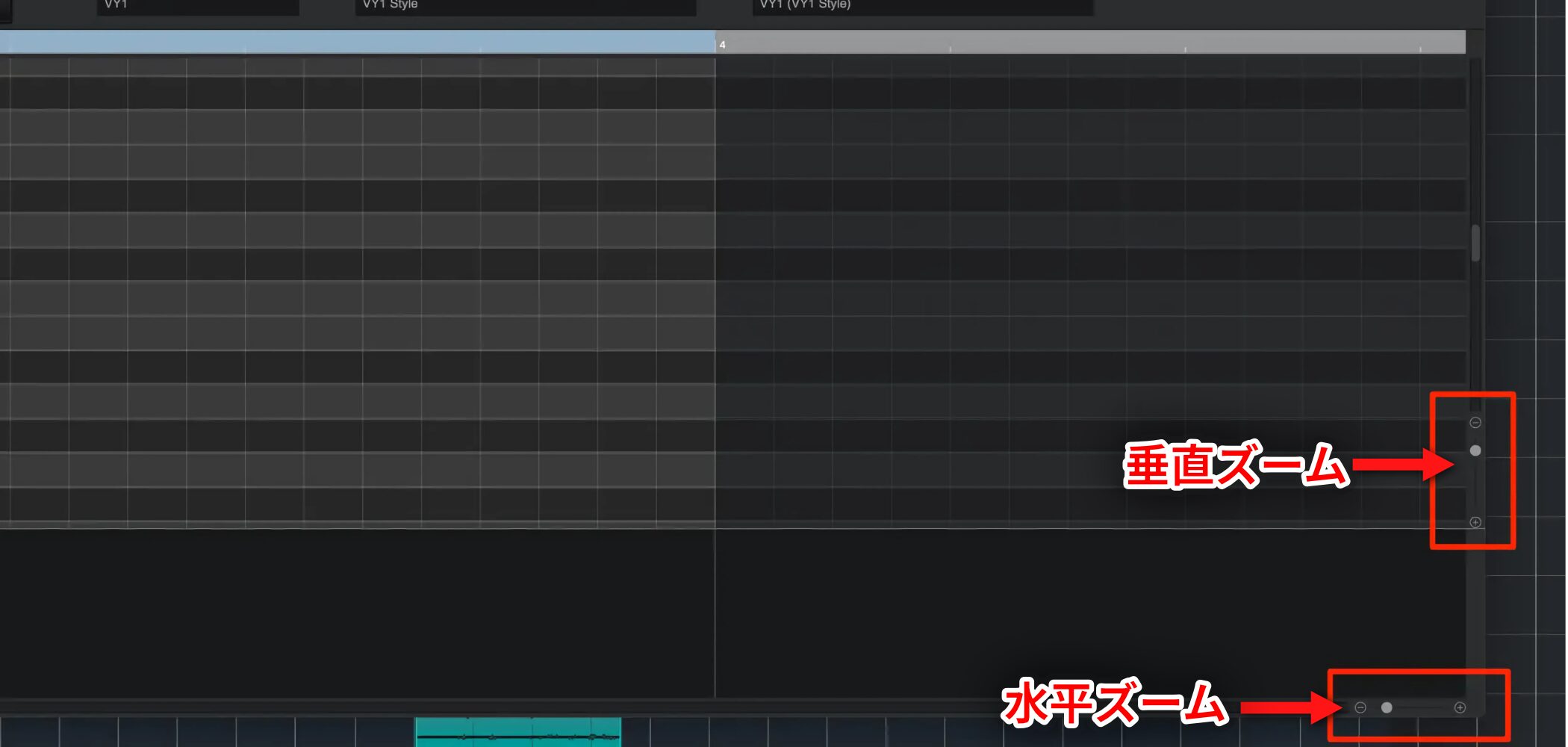
The horizontal control at the bottom right adjusts horizontal zoom, while the vertical control adjusts vertical zoom.
Adjust them to suit the task you are working on.
Entering Lyrics
After entering notes, let's add lyrics.
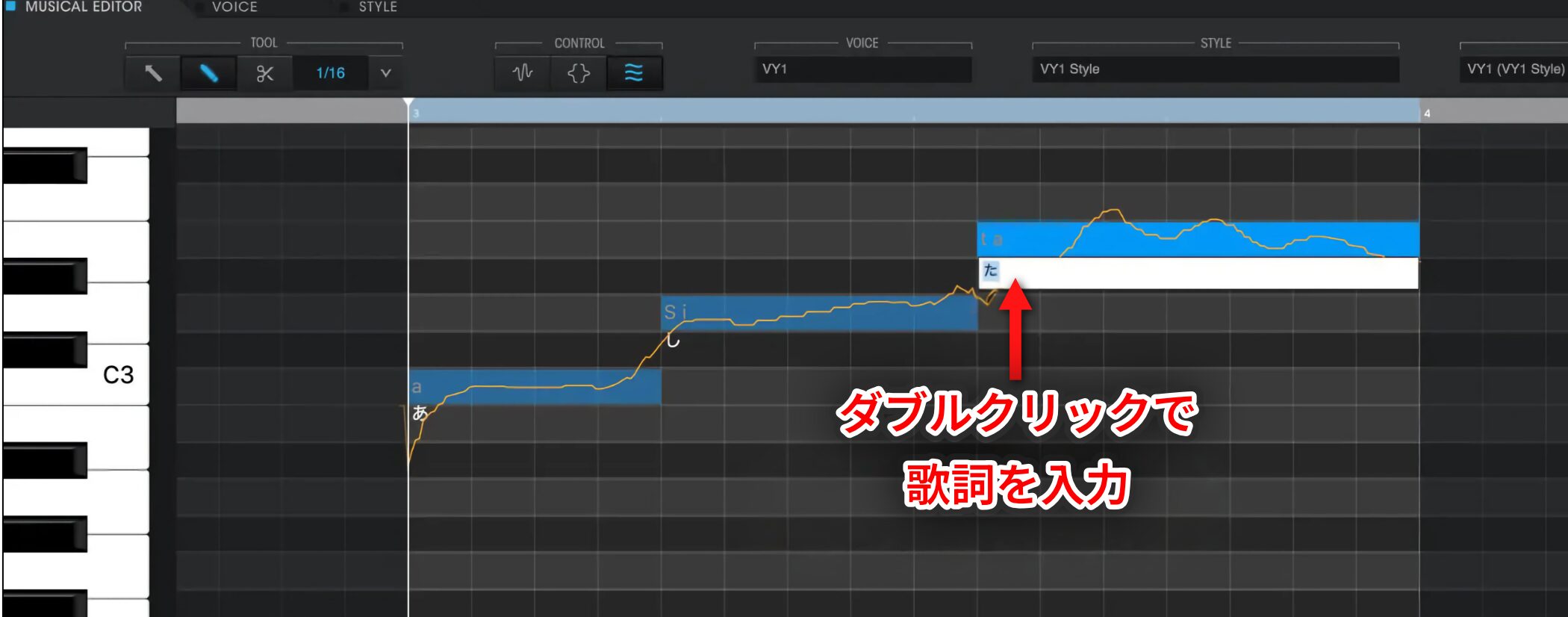
Select the Arrow or Pencil tool and double-click the lyrics beneath a note.
Then type the lyrics you want it to sing using your computer keyboard.
You can enter Japanese or English lyrics, but you need to choose a singer (voicebank) suited to the language you want to use.
Choosing a Voicebank (Singer)
You can change the singer who performs the notes you have entered.
Different voices let you add variety to suit your song, so get familiar with each one.
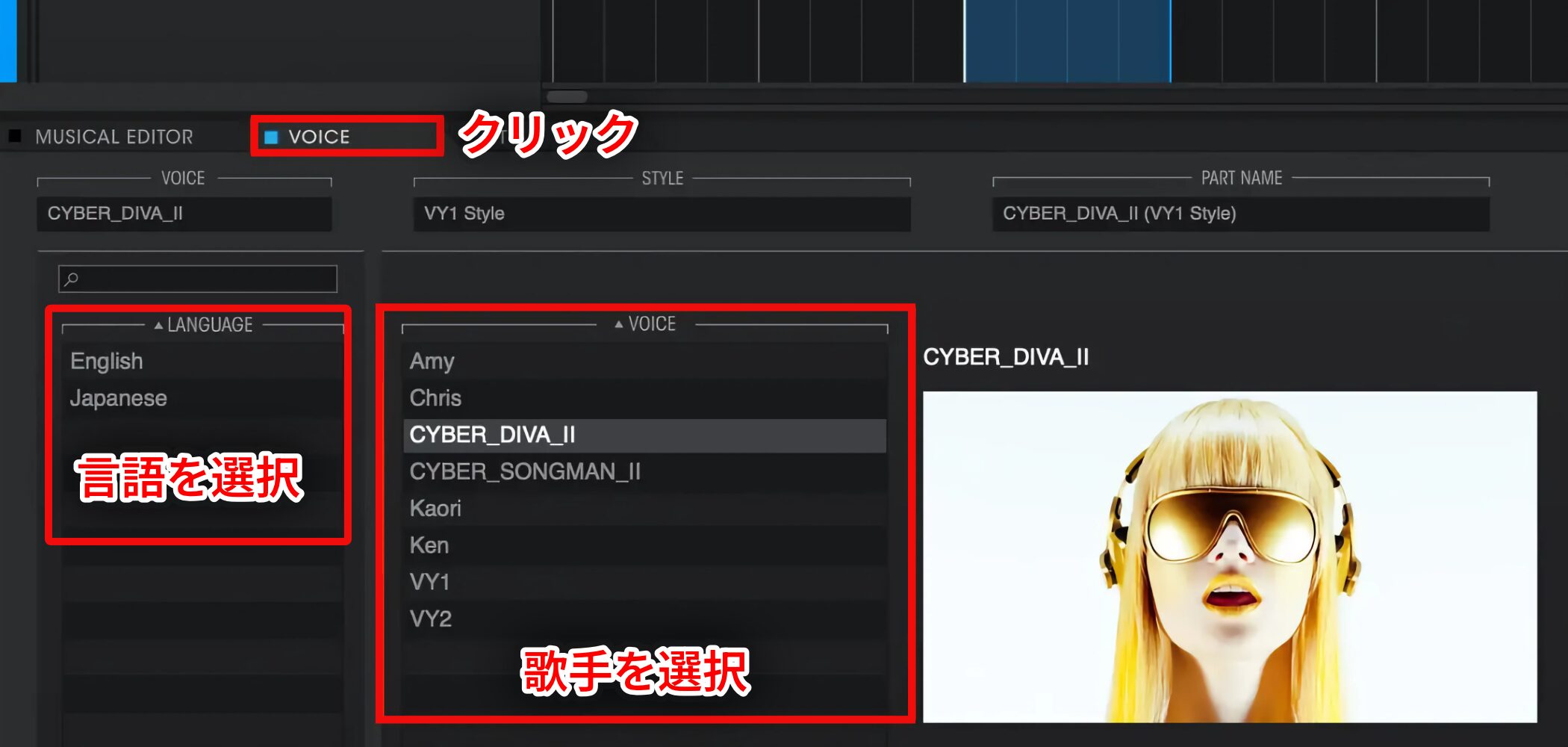
Open the VOICE tab and choose the singer you want.
Selecting a language under LANGUAGE on the left helps you find the appropriate singers quickly.
VOCALOID 5 comes in two packages: Standard and Premium.

- Standard: Four voices, Amy, Chris, Kaori, and Ken
- Premium: Eight voices in total, adding CYBER DIVA II, CYBER SONGMAN II, VY1, and VY2 to the four Standard voices
.
The additional singers in Premium are also highly capable, so take a look if you want a wider selection of voices.
Choosing a STYLE
In addition to the voicebanks above, VOCALOID 5 includes STYLE presets with singing expression and tonal adjustments already applied for you.
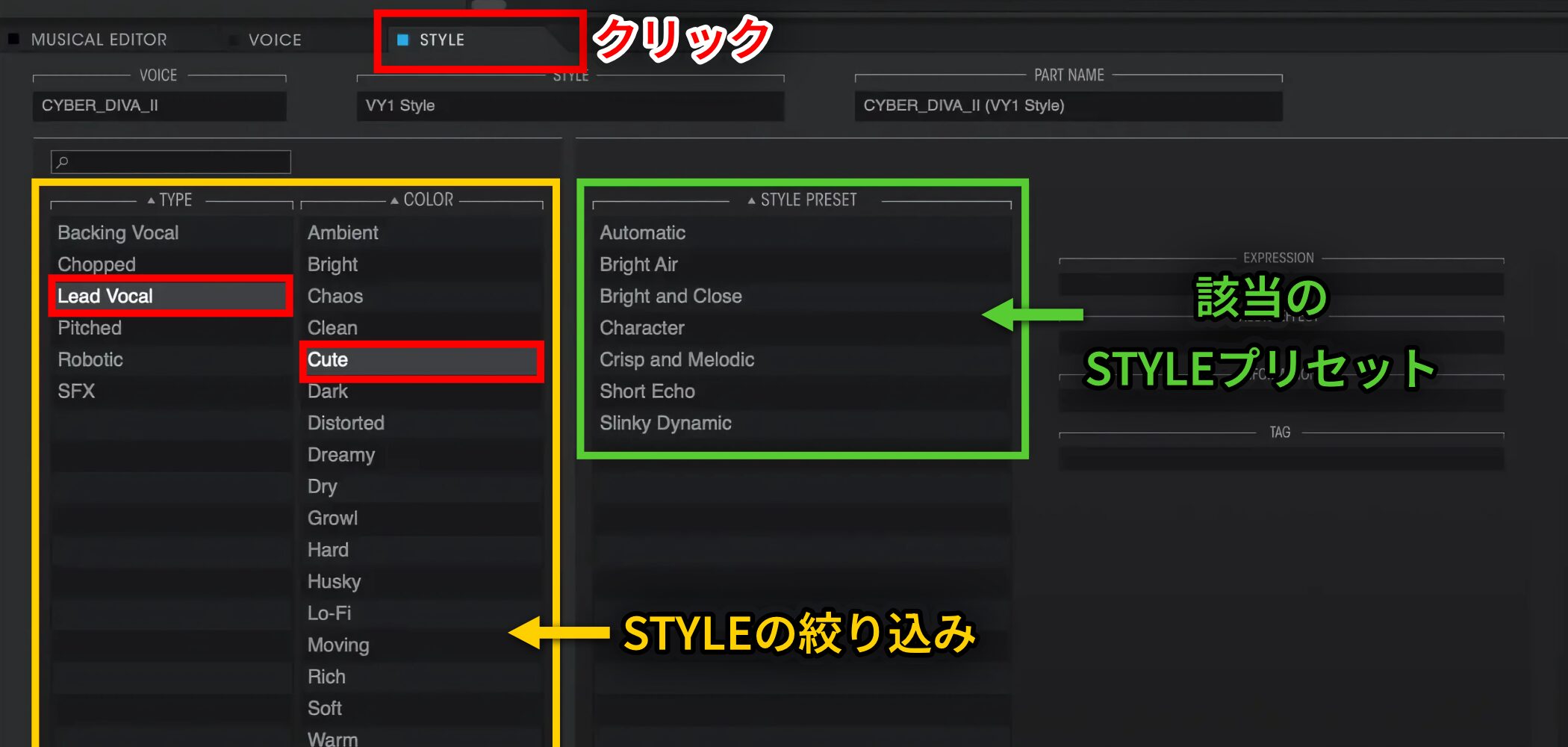
Simply choose from over 100 presets to add the nuance you want. Even if detailed settings are not your strength, you can listen to each preset's effect and create a vocal track that suits your needs.
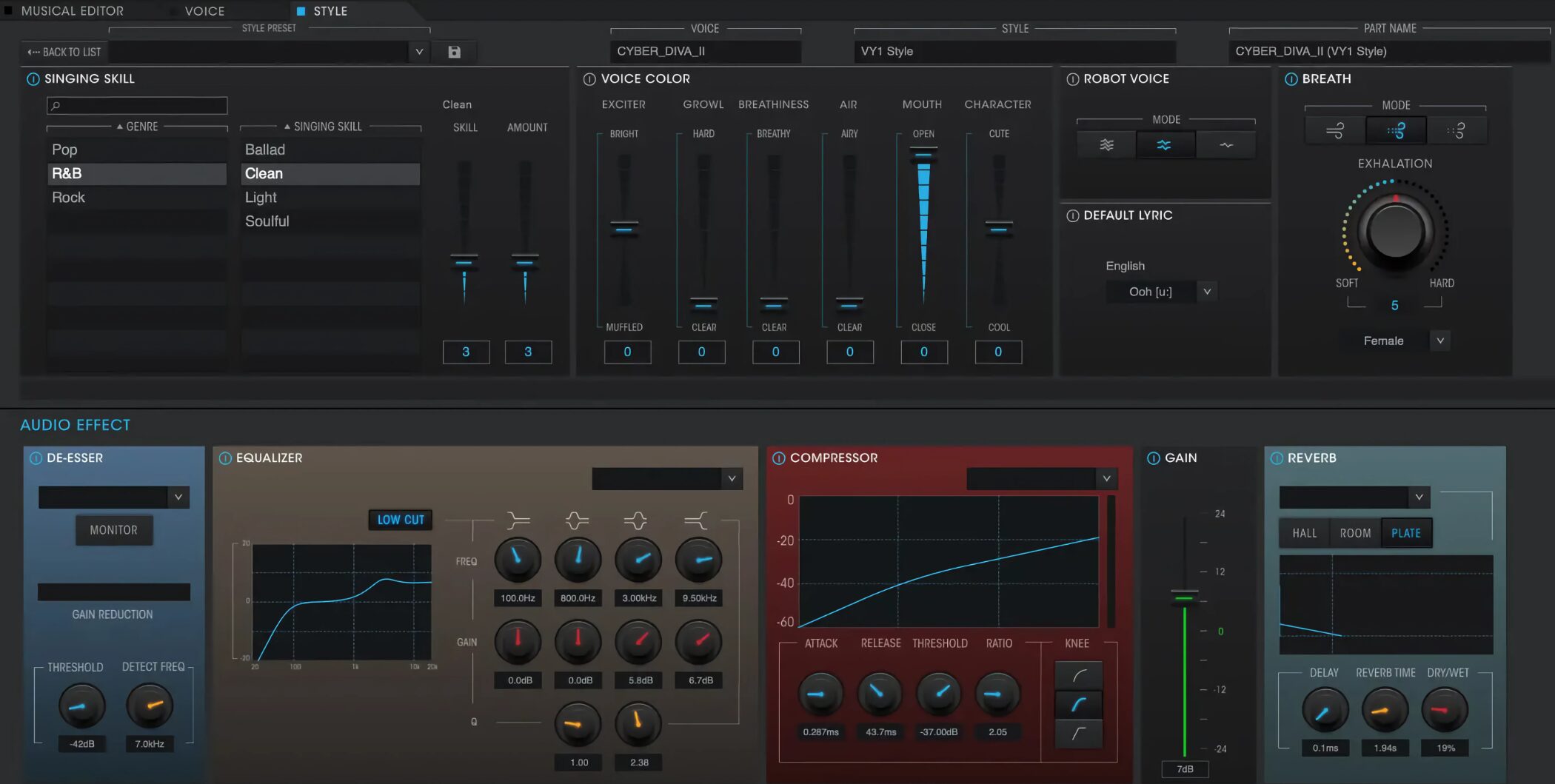
You can also customize these STYLE settings in detail.
We will cover STYLE adjustments and techniques later in the article.
ATTACK EFFECT and RELEASE EFFECT
You can control pitch, dynamics, and other aspects of each note you enter.
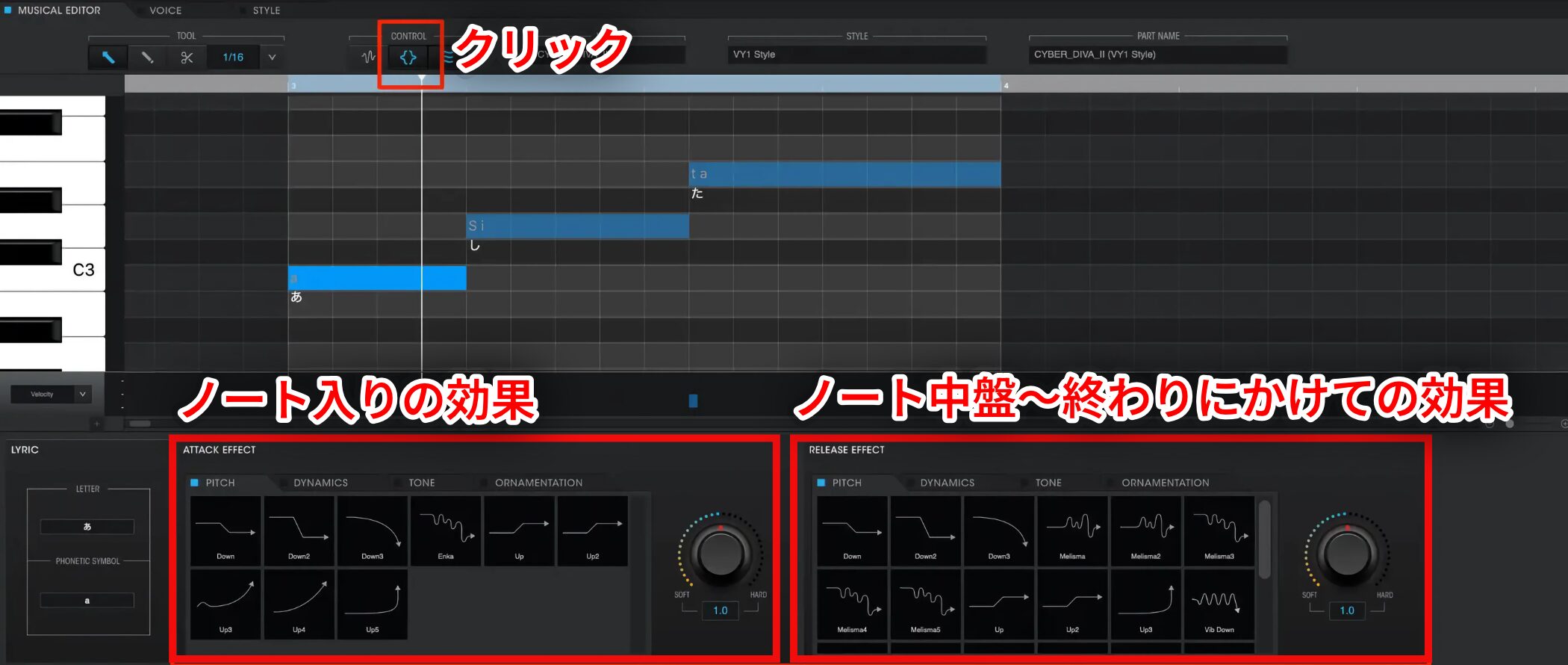
ATTACK affects the beginning of a note, while RELEASE affects the middle through the end.
Applying them is simple.
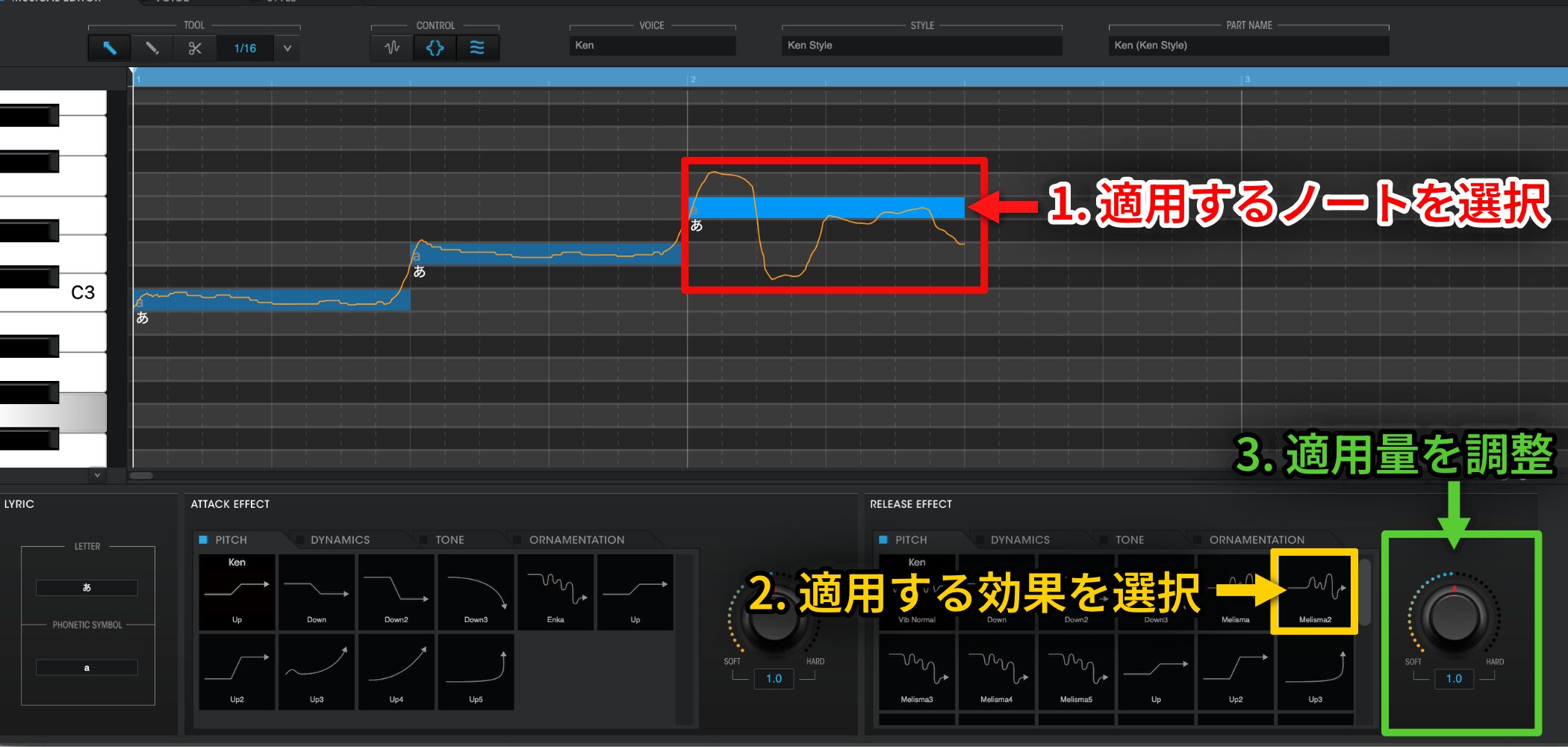
Select a note, then choose the effect you want from ATTACK or RELEASE.
Use the knob to set the amount, or strength, of the effect and give the note more expression.
If you want to take your VOCALOID vocals to the next level, try different nuances to create an original performance that fits your song.
The Phrase Feature
Perhaps you have a backing track but cannot come up with a melody.
Or perhaps you want to find a better melody. In either case, we recommend the phrase feature.
VOCALOID 5 includes more than 2,000 phrase presets and vocal sound effects, which you can import in a form adapted to your song.
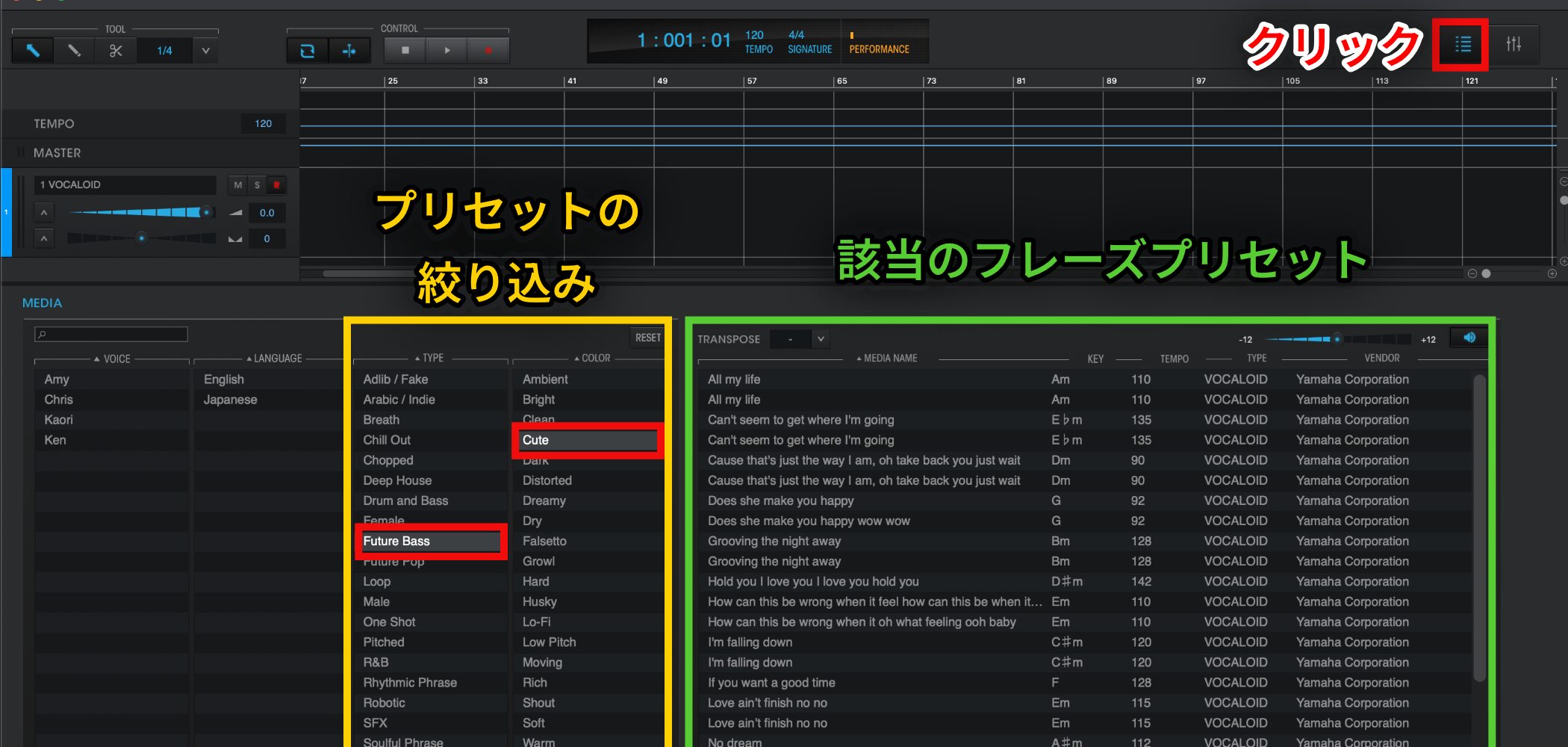
Click the media button at the top right to display the phrase list.
Select a category you like, and the matching presets appear in the section on the right.
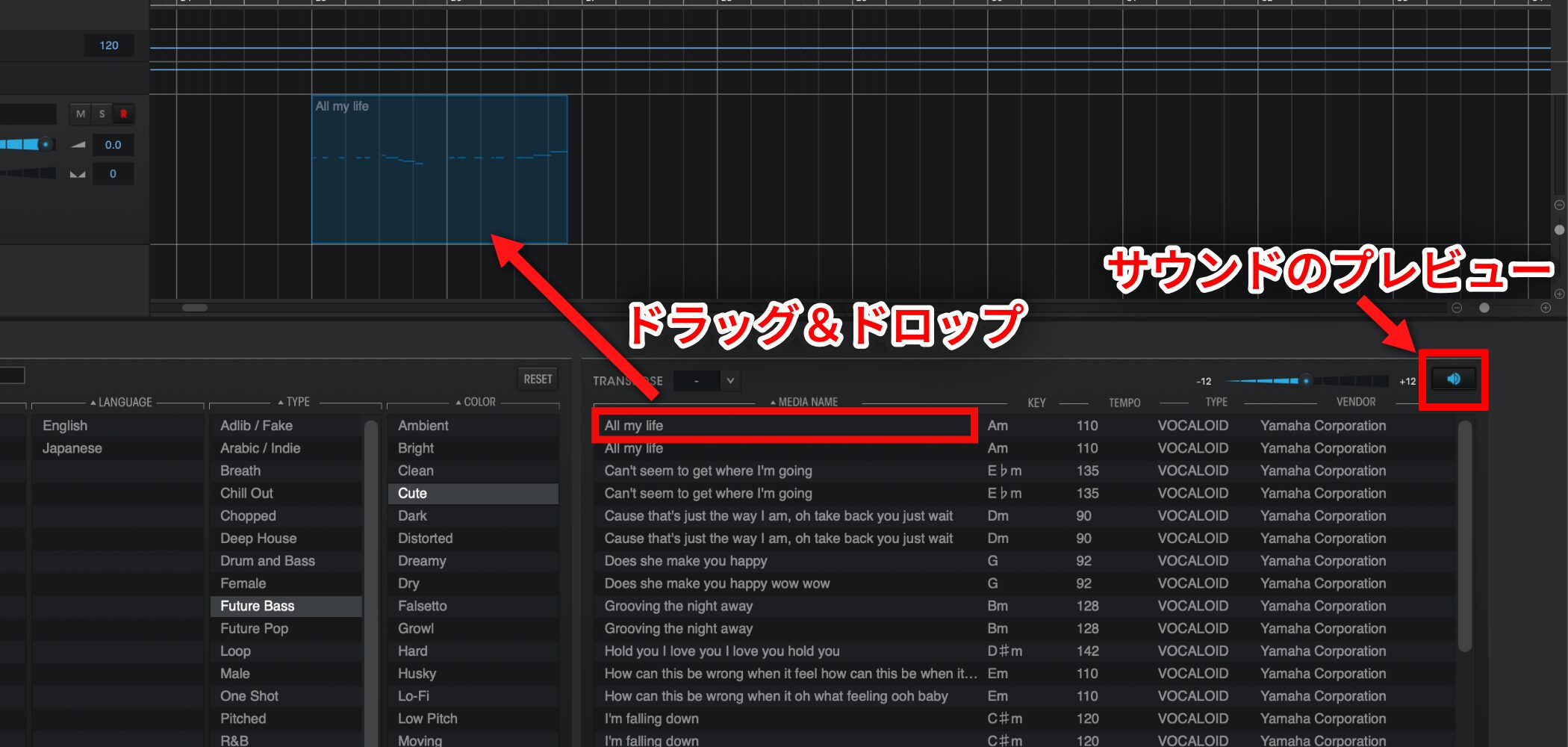
Once you find a phrase you like, simply drag it onto the timeline to import it.
You can also preview its sound before adding it to the timeline.
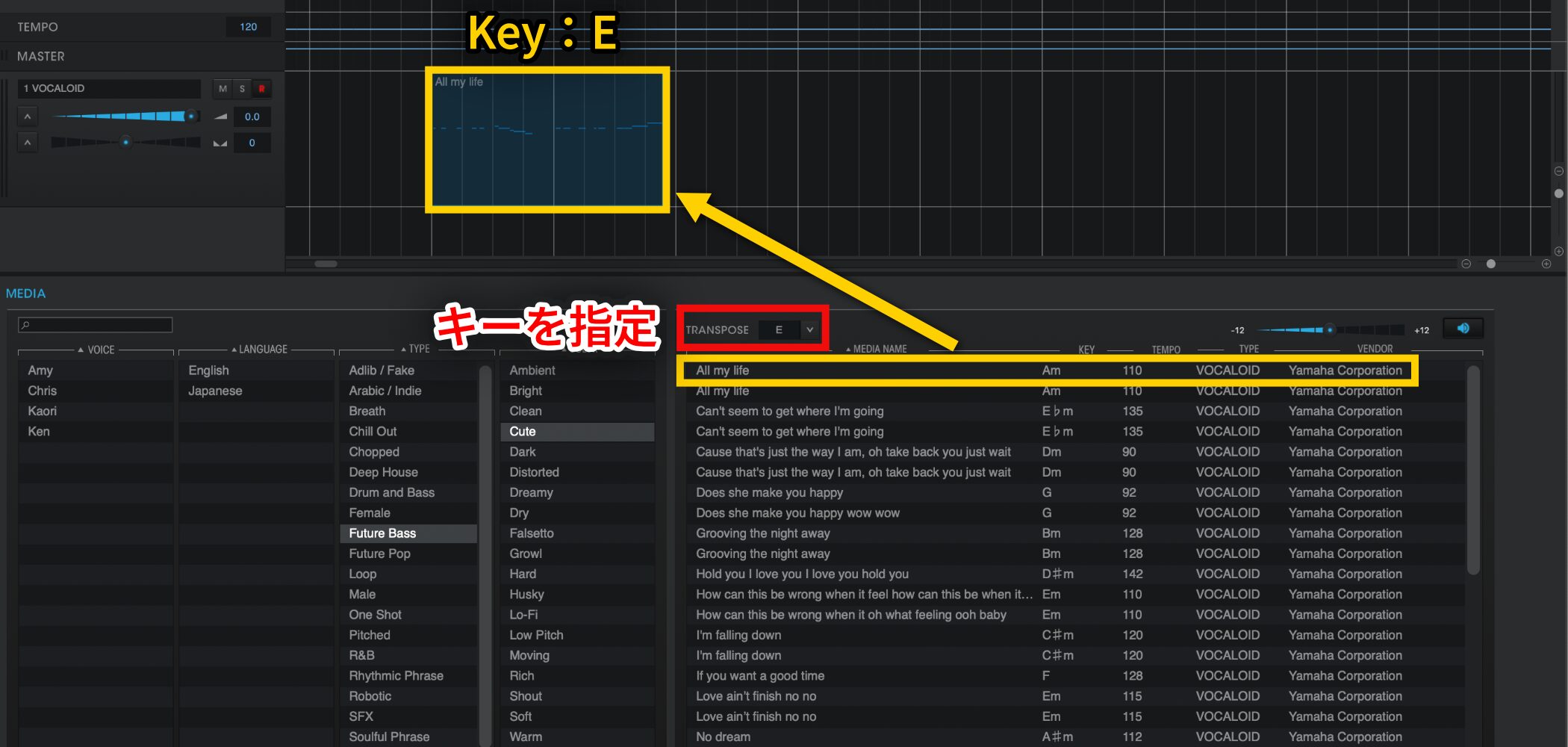
Set your song's key in advance so that the imported phrase is adapted to your song automatically.
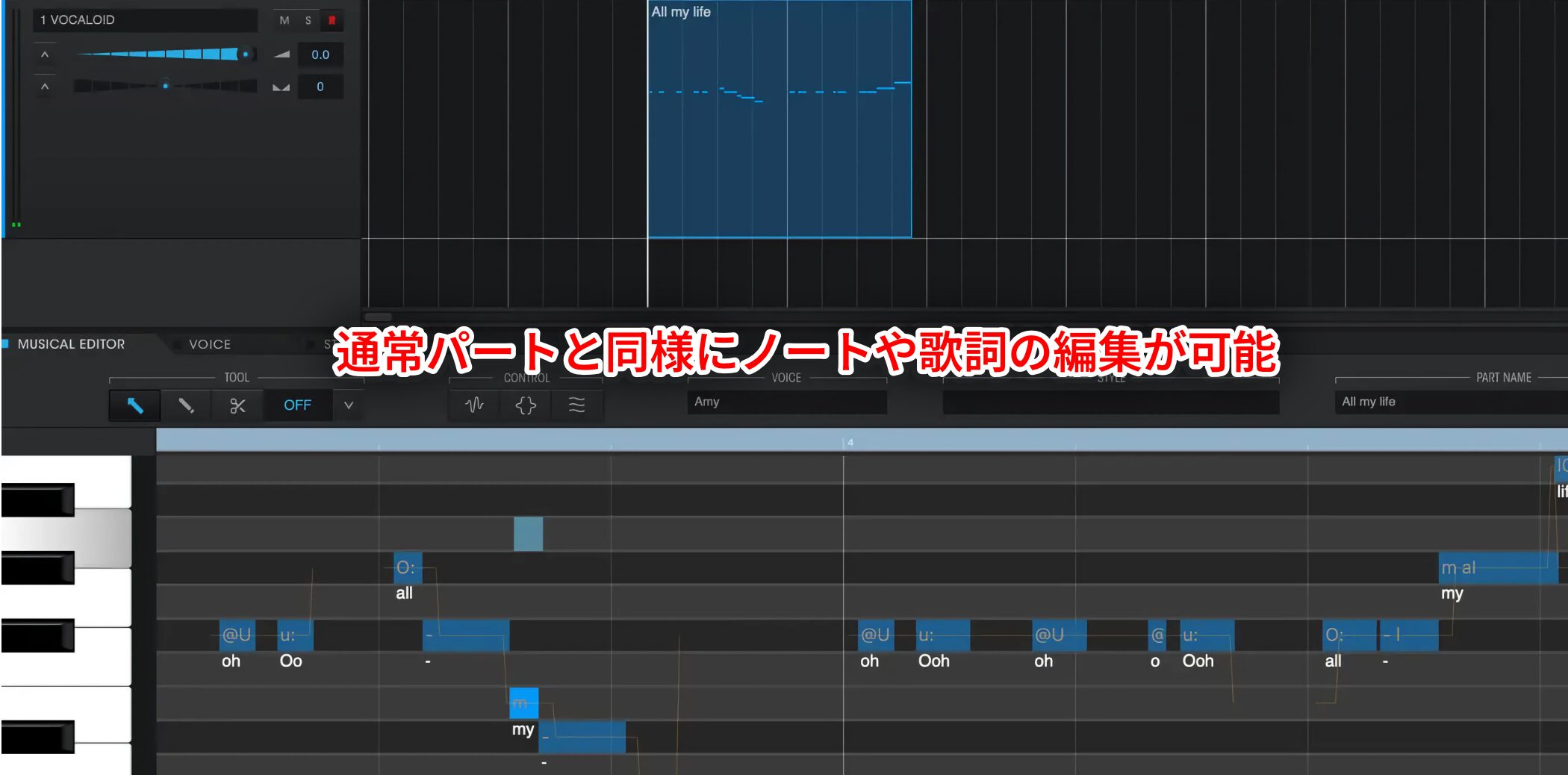
After importing a phrase, you can edit its notes and lyrics just as you would with a normal part.
You can use a preset phrase as a starting point and adapt it to your original song, making this a useful source of melodic inspiration.
Compared with earlier versions, VOCALOID 5 adds many settings and production-assistance features. Even if you struggle to give VOCALOID voices expression or think of a melody, these tools make production easier and more enjoyable.
Making the Most of Phrases and Editing Parts
Next, let's explore VOCALOID 5's standout phrase feature and learn how to optimize imported phrases through part editing.
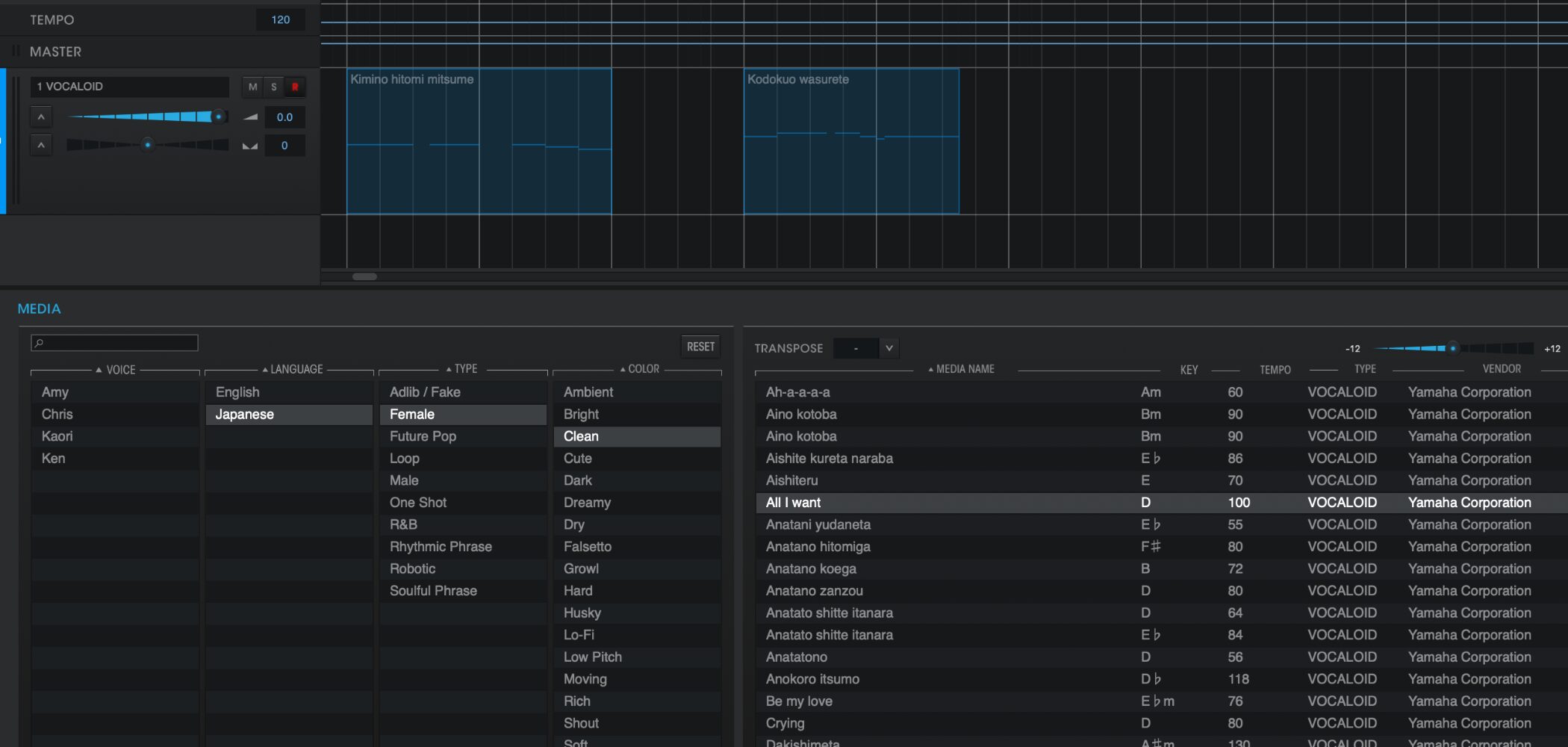
The phrase feature introduced in VOCALOID 5 lets you:
- Freely import more than 2,000 vocal phrases into your songs
- Automatically adapt phrases to your song's key and tempo
- Edit imported phrases freely to suit your original song, and more
Even beginners in music production and composition can enjoy building vocal tracks.
We will also cover part editing and points to watch out for so you can get the most from these phrases.
Video: The Phrase Feature and Part Editing
An Overview of VOCALOID 5's Phrase Feature
We touched on this earlier; now let's take a closer look at how the phrase feature works.
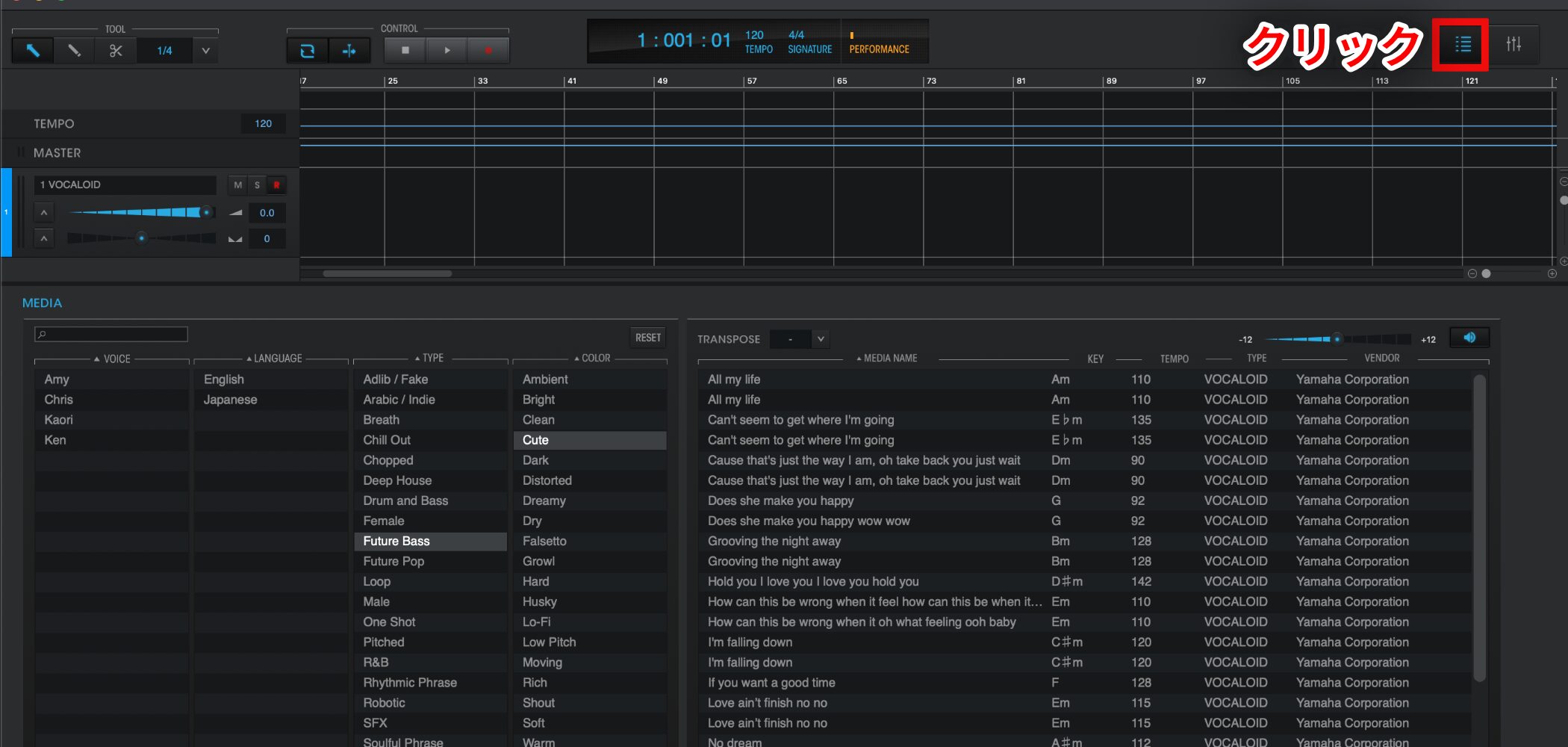
Click the icon at the top right of the window to access the phrase feature.
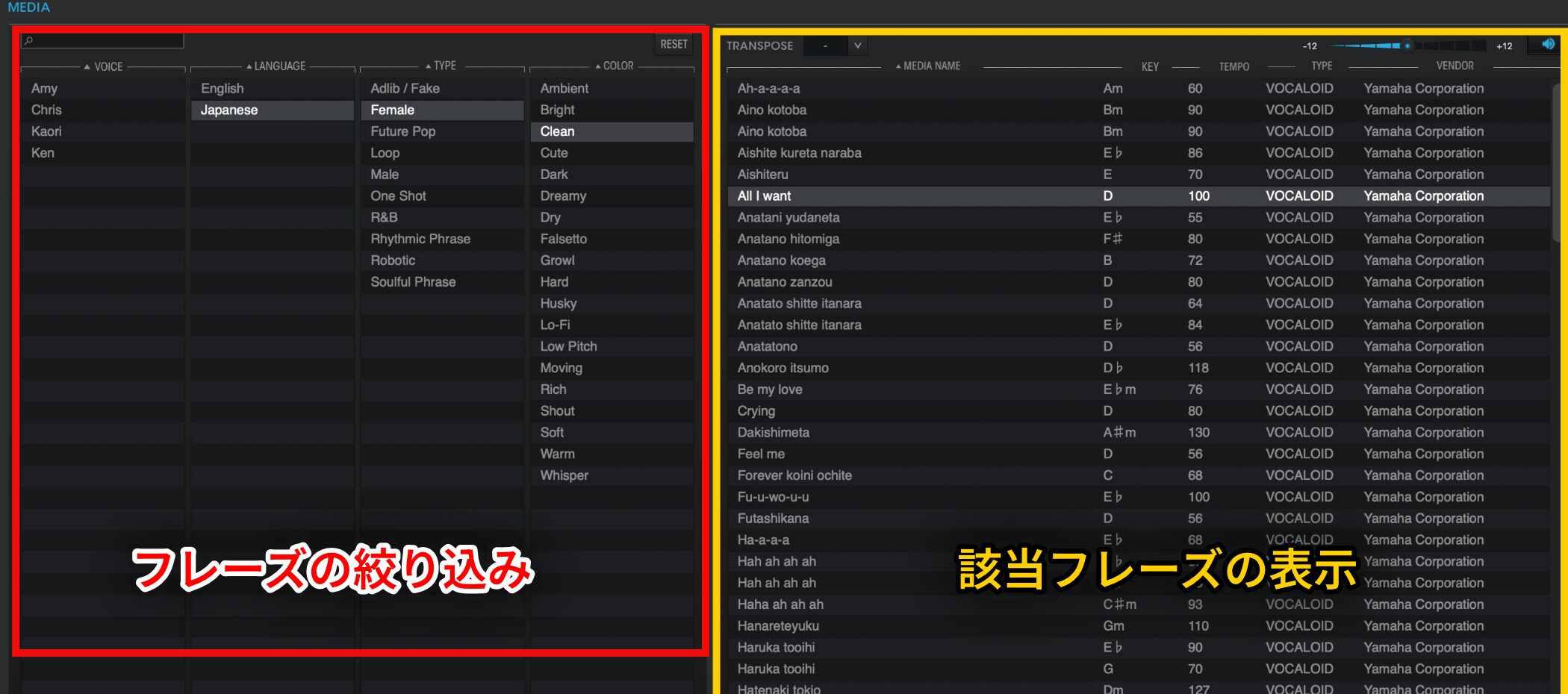
It contains an extensive collection of more than 2,000 phrases.
Use the left side of the window to narrow your search. Matching phrases appear on the right.
This makes finding the right phrase much more efficient.
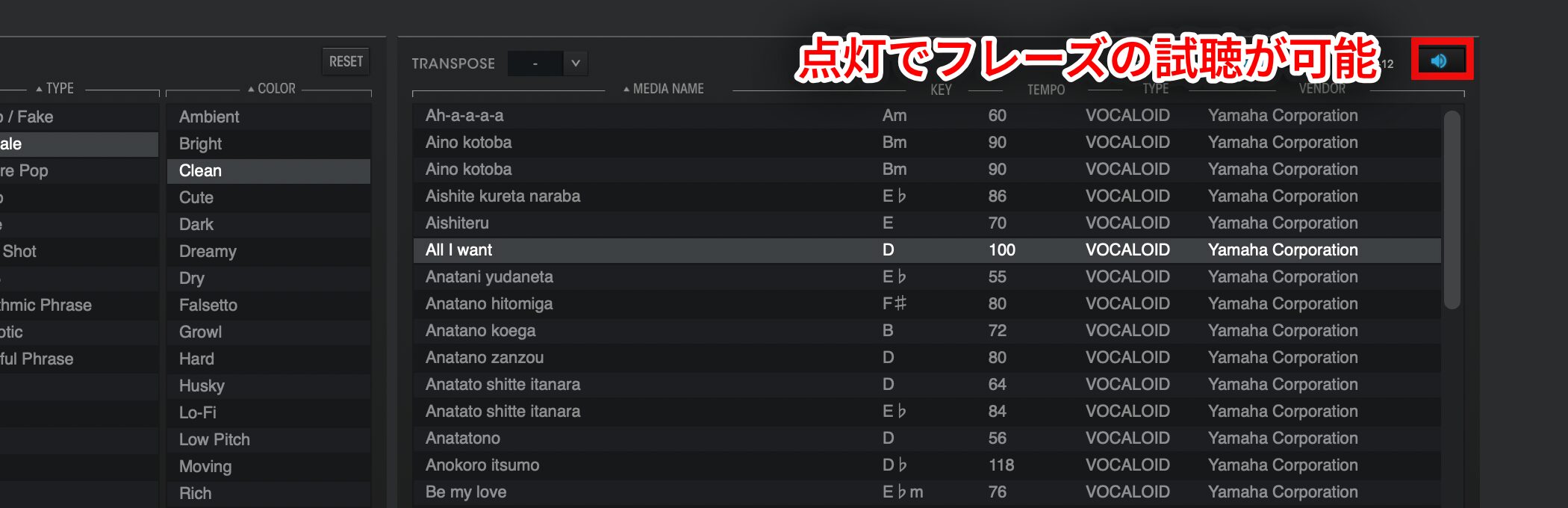
Turn on the Preview button, then click a phrase to hear it quickly.
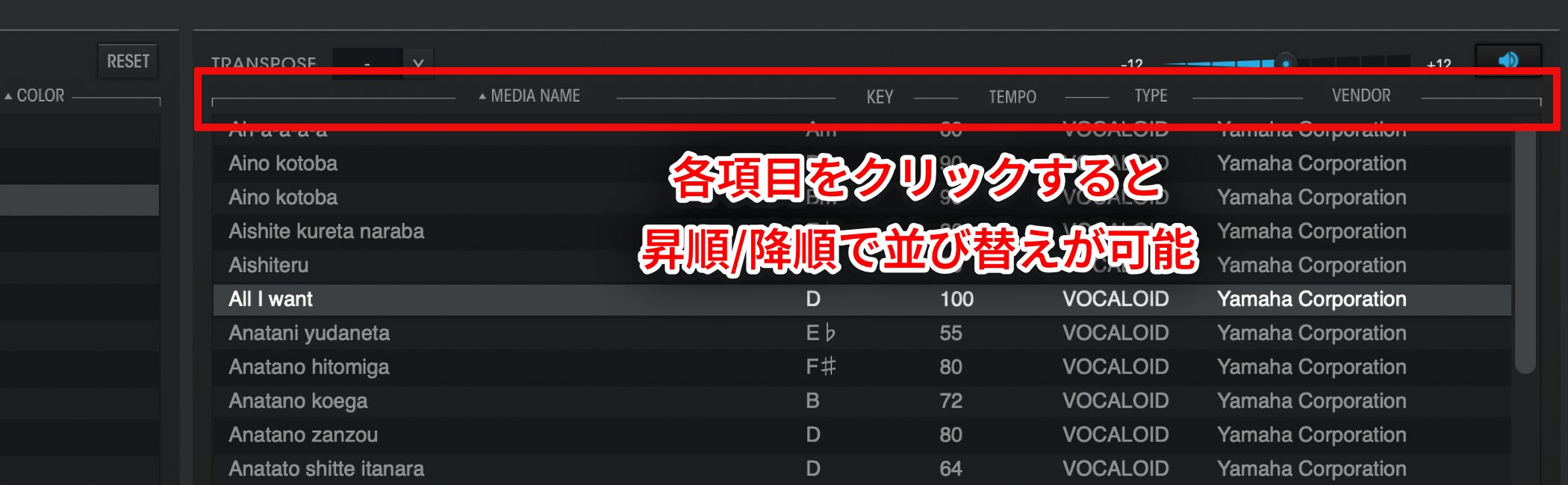
Click a column heading to sort that column in ascending or descending order.
This helps you organize and understand the available phrases.
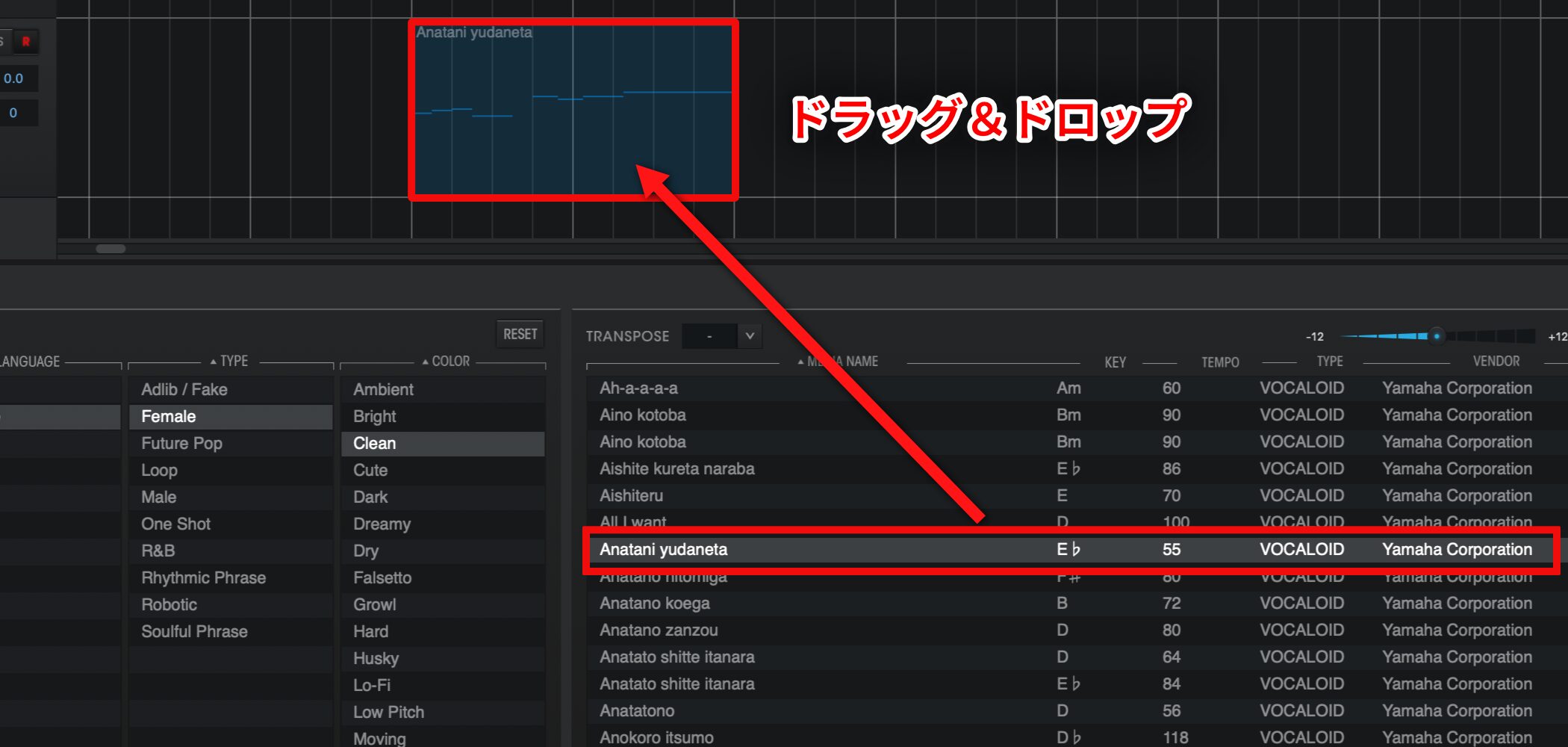
Once you find a phrase you like, drag it onto the timeline.
That is all it takes to add the phrase to your song.
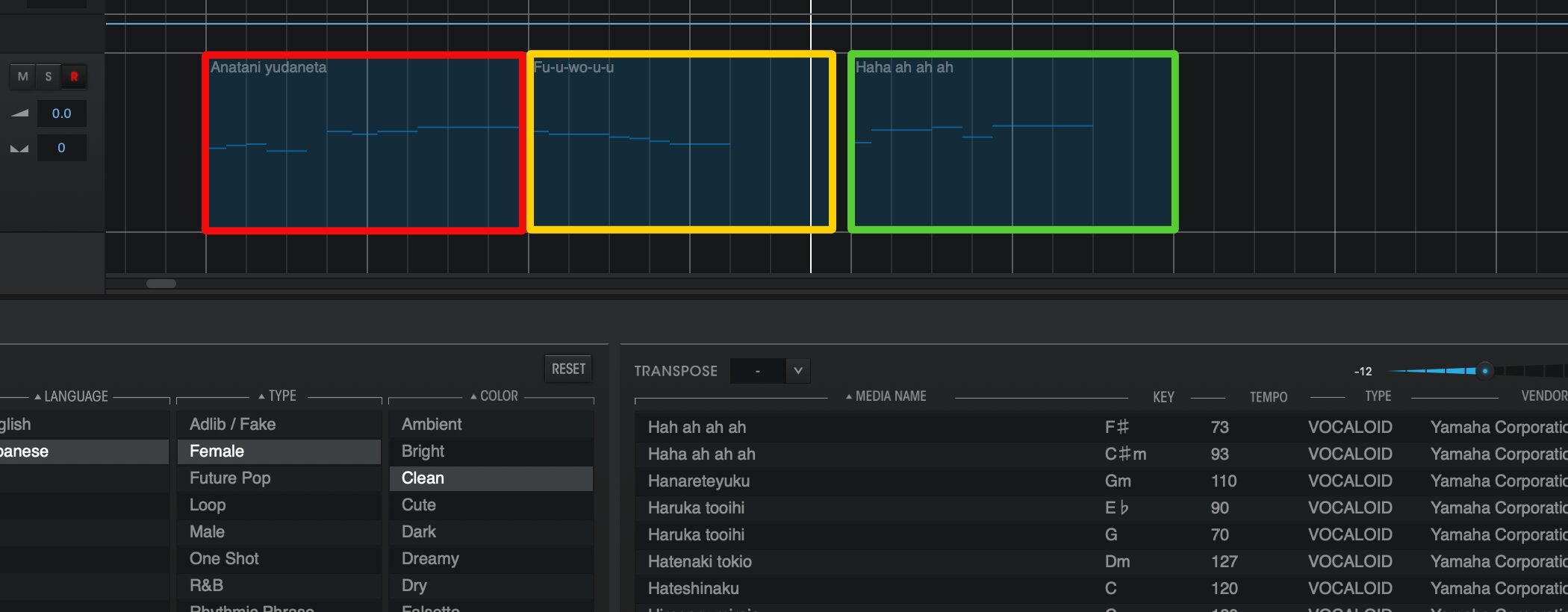
Arrange multiple phrases on the timeline in this way to create your own song.
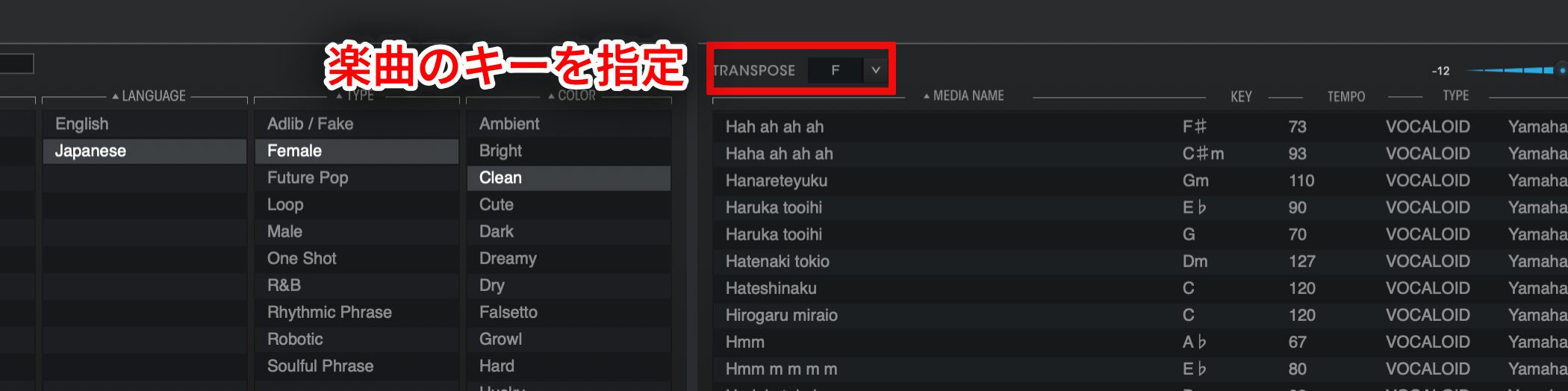
When importing, use TRANSPOSE to specify your song's key so that the phrase is adapted to that key as it is imported.
This makes phrases easy to use even if you are new to composition or are not confident with music theory.
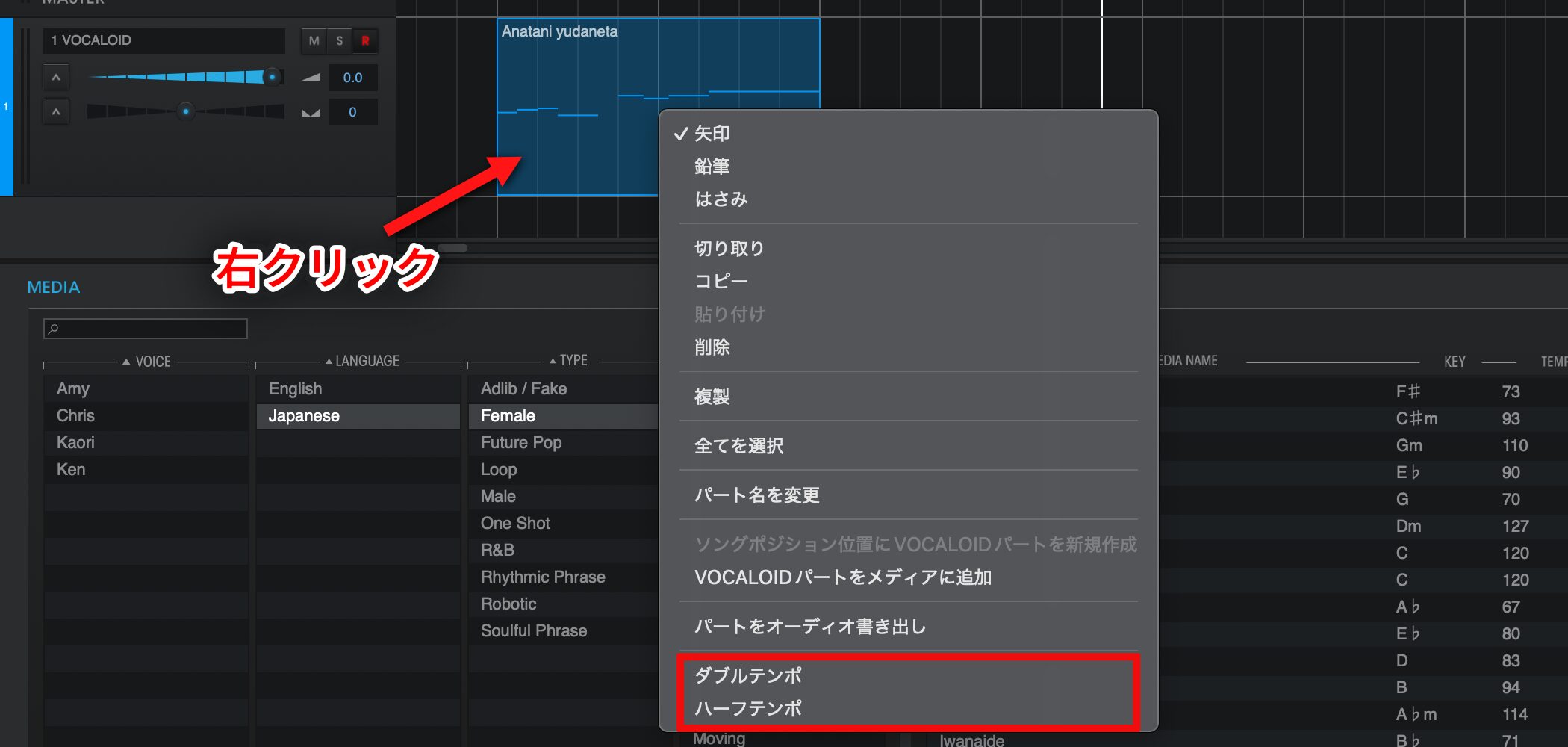
Right-click a phrase and choose Double Tempo or Half Tempo from the menu.
This doubles or halves the part's length while stretching or compressing the phrase itself, using a time-stretch function.
It is useful for dramatically changing a phrase's character or finding ideas for beats and grooves.
Types of Vocal Phrases
Phrases come in two types: VOCALOID and WAV, and each is handled differently.
Let's look at the differences.
VOCALOID Type
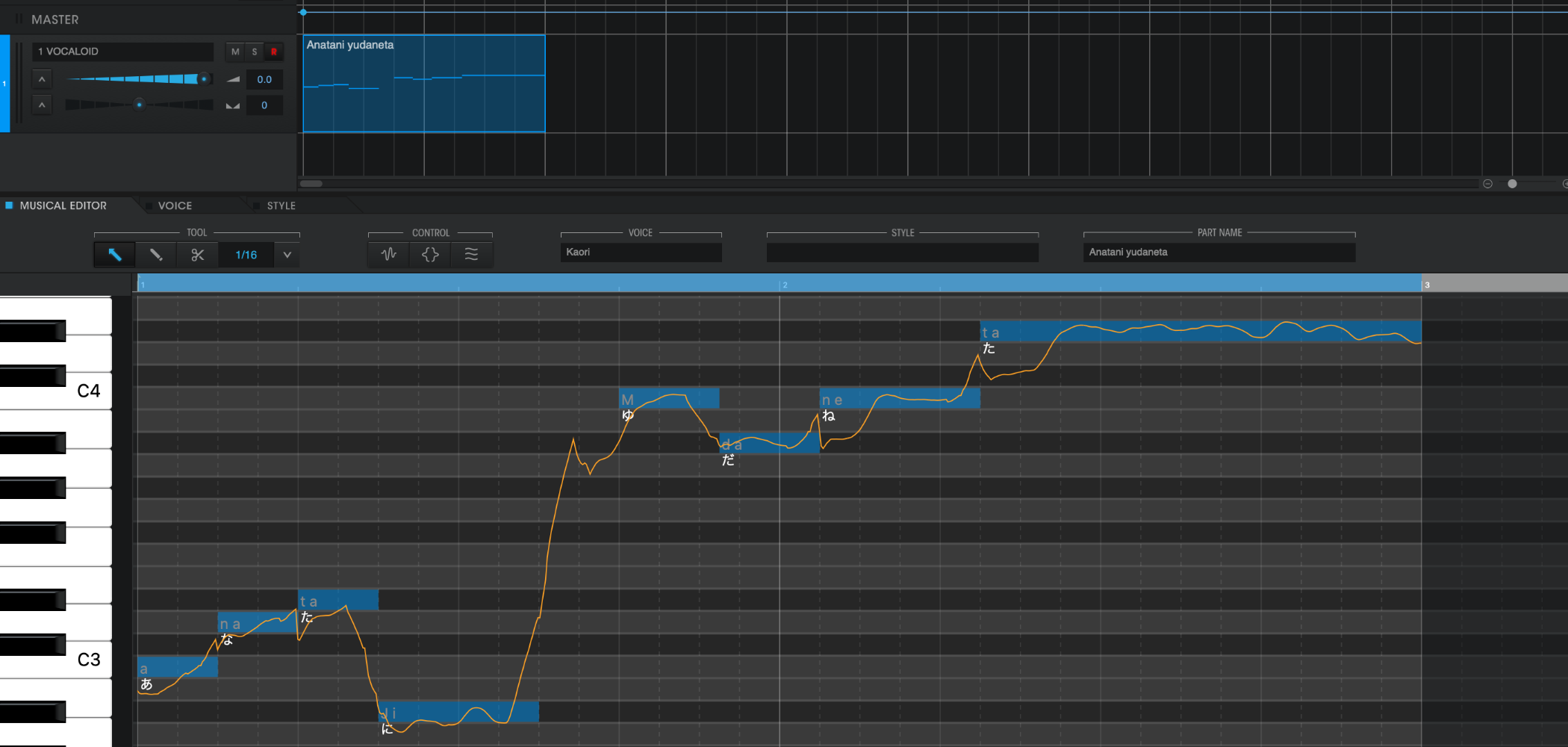
The phrase appears as MIDI notes, allowing you to freely make your own edits.
The part is shown in blue.
WAV Type
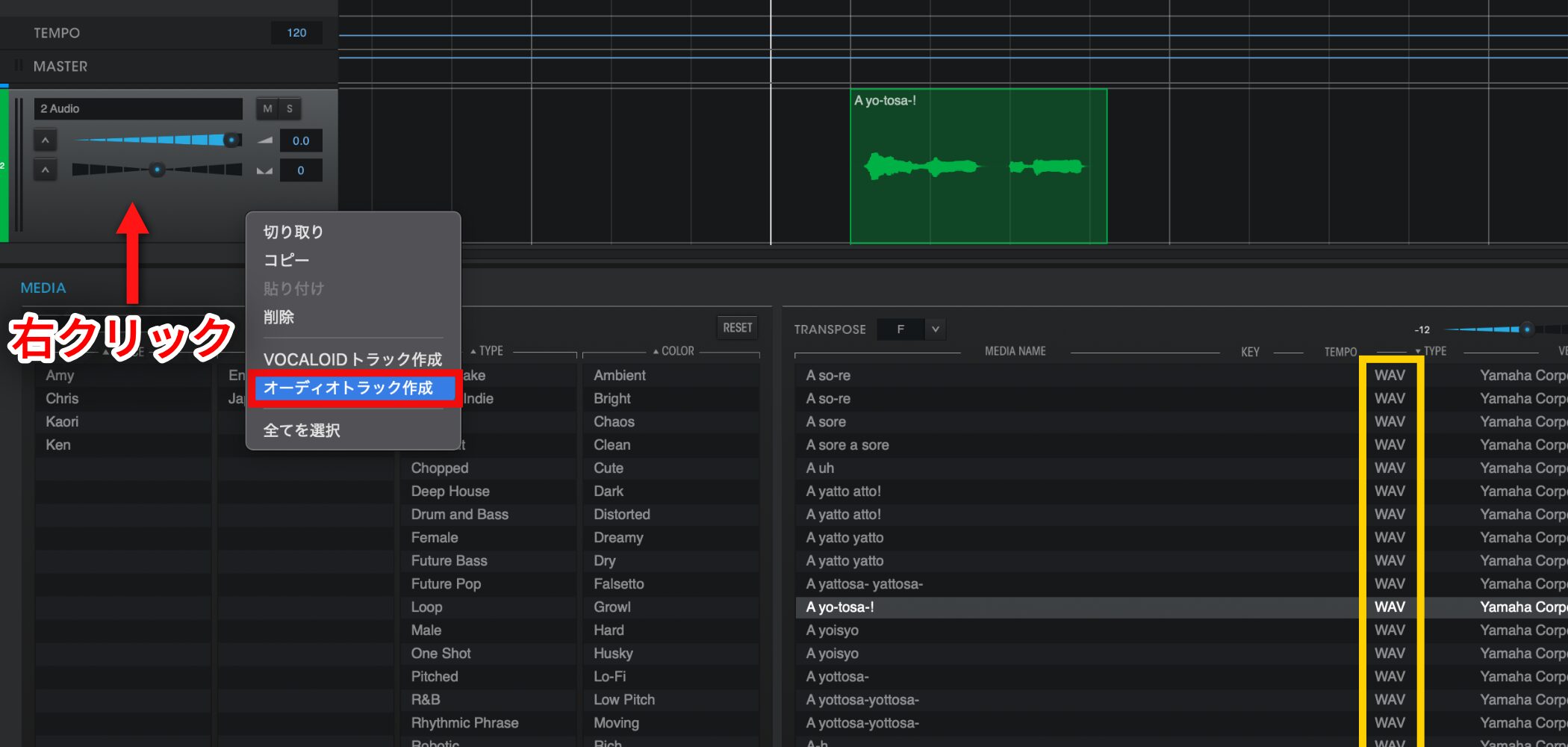
The phrase appears as a waveform, and its contents are fixed.
You cannot make detailed edits to the phrase itself, but these phrases include sound effects and shouts that help create a song's atmosphere.
The part is shown in green.
Right-click and choose Add Audio Track, then select a WAV-type phrase to add it.
A Note on Phrase Types
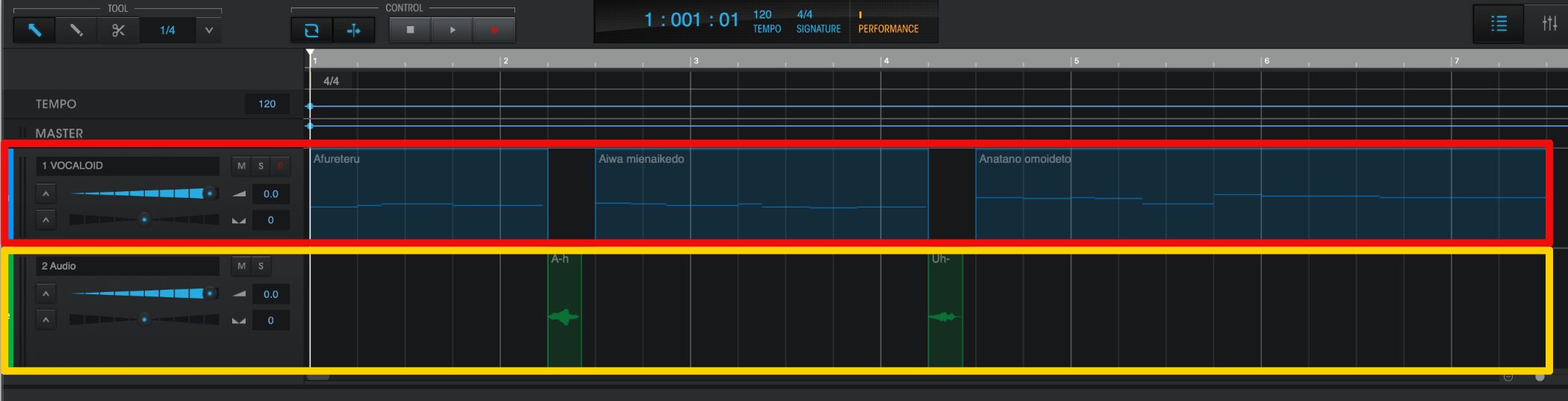
The two types cannot be placed together on the same track.
Place them on separate tracks, as shown in the image.
Editing Parts in VOCALOID 5
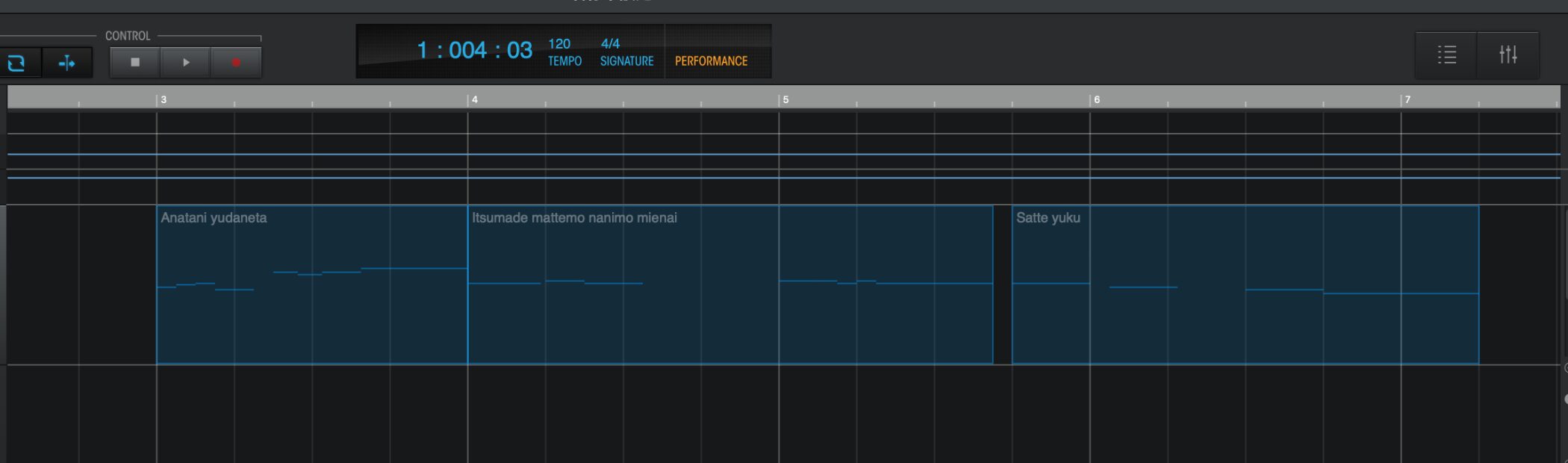
When arranging VOCALOID-type phrases, you will notice that each part may use a different voicebank or have different vocal nuances.
Once you have chosen your phrases, let's make these consistent.
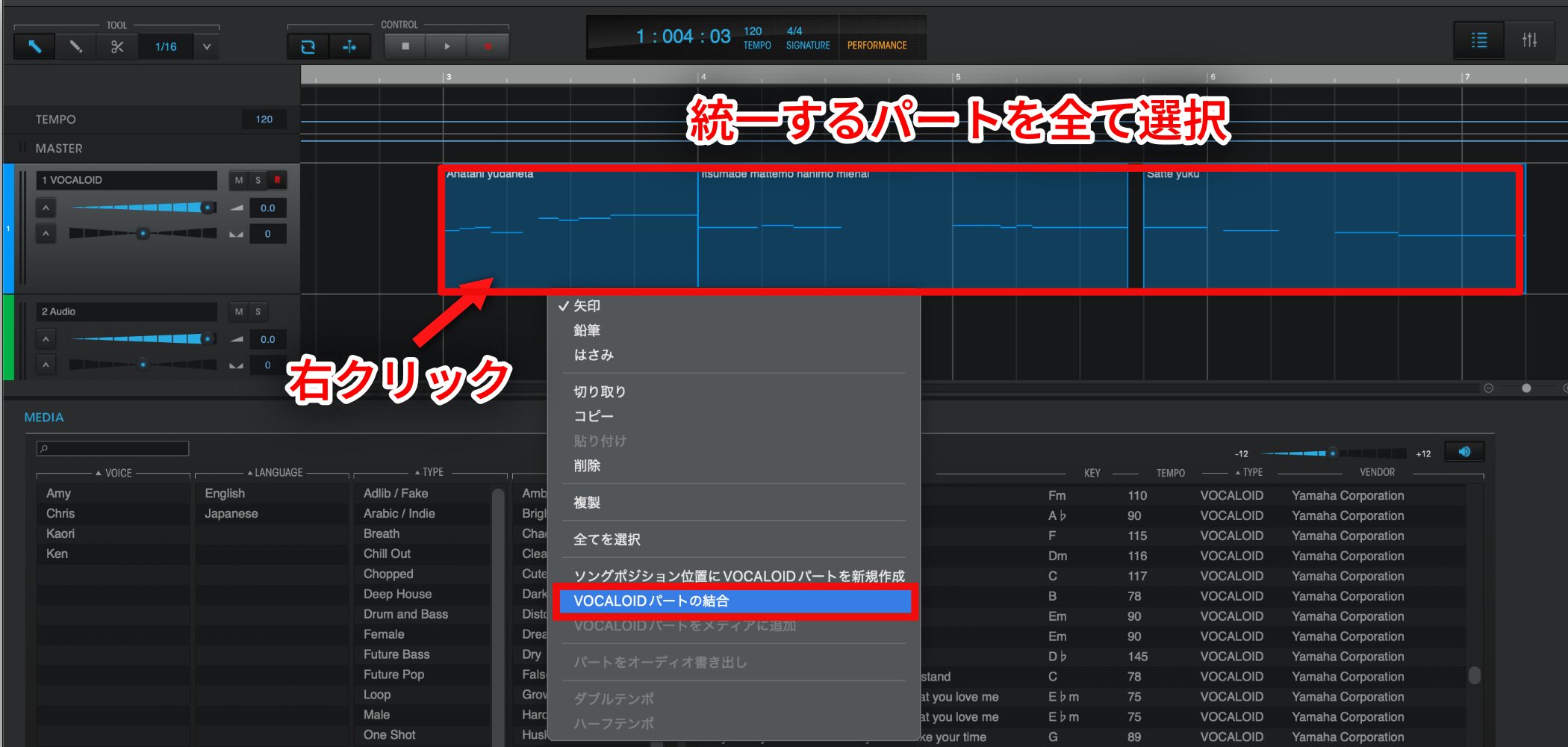
Select all the parts you want to unify and right-click.
Choose Join VOCALOID Parts from the menu.
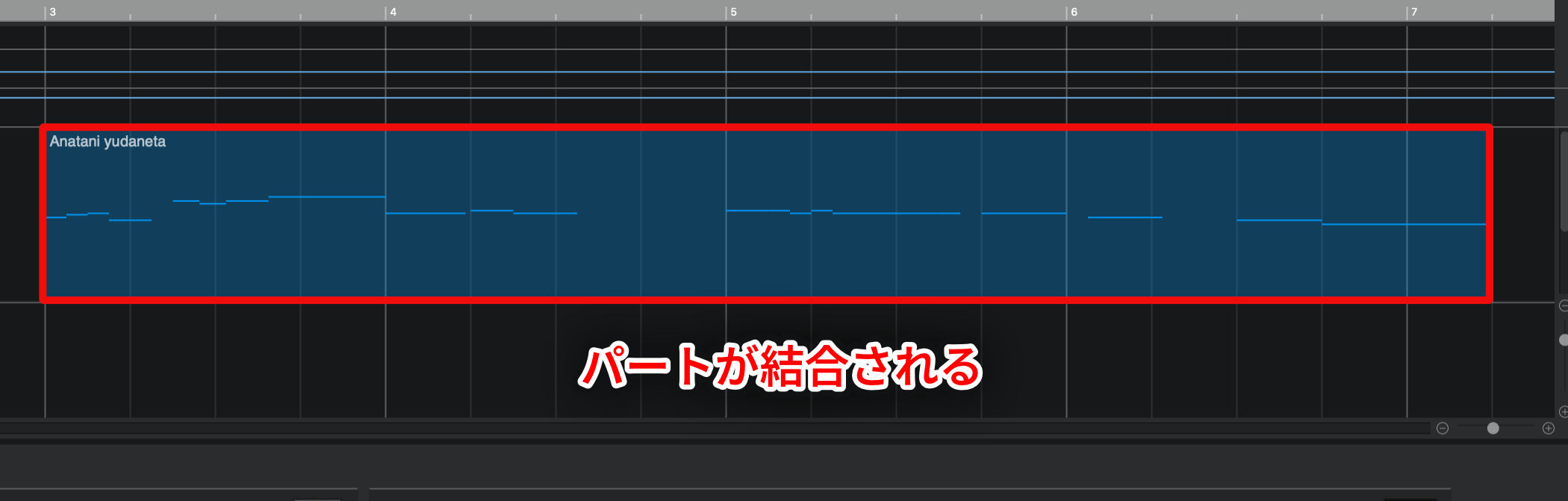
The parts are joined as shown. Their sound, including the voicebank, is unified to match the first selected part.
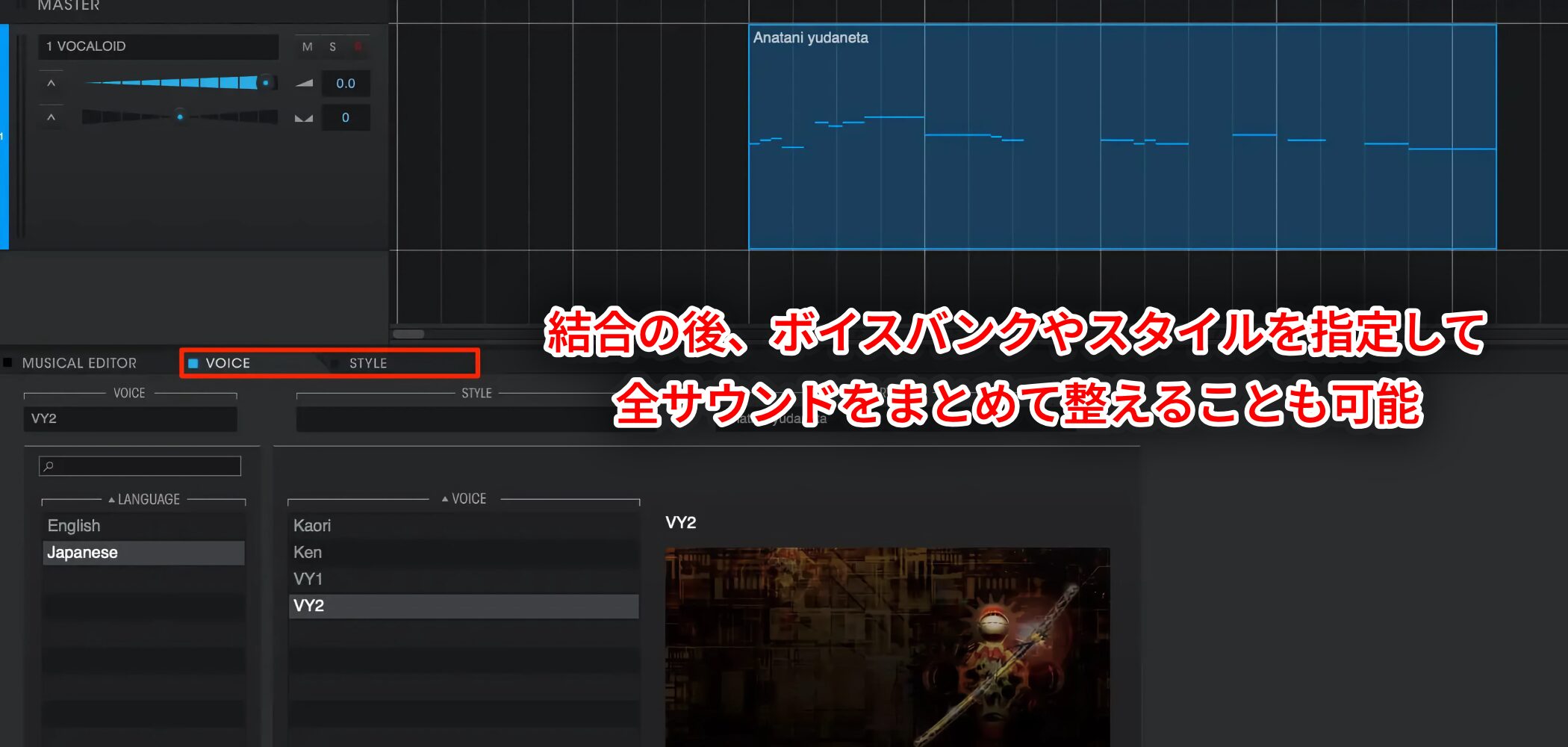
Of course, after joining the parts, you can choose a voicebank or style again to adjust the entire sound at once.
A Note on Joining Parts
There is an important language-related consideration when joining parts.
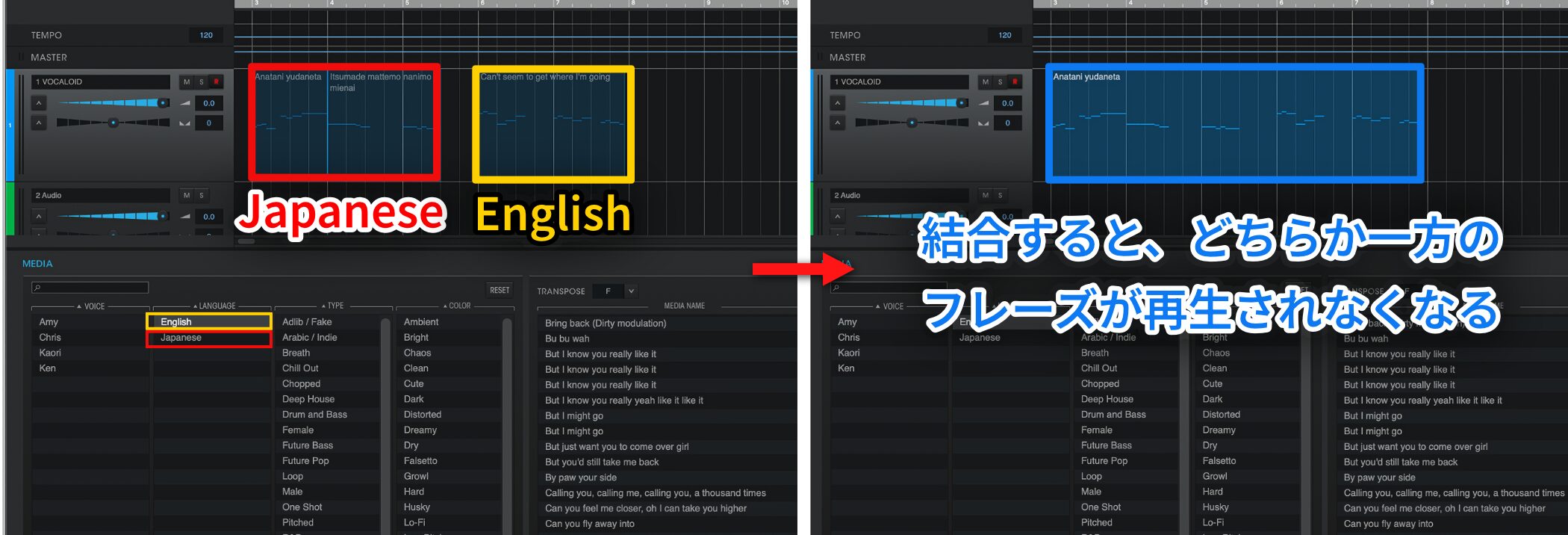
If you join a mixture of Japanese and English phrases, the phrases for one of the two languages (voicebanks) will no longer play.
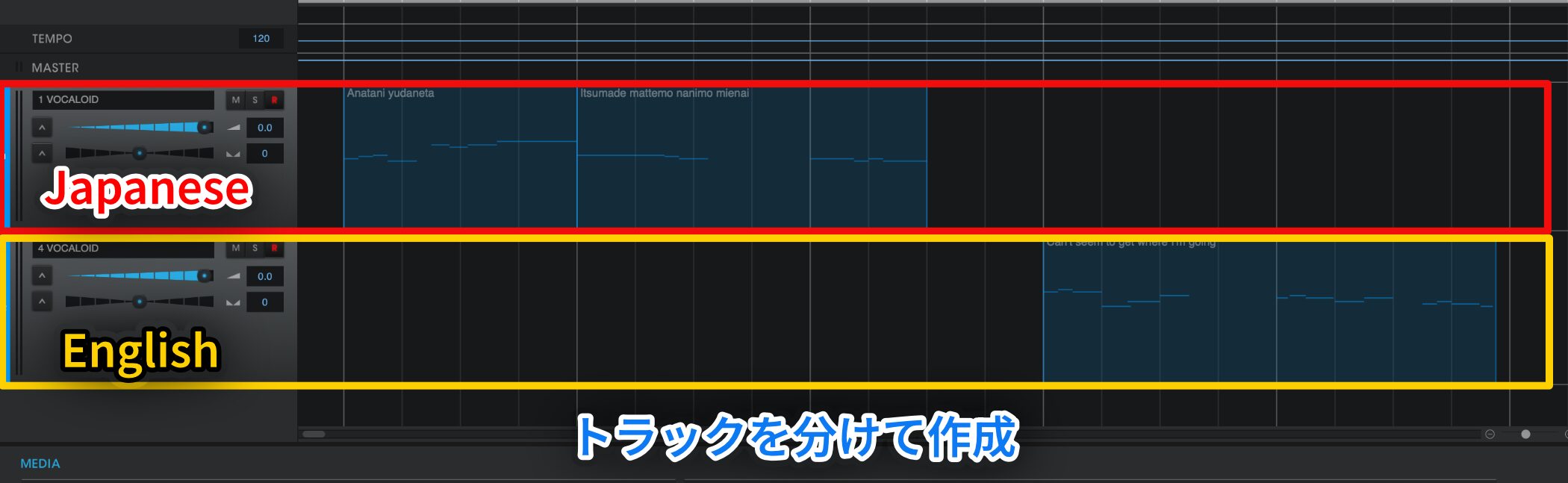
Avoid joining parts in different languages, or place them on separate tracks.
As you can see, this feature has many uses, from finding phrases that suit your song to getting ideas for melodies.
Try incorporating it into your productions!
Adding Expression to Your Arranged Phrases
Next, we will use lyrics, styles, and attack and release effects to create realistic, high-quality vocal tracks from the phrases we have entered.
In particular, the Emotion Tool introduced in VOCALOID 5 is a reliable aid for creative, efficient editing.
Video: Entering Lyrics, Attack and Release Effects, and the Emotion Tool
Entering Lyrics
First, let's enter lyrics for the phrase.
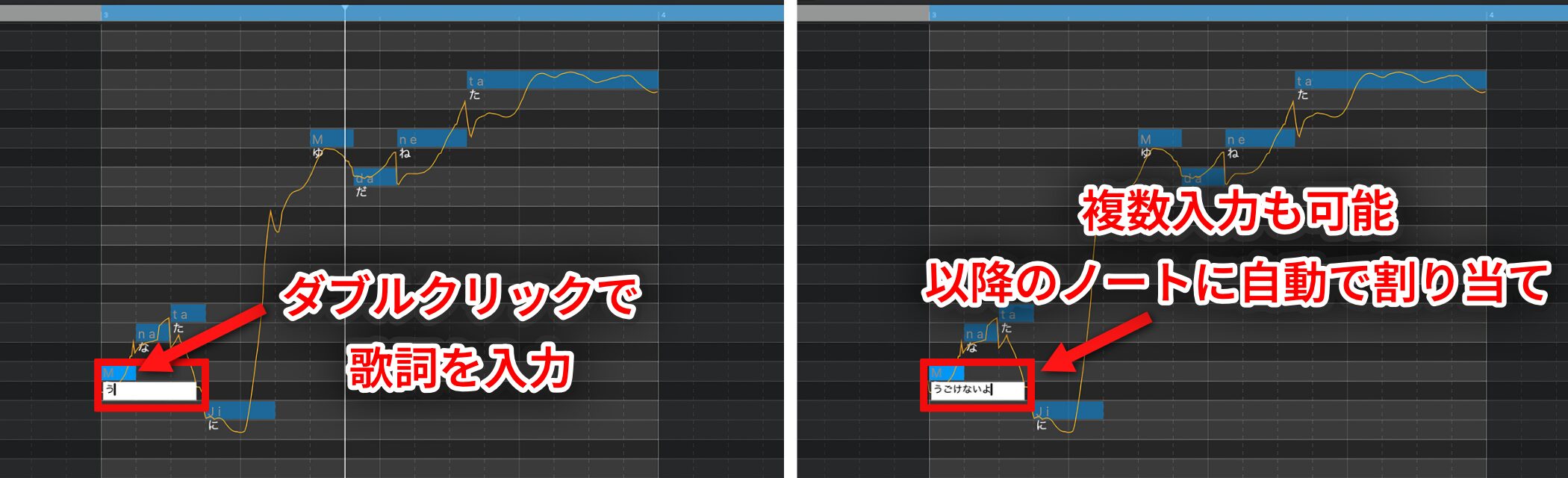
You can double-click the text entry area below a note to enter lyrics. Alternatively, entering multiple characters on the first note lets you assign lyrics to subsequent notes all at once.
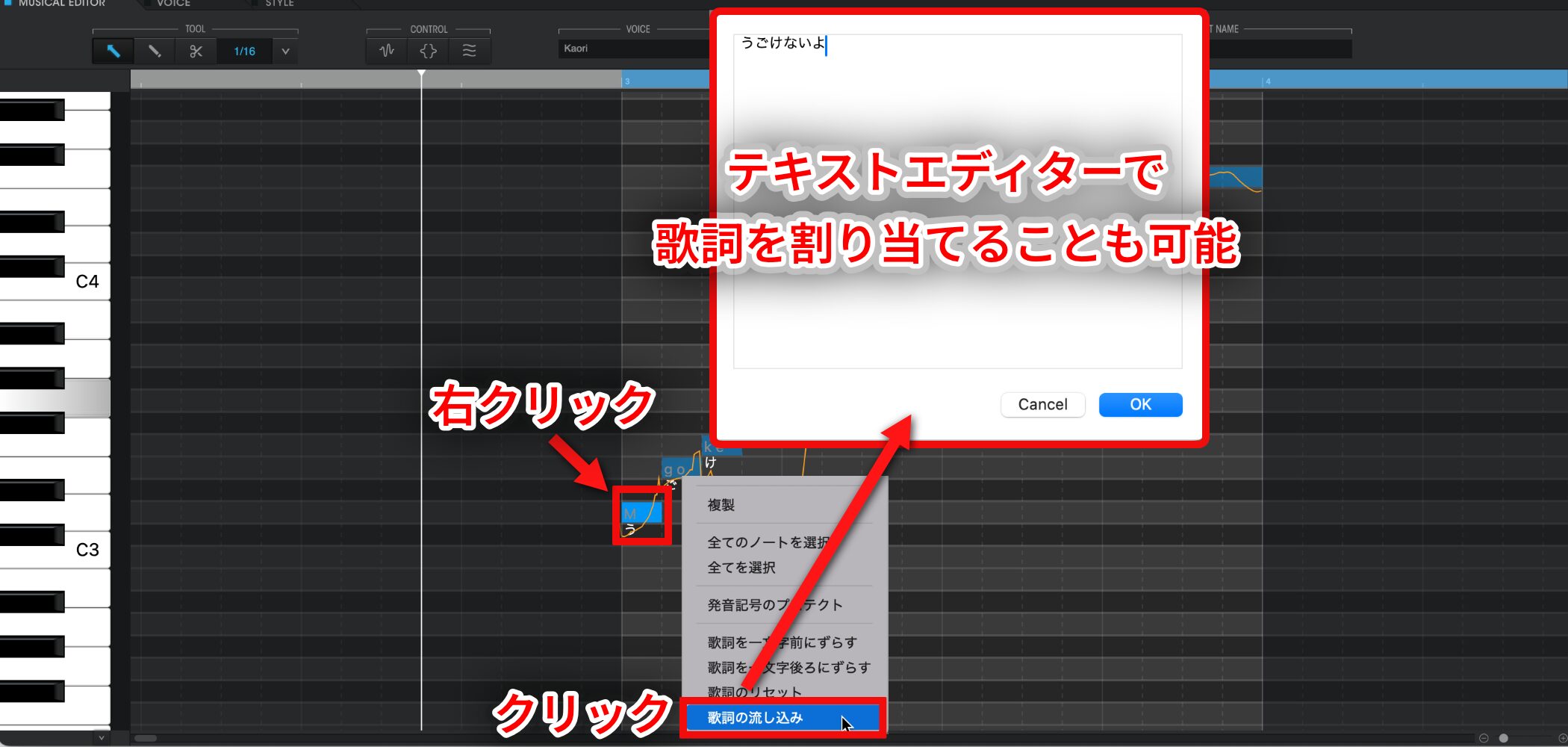
You can also right-click a note and use Insert Lyrics to assign lyrics with a text editor.
Entering Lyrics with a Hyphen (-)
You can also change the pitch of a sustained note.
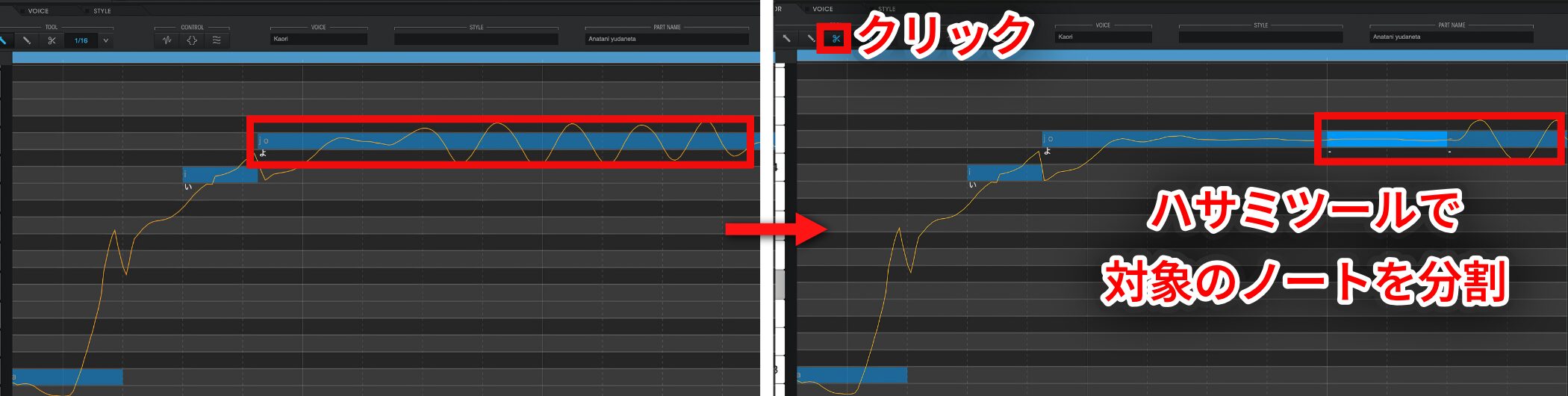
Split the target note with the Scissors tool, and a hyphen (-) will be assigned to the lyrics of the split note.
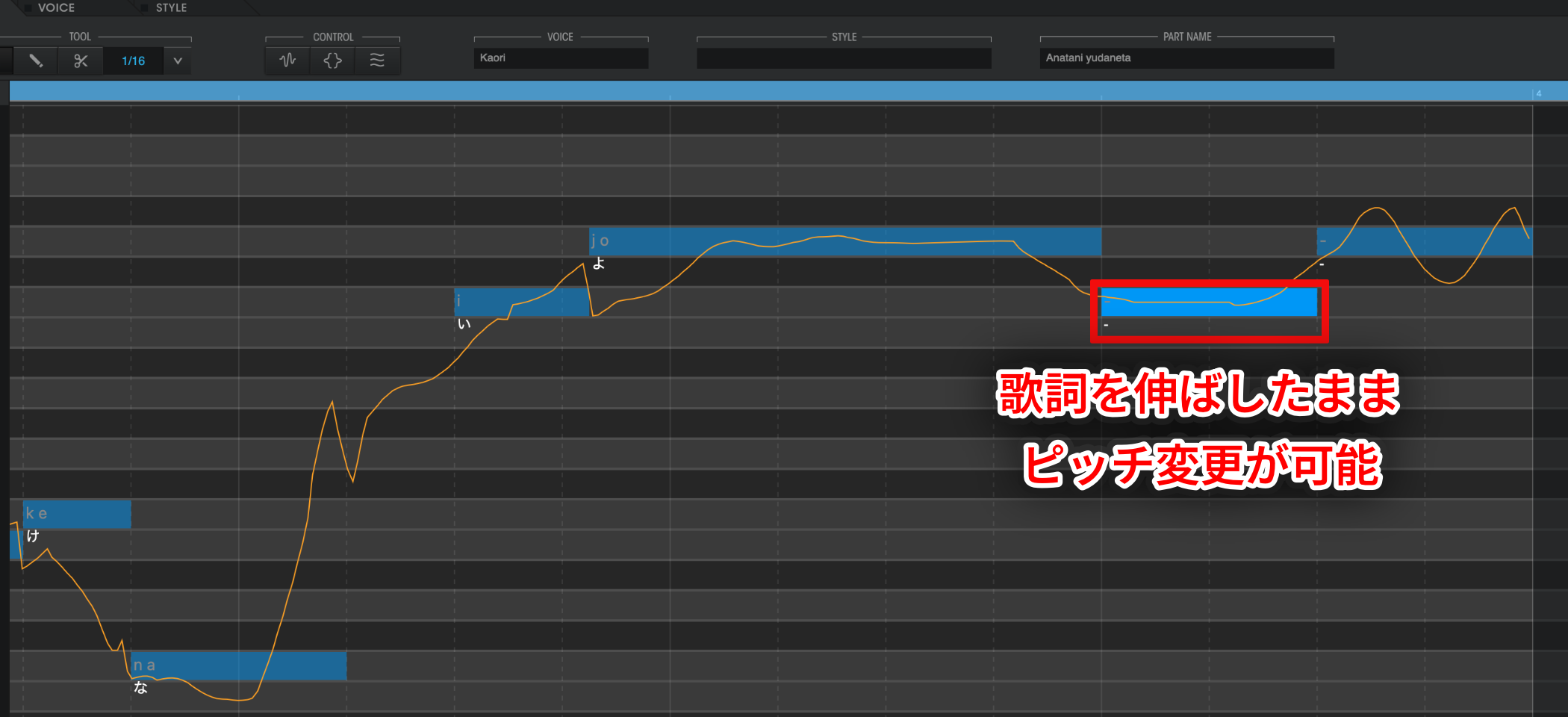
Then move the note to the desired pitch to change the pitch while sustaining the lyric.
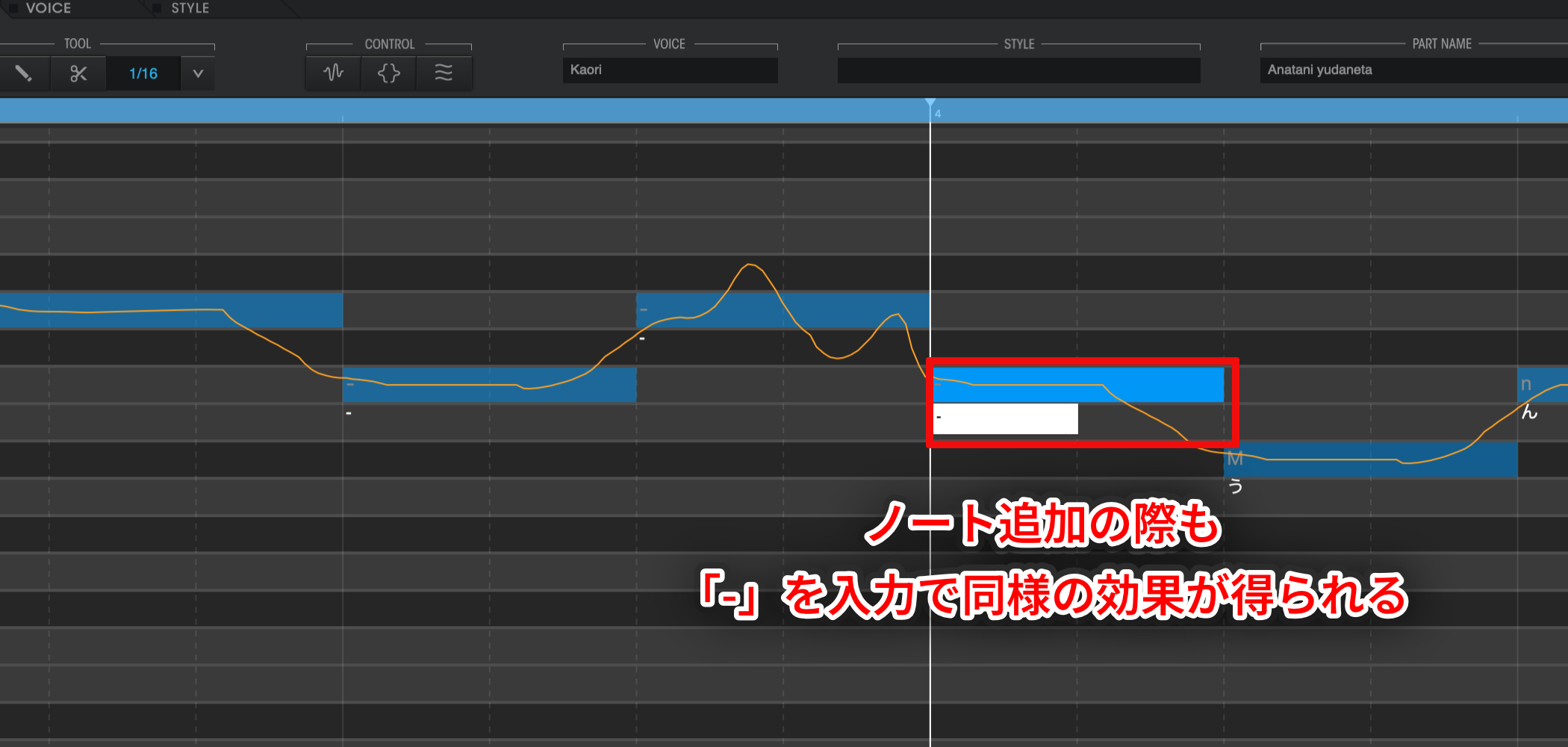
You can achieve the same effect by adding a new note and entering a hyphen (-) as its lyric, without splitting an existing note.
Controlling Consonants with Velocity
If you use a DAW, you probably associate velocity with how strongly or softly a note is played.
In VOCALOID 5, however, it is a parameter that controls consonant length.
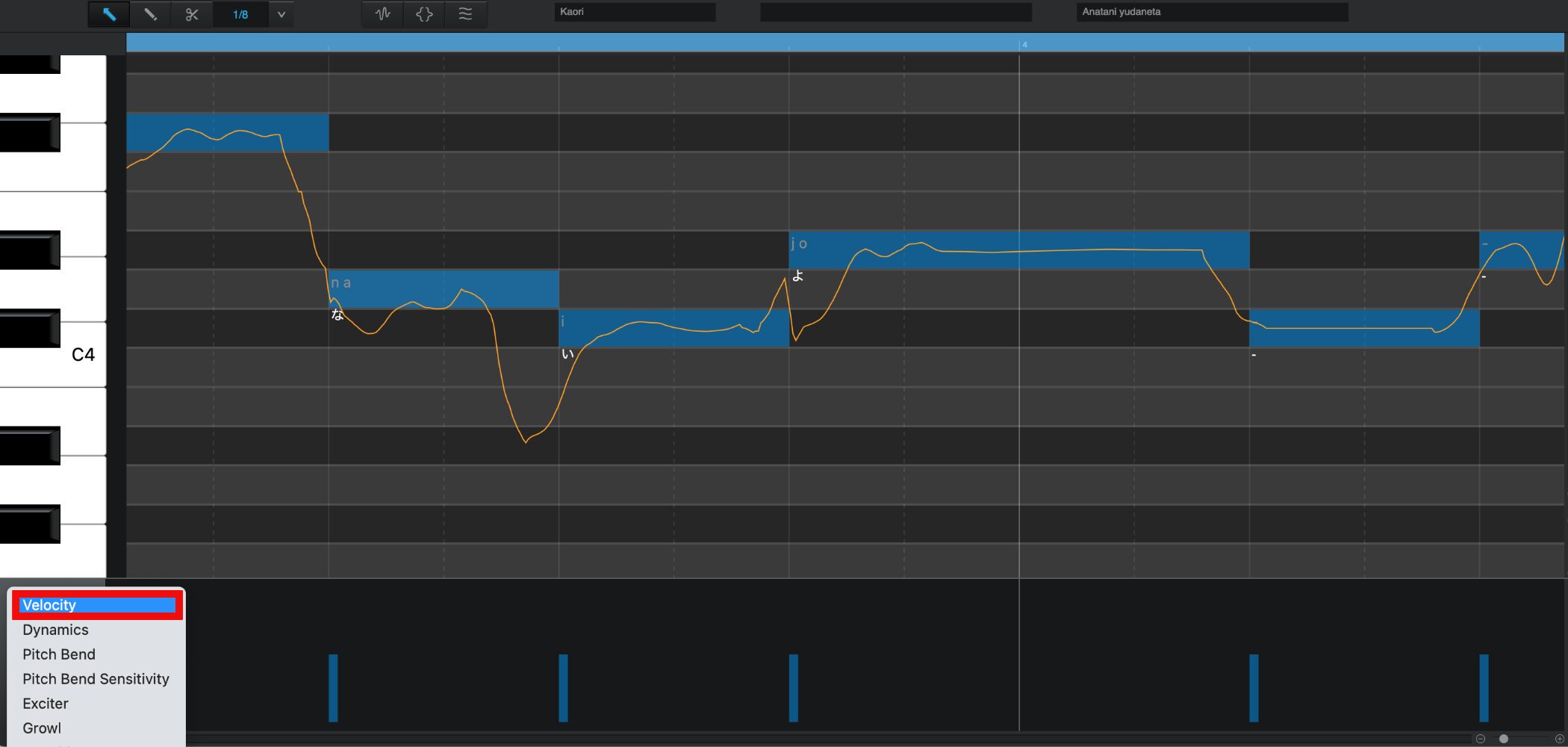
The controller area is located below the Musical Editor.
Select Velocity here.
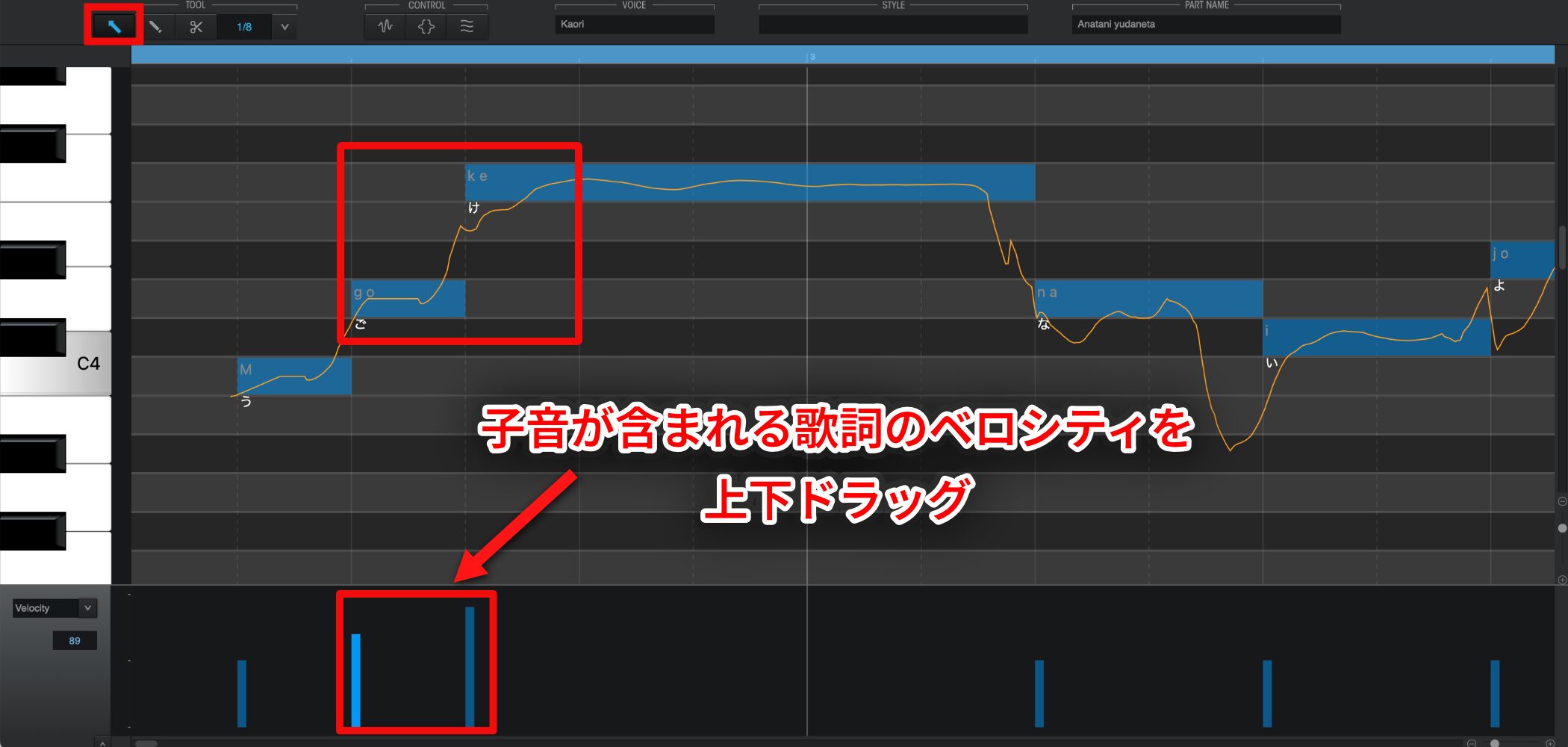
For lyrics containing consonants, drag the velocity values up or down to adjust them.
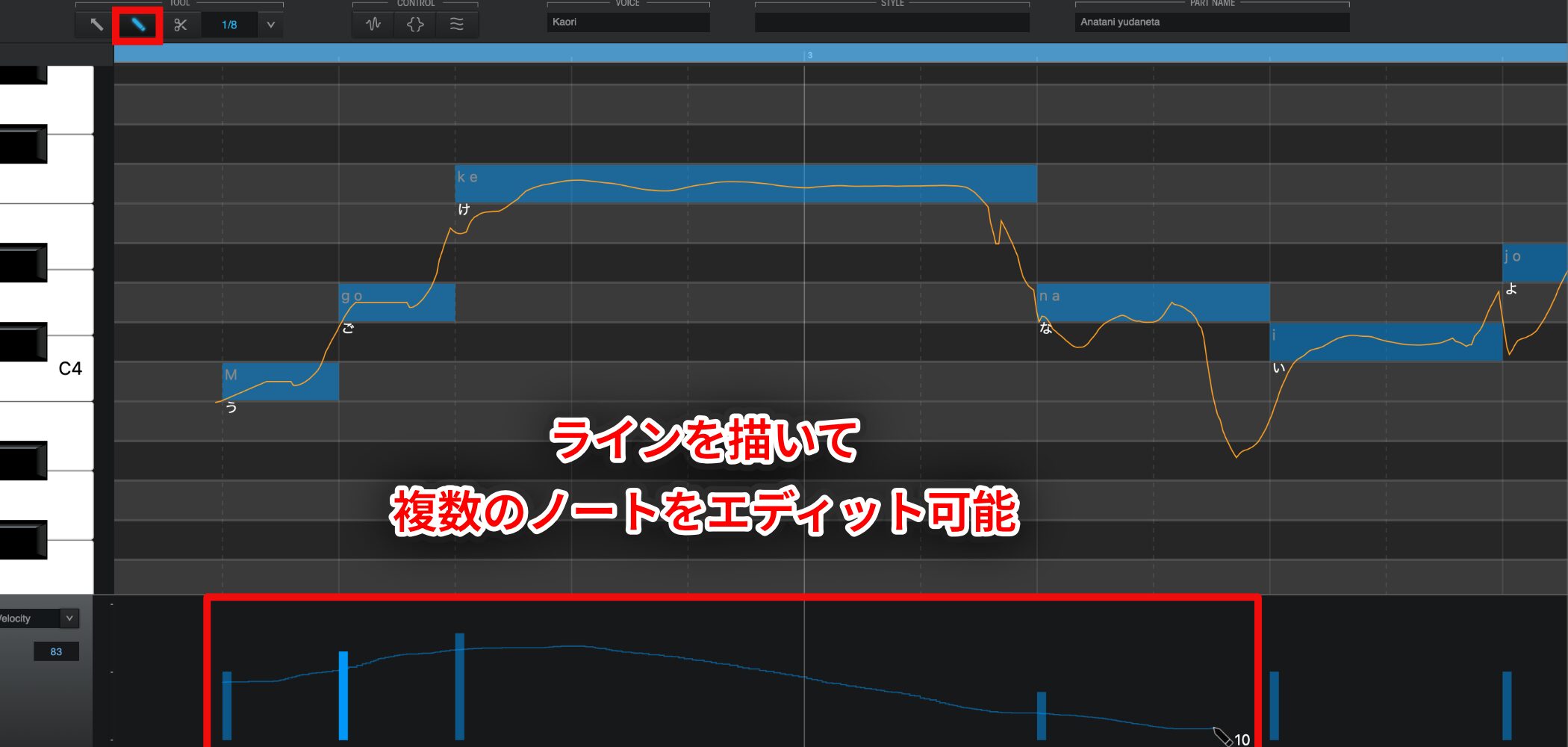
The Pencil tool lets you edit multiple notes in succession.
- Higher values make notes longer and connect the sound more smoothly.
- Lower values make notes shorter, creating a tighter, crisper performance.
Adjusting Velocity with the Emotion Tool
You can also edit velocity with the Emotion Tool.
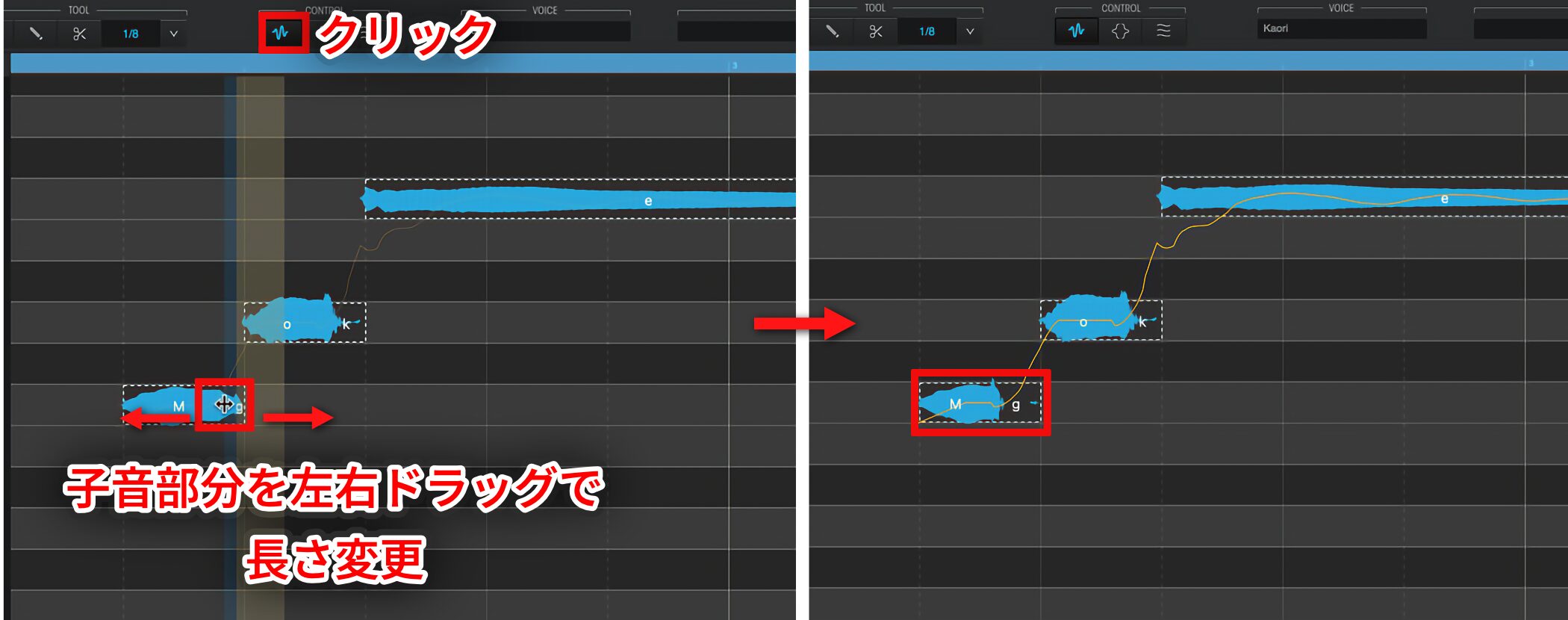
Enable the Emotion Tool, or use the following shortcut:
- Mac: Option key
- Windows: Alt key
While you hold the key, it works as if the Emotion button were enabled.
Drag left or right while watching the consonant portion to change its length.
Seeing the actual length makes editing intuitive.
Note length is also an important part of musical expression.
Try different patterns to suit the groove of your backing track and your preferences.
Applying Attack and Release Effects
Attack and release effects let you add a variety of nuances to vocal pitch.
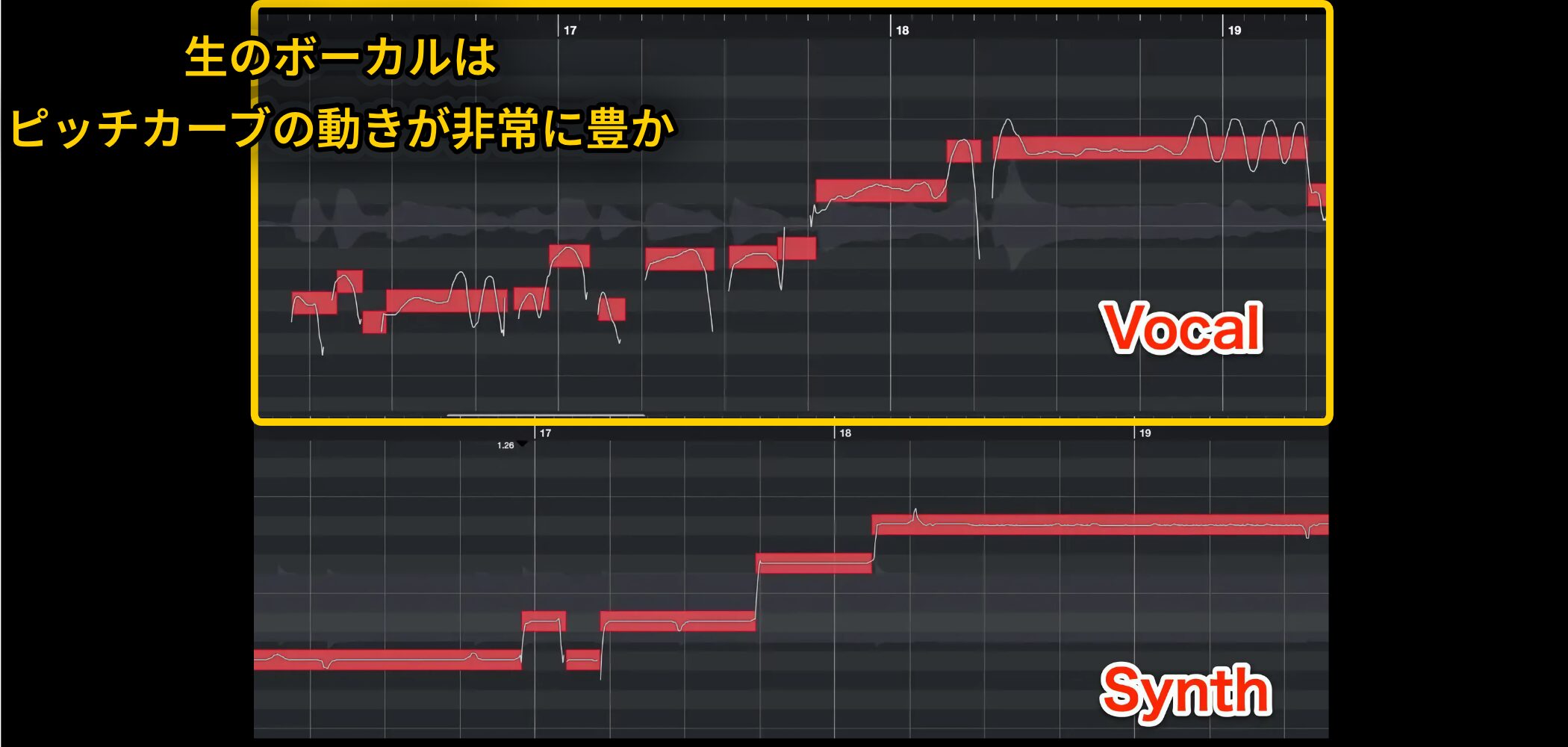
Comparing the pitch curves of a live vocal and a synthesizer sine wave reveals that the live vocal has a much richer range of pitch movement.
Let's apply this kind of pitch curve to our VOCALOID phrases as well.
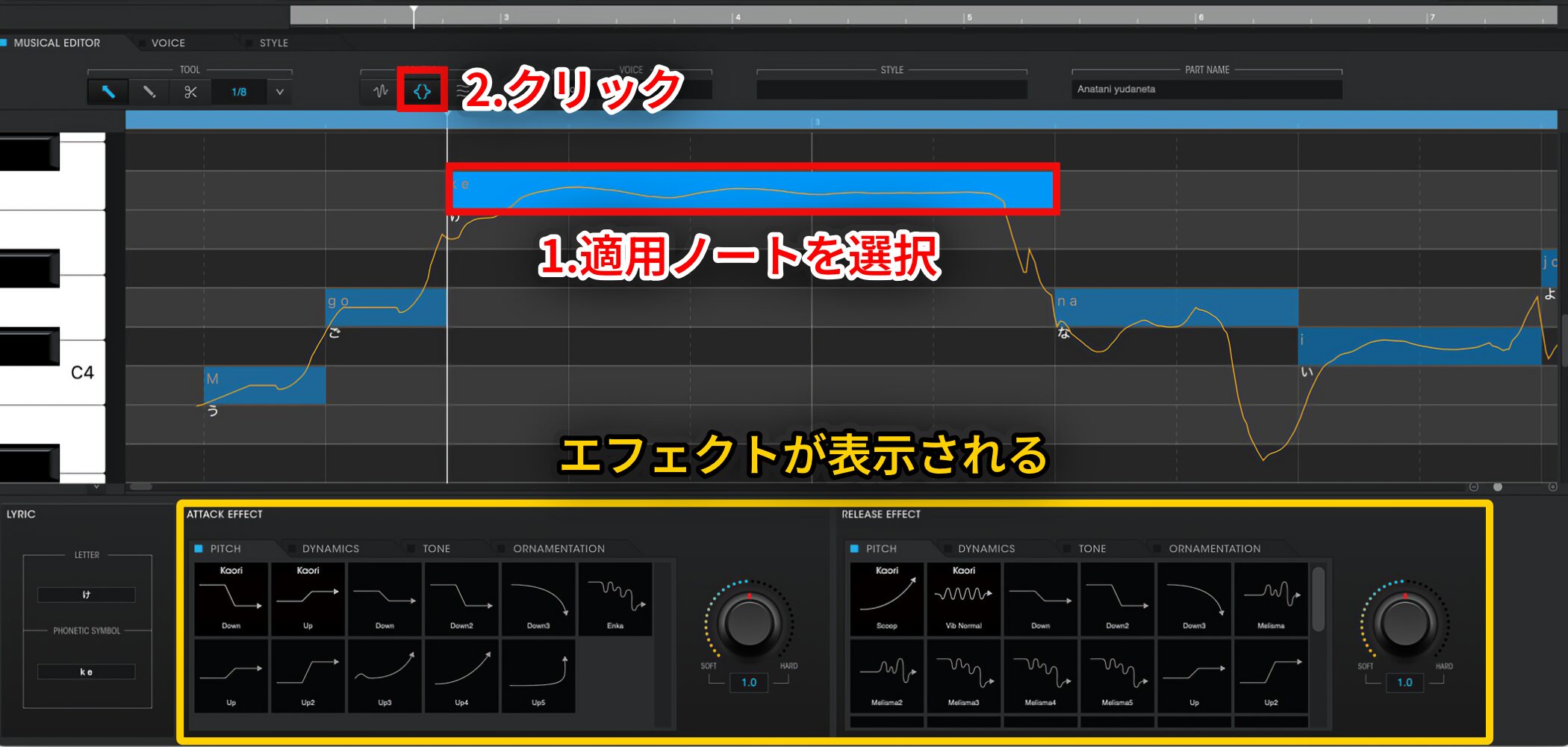
Select a note and click the button in the center of CONTROL to access the attack and release effects.
A key feature is that each note can have its own attack effect and release effect, one of each.
This lets you express complex pitch nuances in detail.
- ATTACK EFFECT: Applies a pitch-curve effect from the beginning toward the middle of a note.
- RELEASE EFFECT: Applies a pitch-curve effect from the middle toward the end of a note.
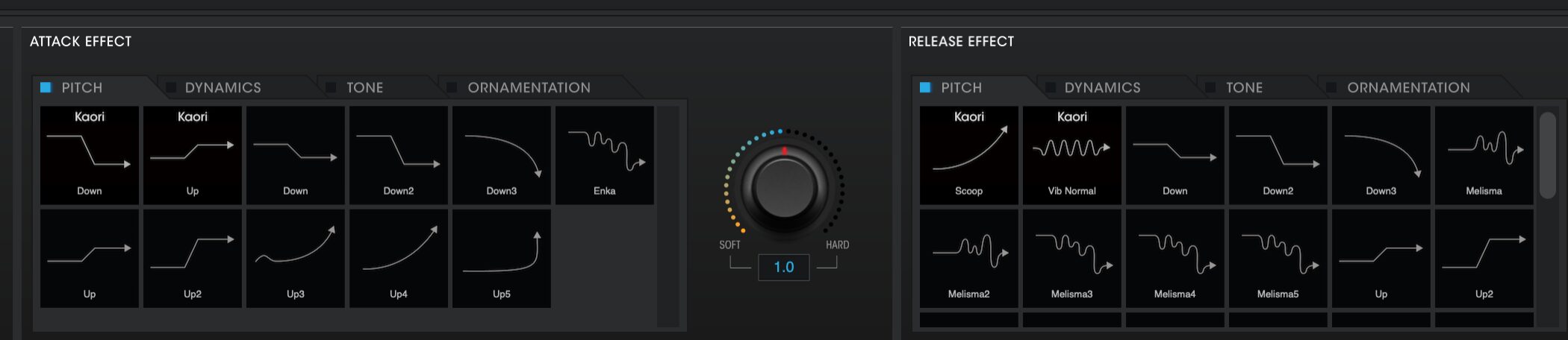
Many variations are available, organized into four main categories.
There are also curves that create unusual special effects, covering a wide range of genres from ballads to electronic music.
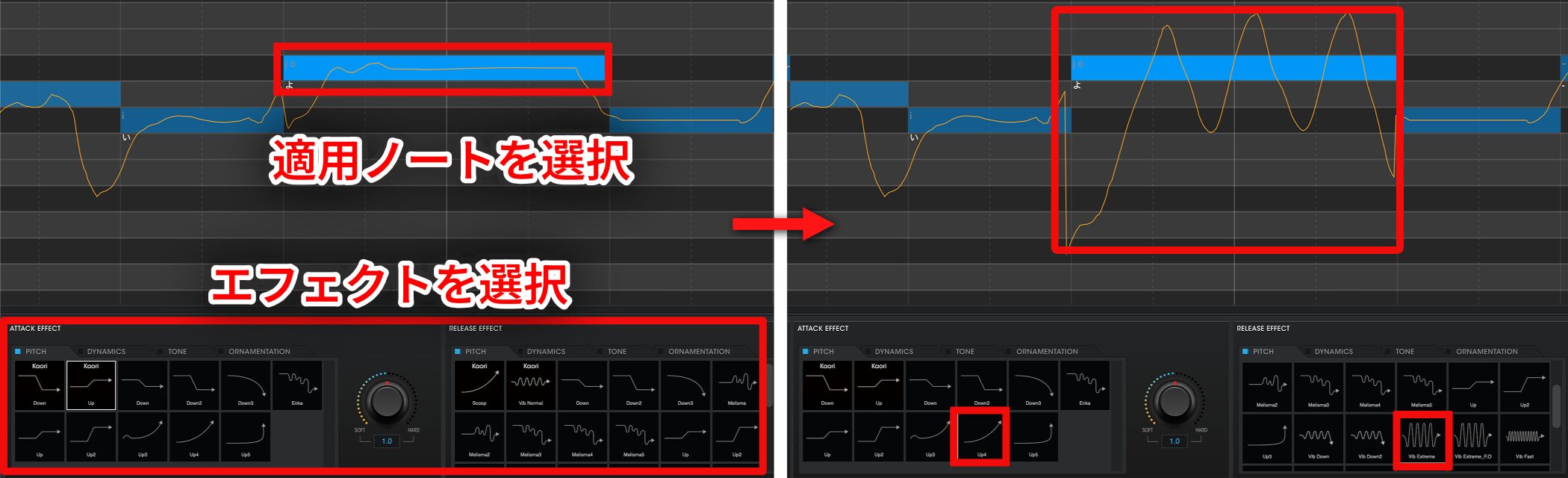
Applying an effect is easy: select the note and choose an effect from the list.
The note's pitch curve responds immediately.
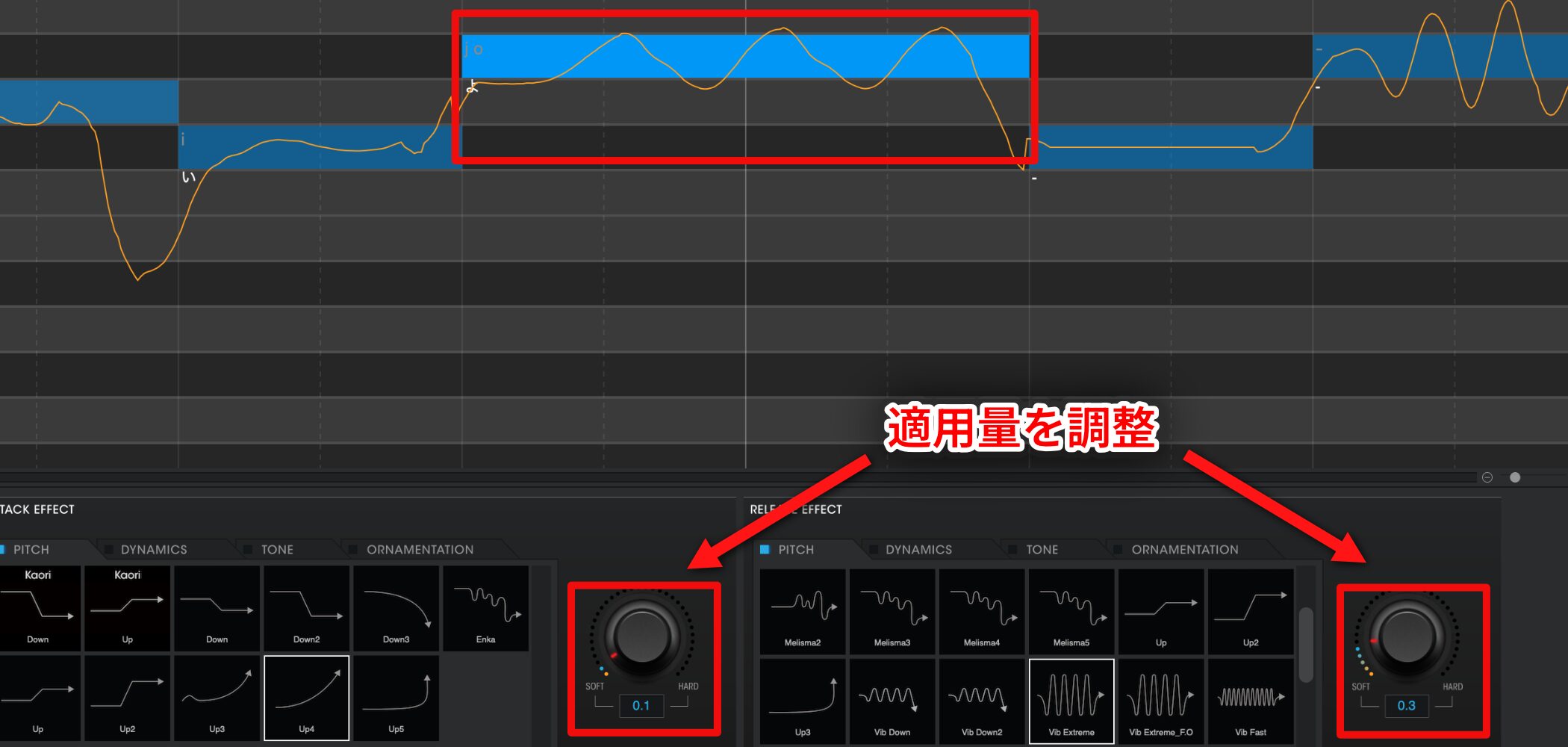
Adjust the effect amount with the knob on the right.
Turning the knob to the right increases the strength of the effect.
Controlling Effects with the Emotion Tool
The Emotion Tool we used to set velocity is useful here, too.
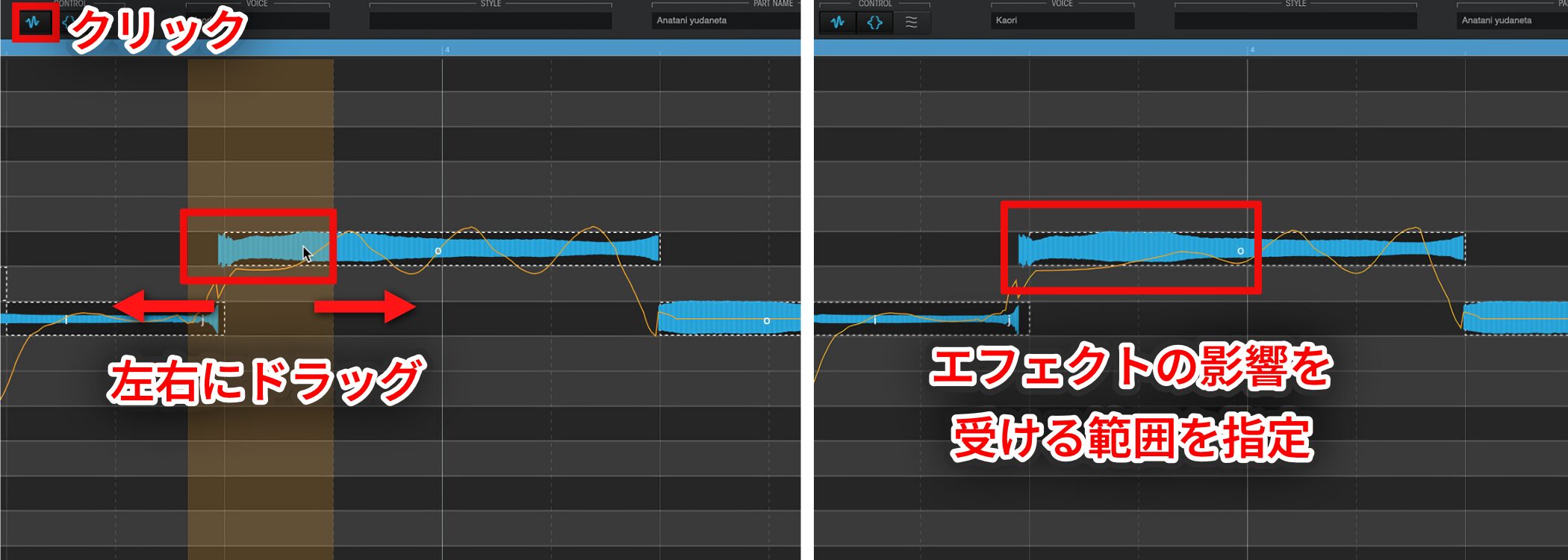
Move the cursor over a section with an effect to highlight the range where it is applied.
Drag this range to specify the area affected by the effect.
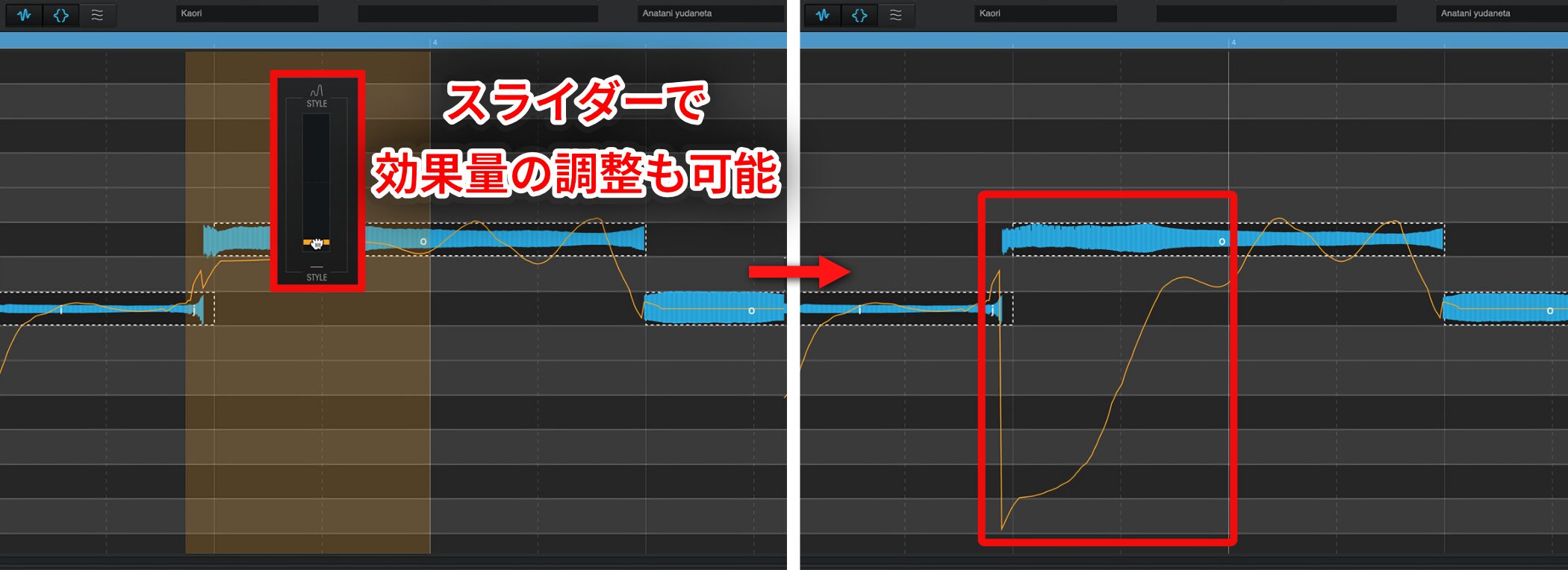
You can also adjust the effect amount by clicking and holding the highlighted area.
Listen to the phrase repeatedly as you work toward the nuance you want.
Controlling Auto Breath
Auto Breath is a feature that can make vocal phrases sound more realistic.
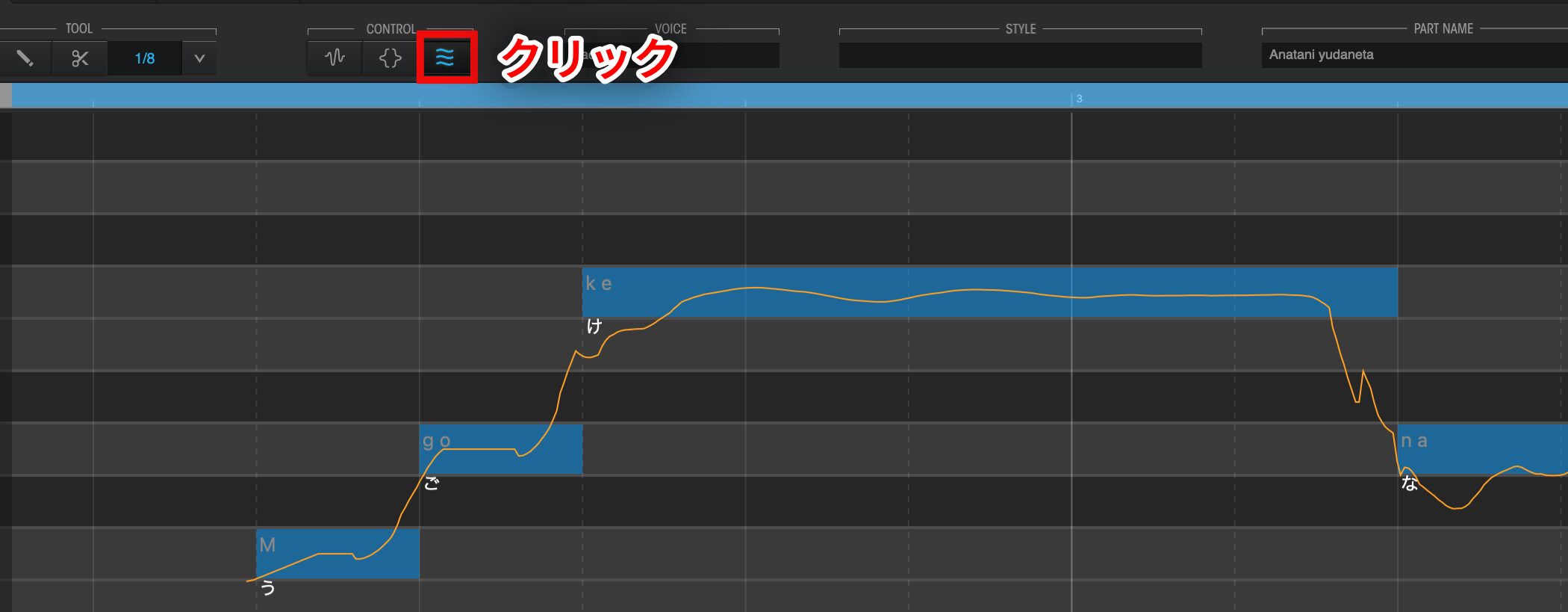
Click the Auto Breath button to enable it.
You can also customize the breath settings.
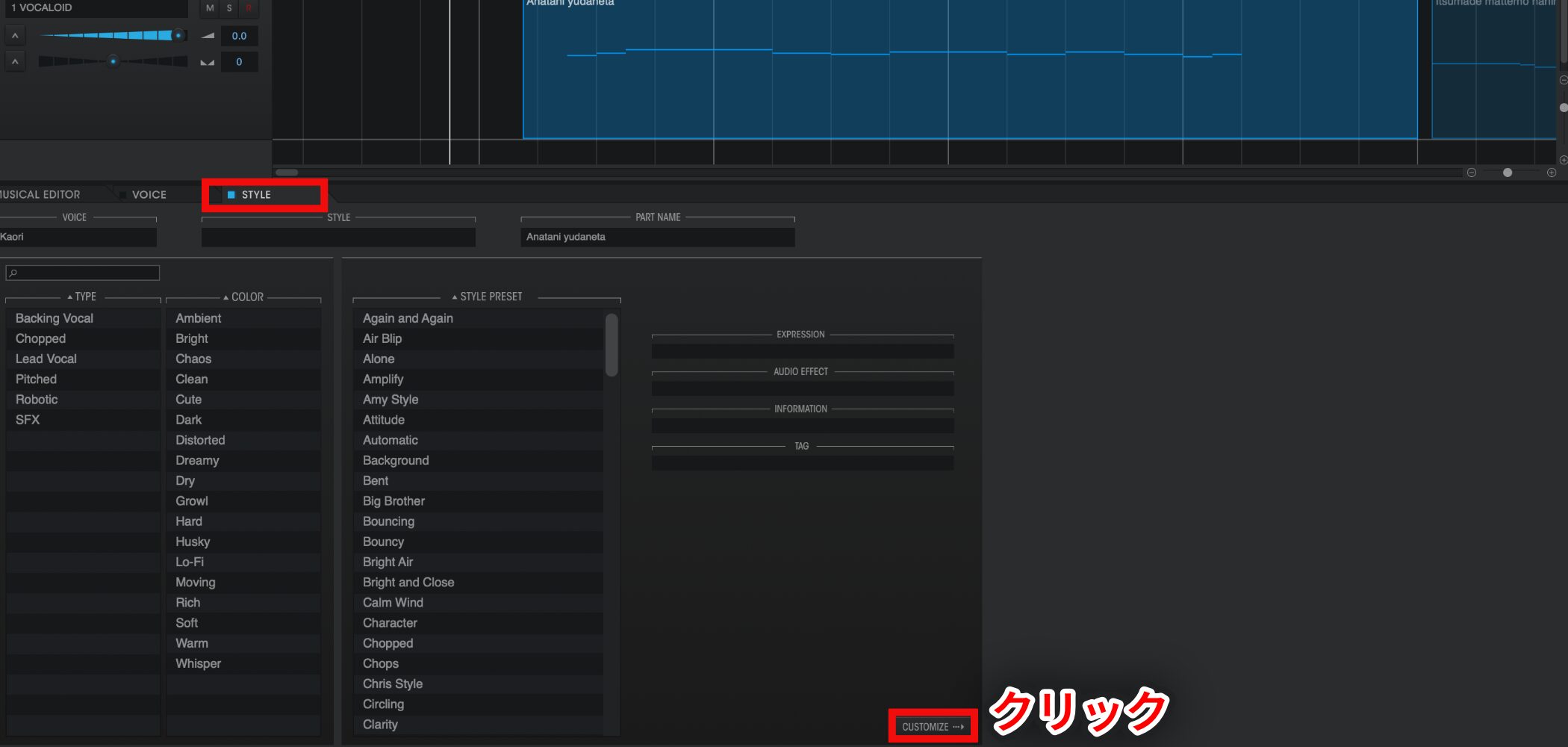
Click CUSTOMIZE at the bottom right of STYLE.
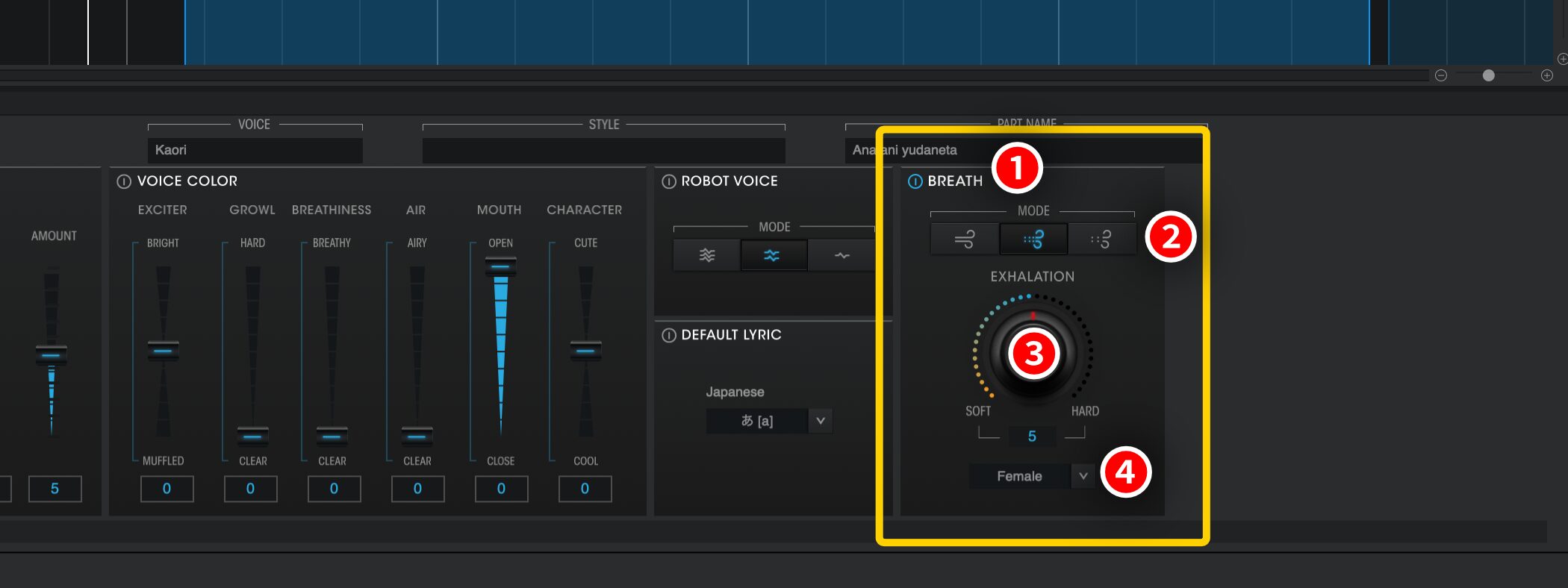
Use the BREATH section to adjust the details.
- 1. In addition to the Auto Breath button above, you can use this icon to turn Auto Breath on or off.
- 2. Adjusts the frequency of breaths. Moving it left inserts more breaths between phrases.
- 3. Adjusts breath volume. Turning the knob right toward HARD makes breaths louder.
- 4. Selects a male or female breath sound.
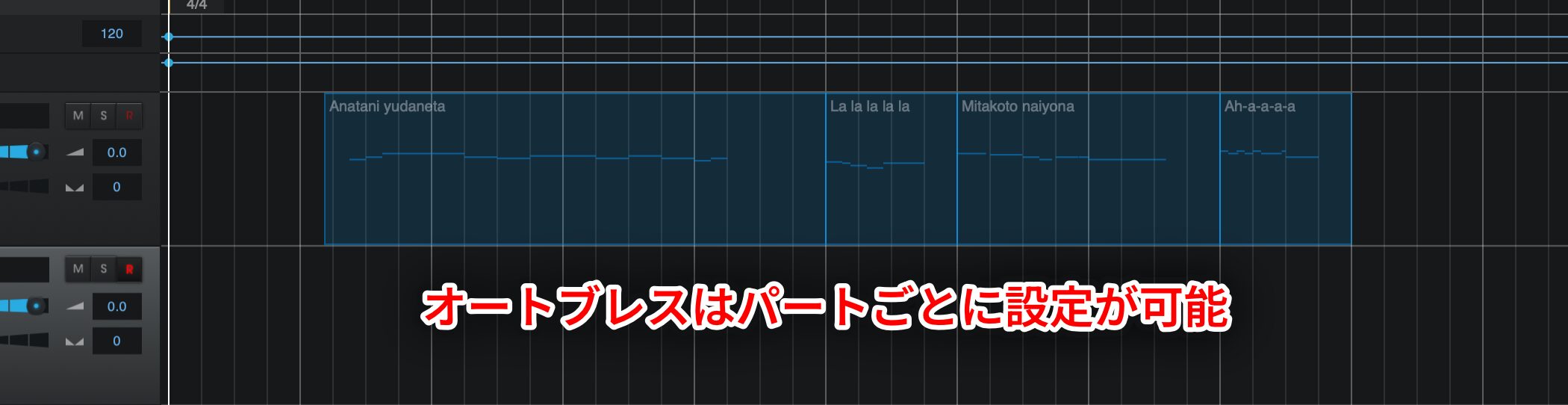
Auto Breath can be configured separately for each part.
Choose settings to suit your intentions, such as parts with no breaths or parts with more frequent breaths.
Features for Shaping Your VOCALOID Sound
Next, we will cover creating harmony parts, applying effects, and routing separate outputs to refine your VOCALOID 5 sound.
Combine these features with the attack and release effects discussed above to create vocal tracks that fit your song.
Video: Creating Harmony Tracks, Processing Effects, and Using Multiple Outputs
Creating Harmony Tracks
You can only open one instance of VOCALOID 5 in a DAW project.
To create harmony parts or layer multiple tracks, add tracks inside VOCALOID 5.
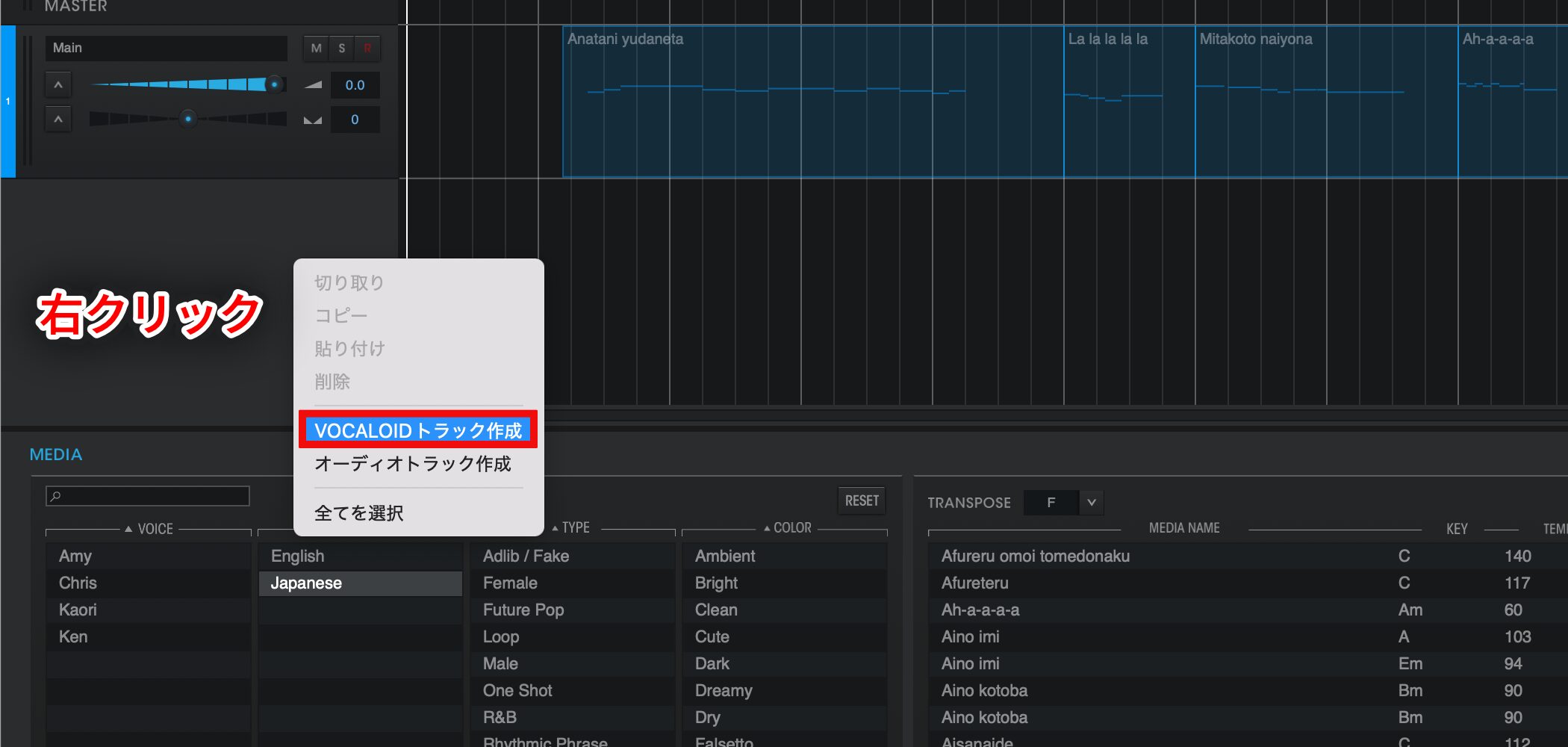
Right-click the track list and select Add VOCALOID Track.
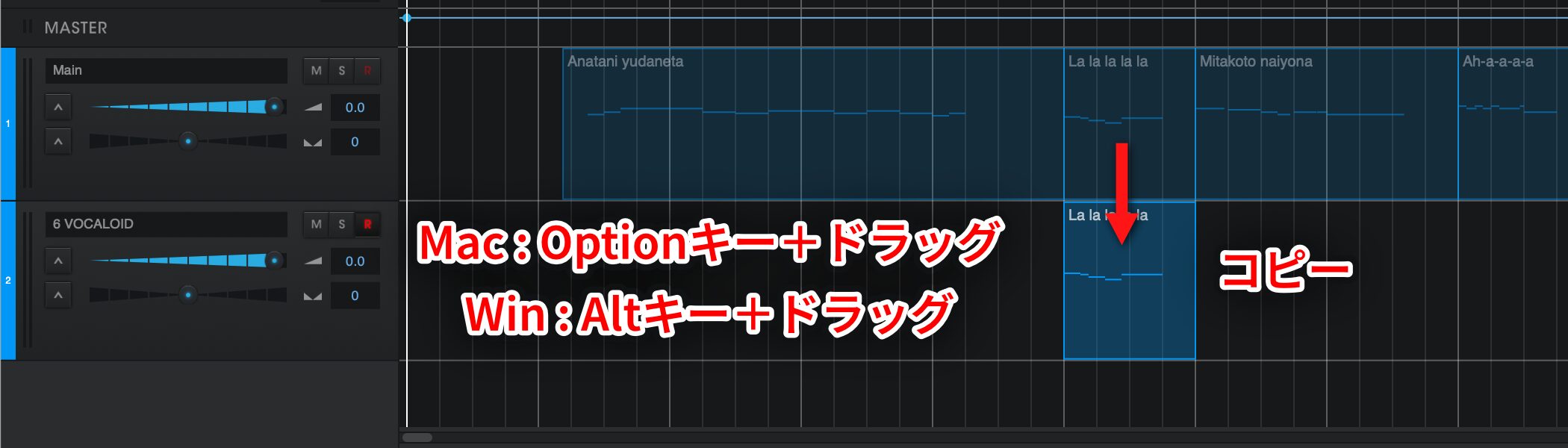
Copy the part you want to use for the harmony onto the new VOCALOID track.
To duplicate the desired part, use:
- Mac: Option + drag
- Windows: Alt + drag
This makes it easy to duplicate a part.
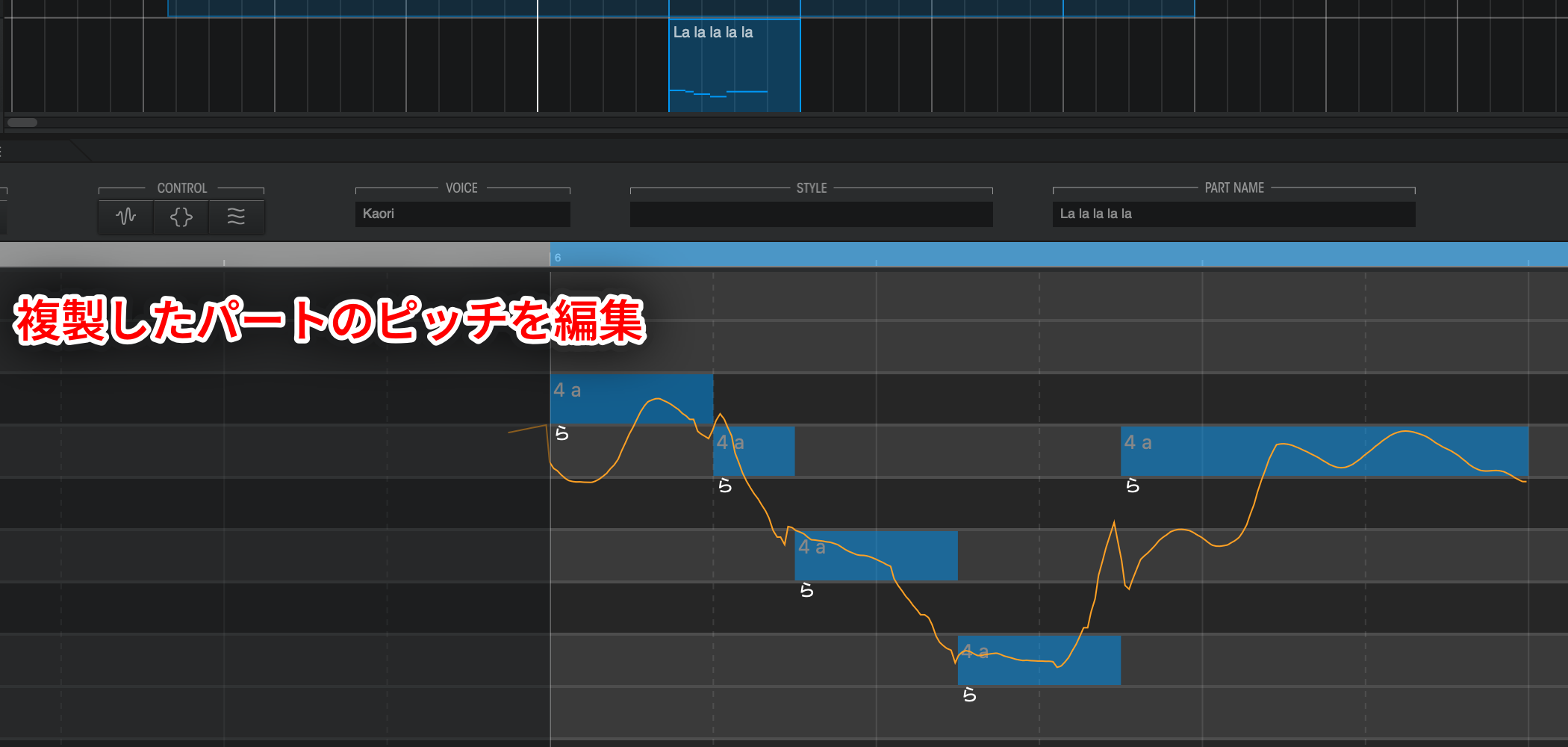
Then edit the pitches in the duplicated part.
Select notes and use these shortcuts:
- Up/Down arrow: Move in semitone steps.
- Shift + Up/Down arrow: Move in octave steps.
These shortcuts let you change the selected notes' pitches.
They are very useful for speeding up editing.
Applying Effects
VOCALOID 5 provides a wide range of audio effects.
There are two main ways to apply them.
Method 1: Apply Effects to Individual Parts
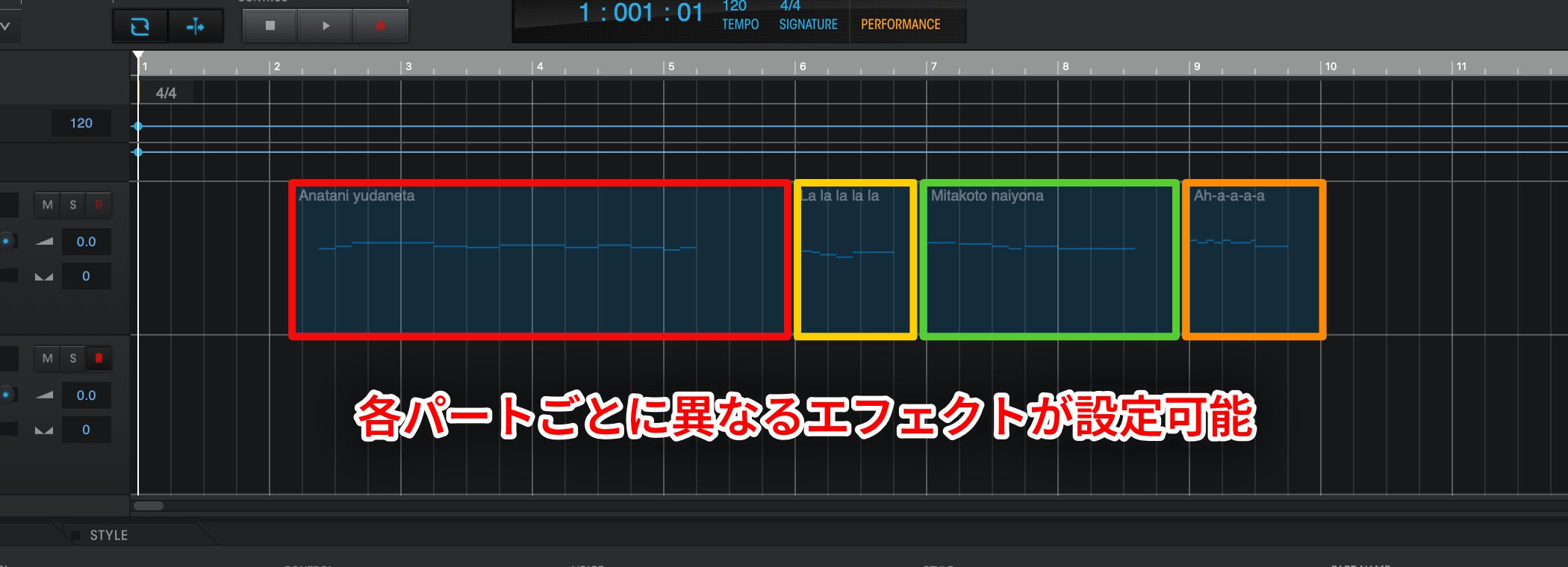
You can set different effects for each part.
This is useful when you want detailed control over how effects are used.
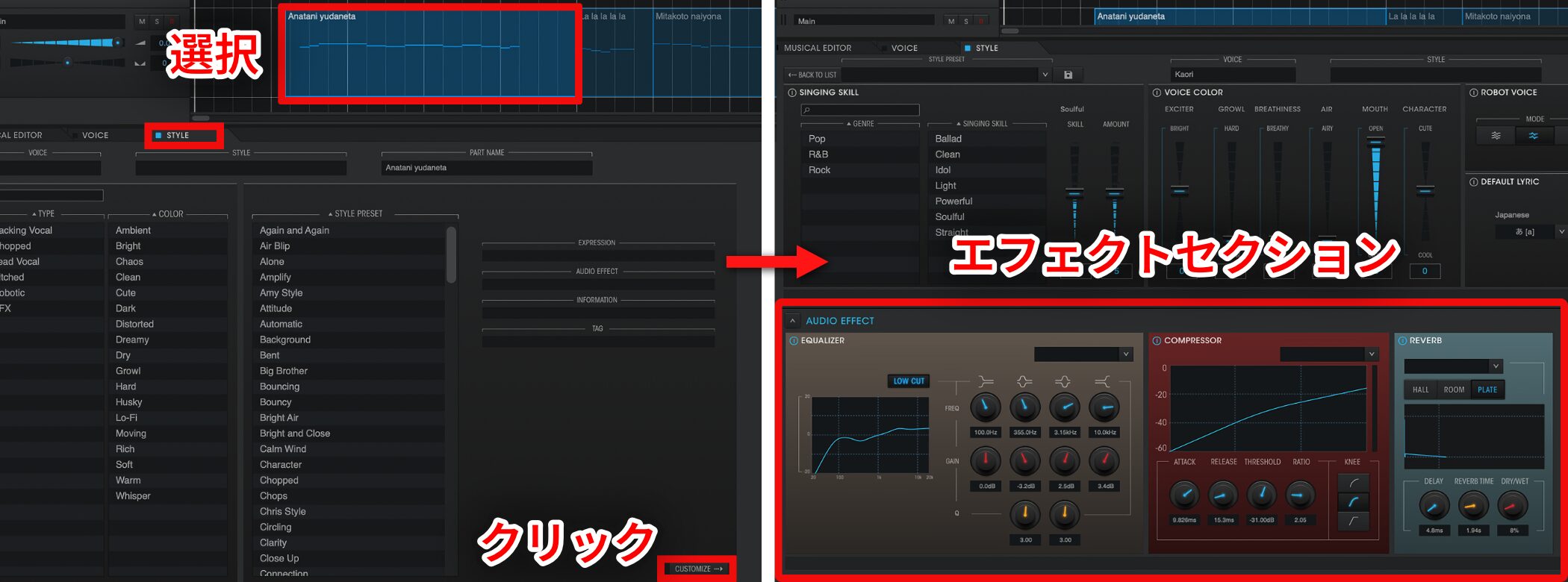
For a VOCALOID part, click the part, then click STYLE → CUSTOMIZE to display the effects section.
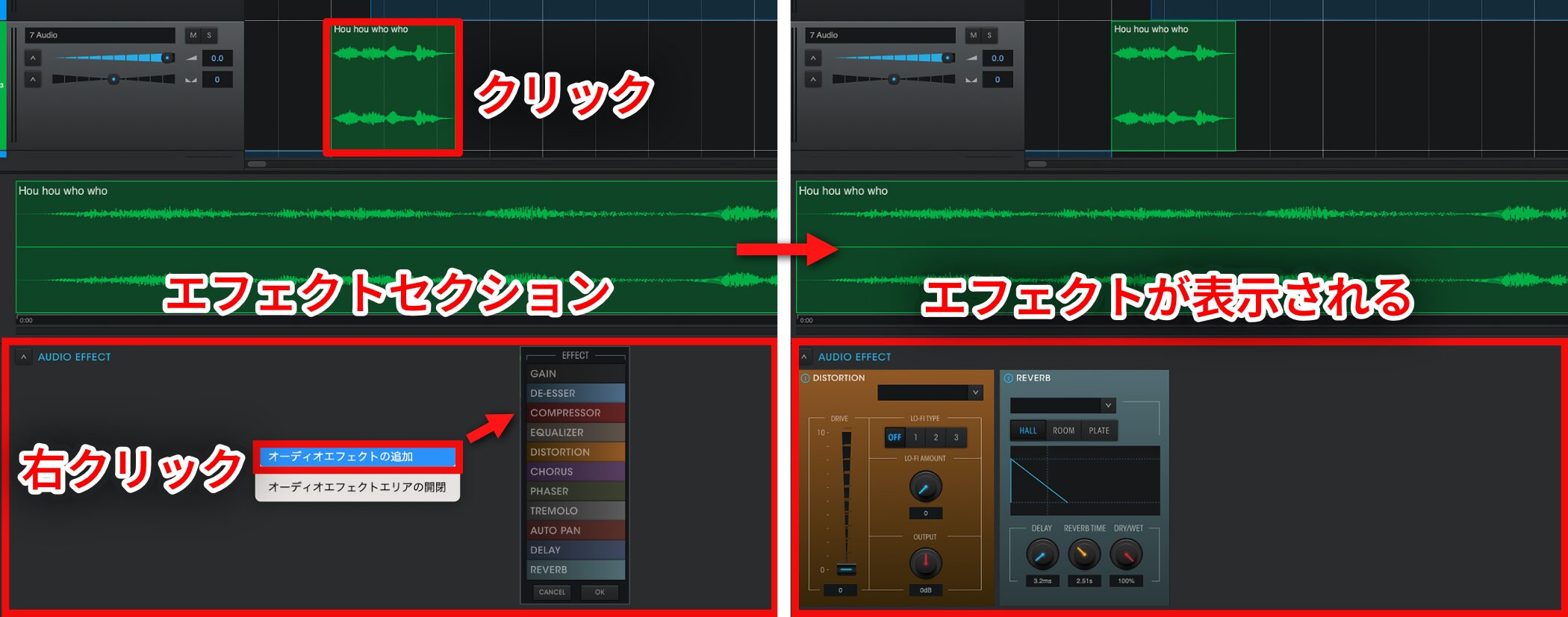
For an audio part, click the part to display the effects section below.
Right-click and select Add Audio Effect from the menu to display the effects list.
Select the desired effect and click OK to display it.
Method 2: Apply Effects to All Parts on a Track
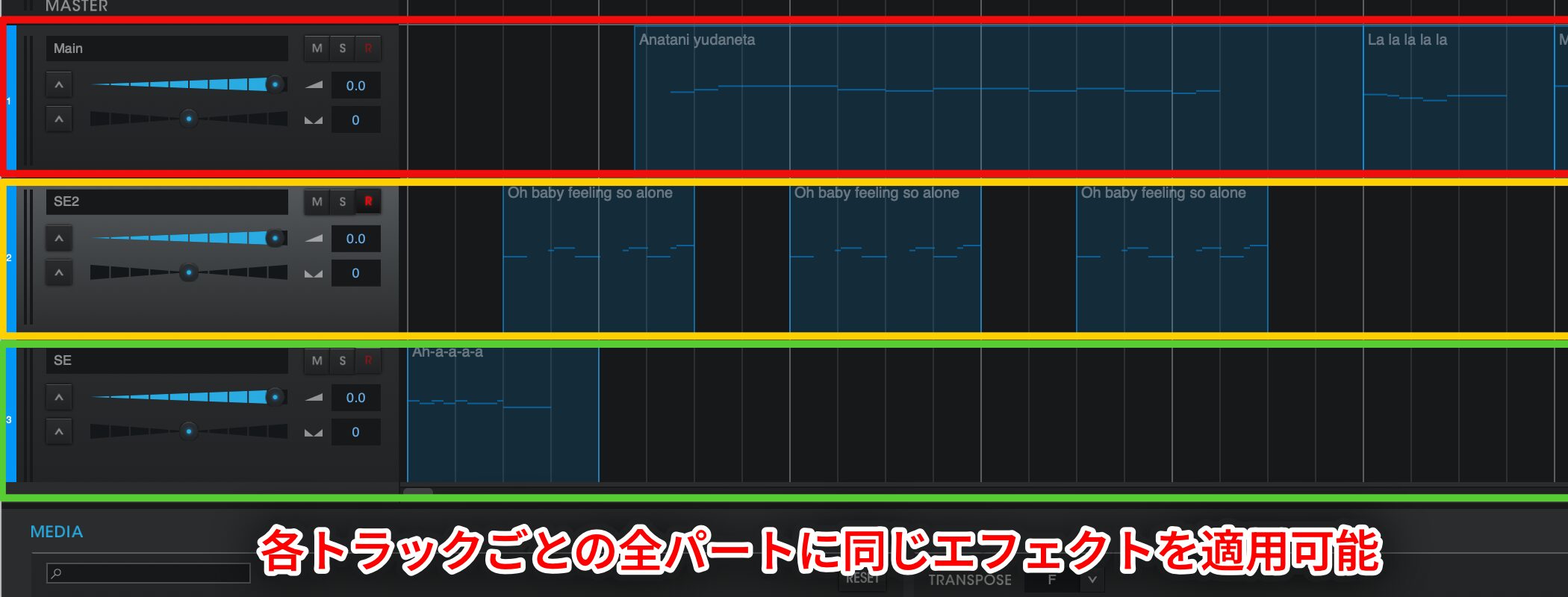
Apply effects to all the parts on a track.
This is an efficient approach when you want a consistent effect across the track.
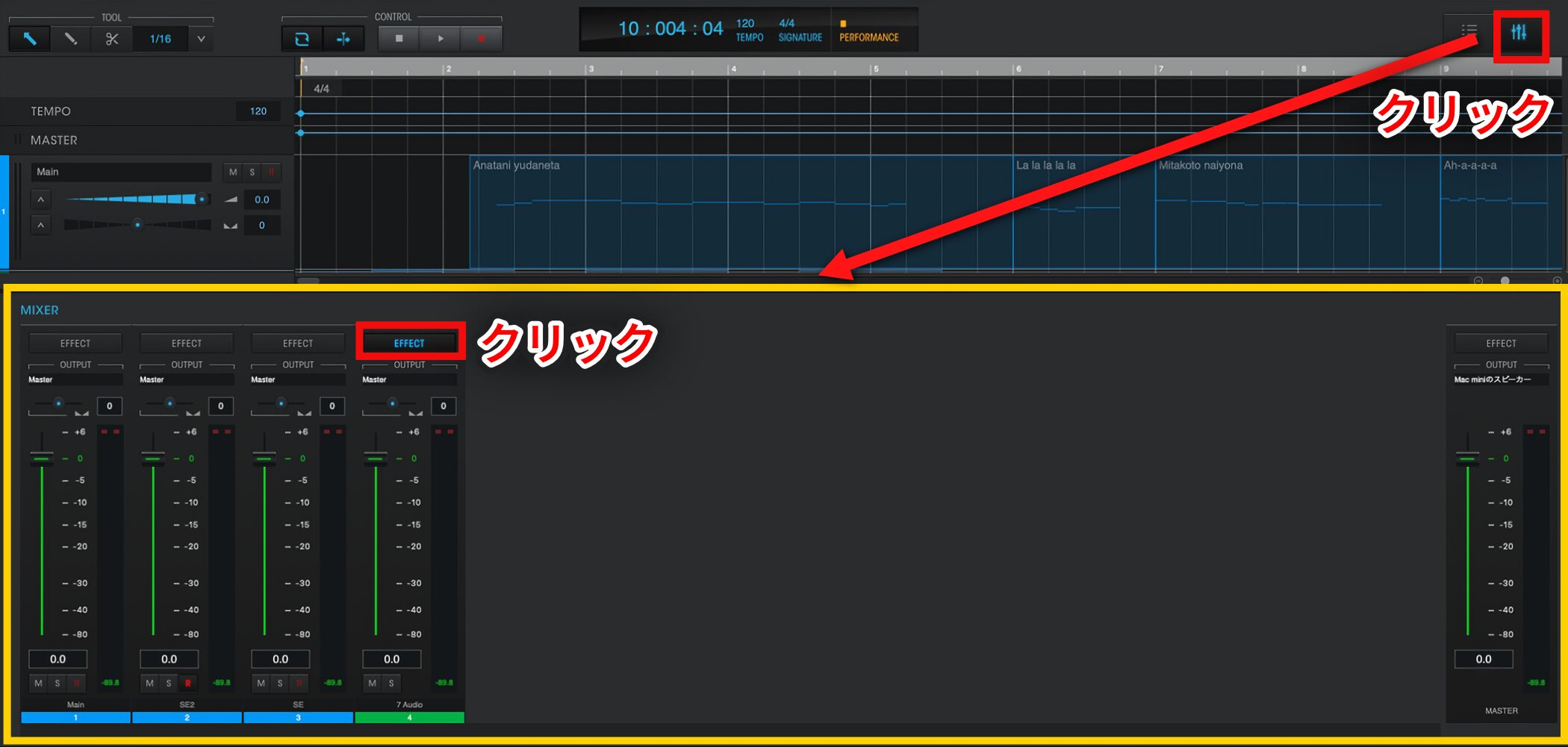
Click the Mixer button to display all the tracks used in VOCALOID 5.
Each track has an EFFECT button above it. Select EFFECT on the track you want to process.
The method for adding an effect is the same.
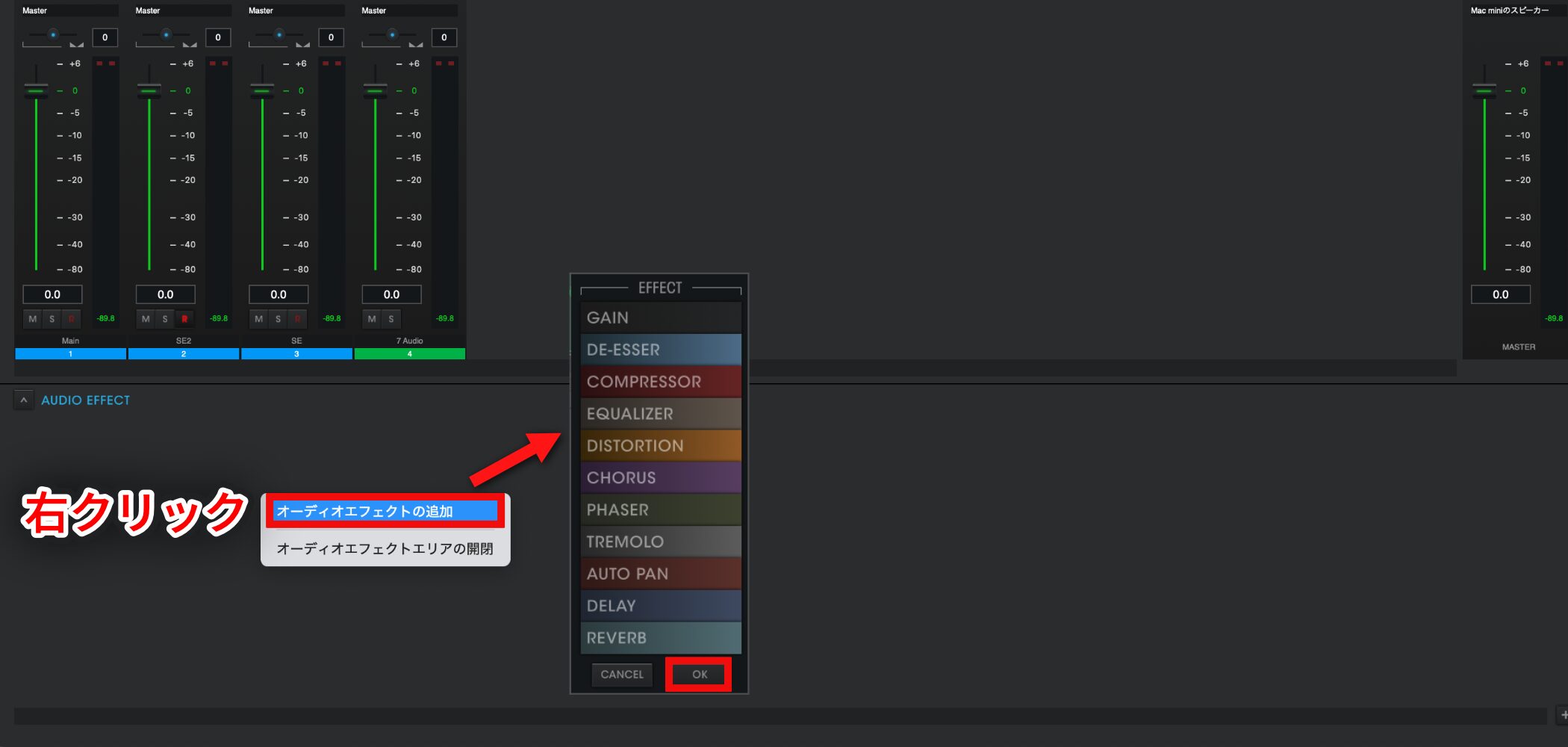
Right-click the effects section and select Add Audio Effect.
Choose the desired effect from the list and click OK.
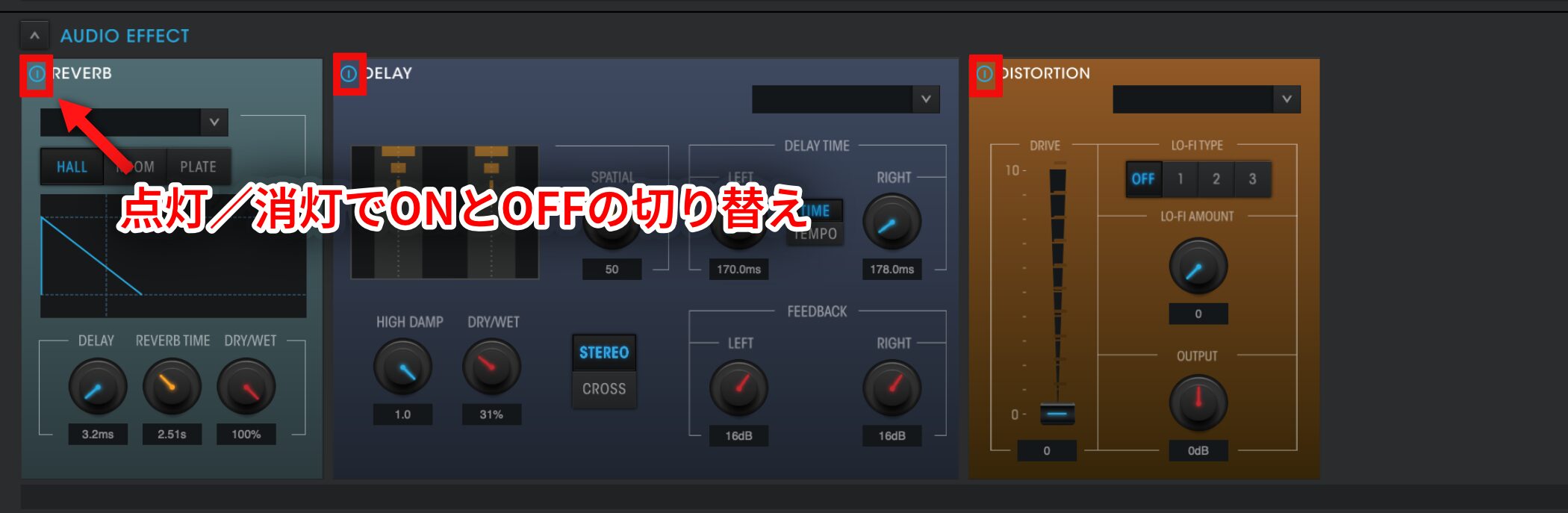
Click the power button at the top of an effect to switch its processing on or off while retaining its settings. You can also:
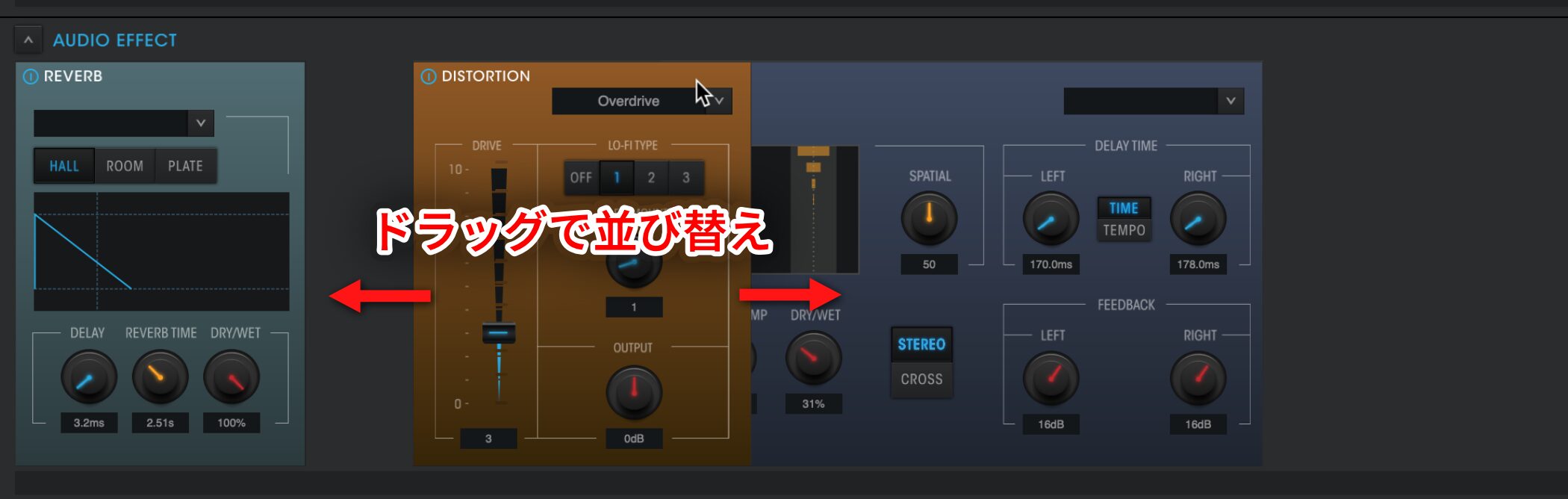
Drag effects left or right to change their order.
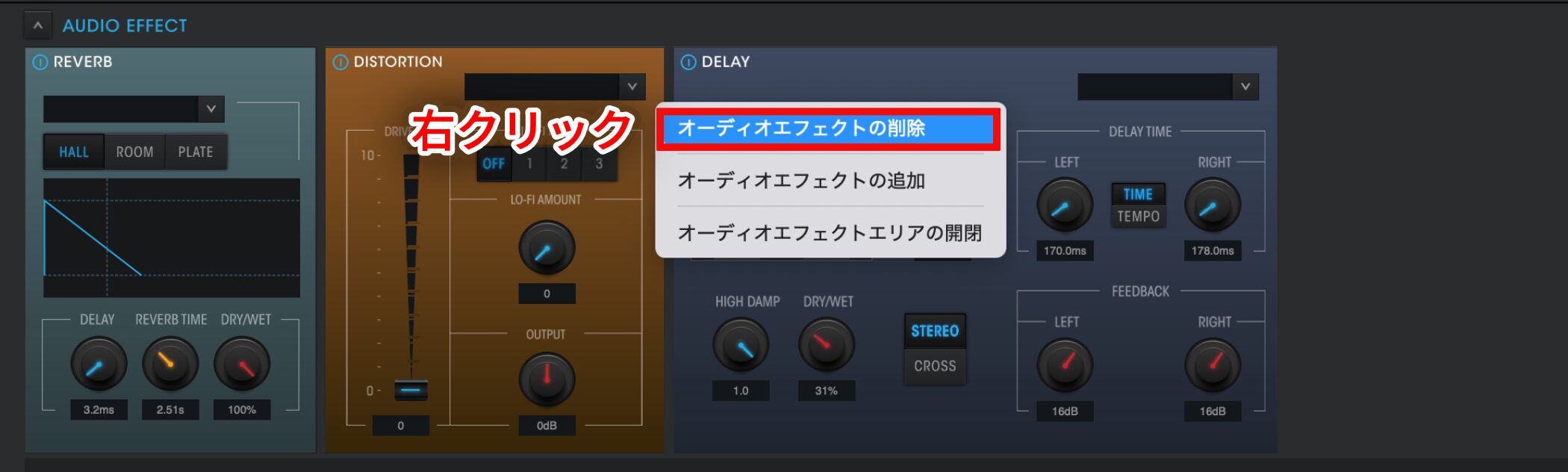
Right-click an effect and select Delete Audio Effect to remove it.
Routing Separate Outputs to Your DAW
Depending on your workflow and the stage of production, you may want to send each VOCALOID 5 track to your DAW separately.
VOCALOID 5 makes this multi-output routing easy.
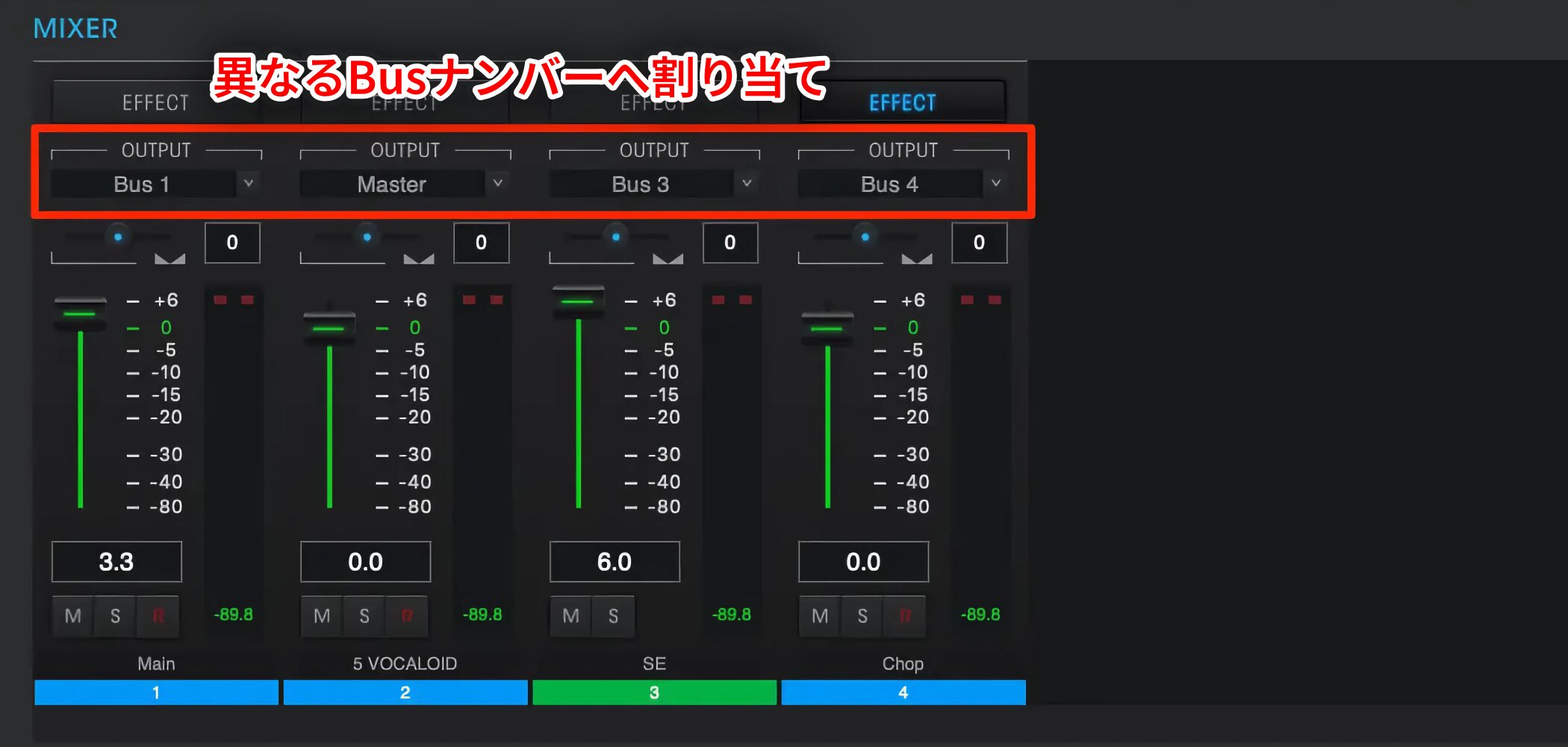
The setup is simple.
For each track in the Mixer window, assign its OUTPUT to a different bus number.
That completes the setup on the VOCALOID 5 side.
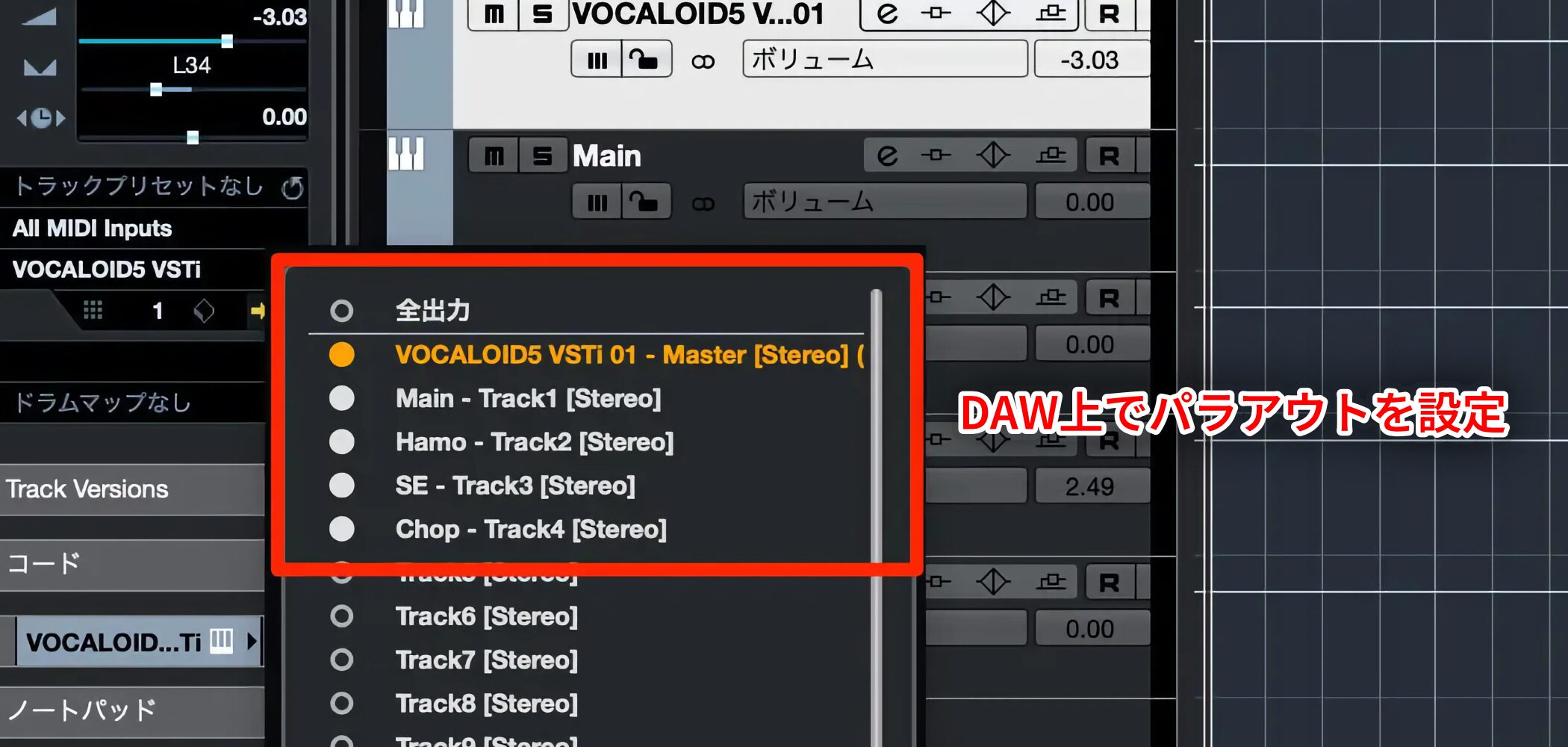
Next, configure your DAW to receive those outputs.
See the links below for multi-output setup instructions.
Multi-Output Setup by DAW

 Logic
 Cubase
 Ableton Live
 Studio One
 FL Studio
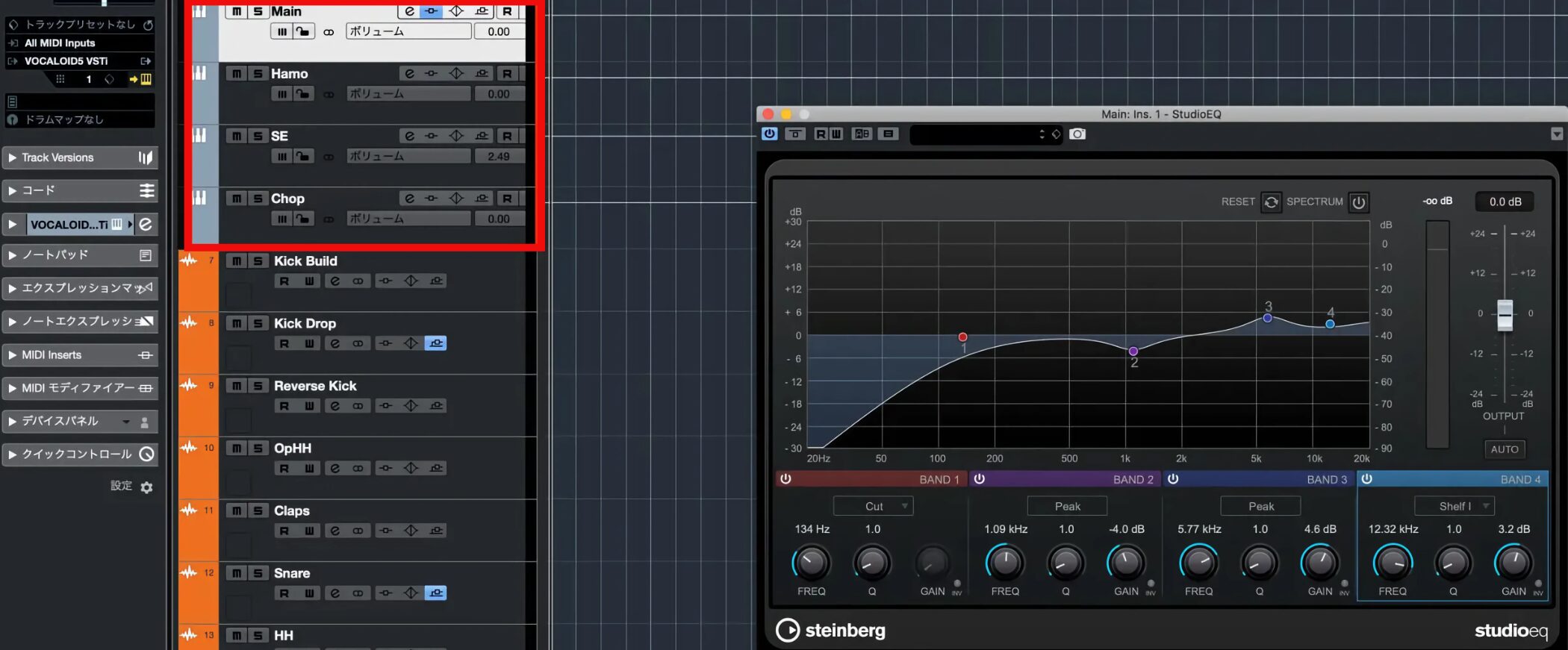
Once set up, you can edit each track's volume, pan, effects, automation, and more in detail.
Exporting Audio
You can export each track in VOCALOID 5 as audio.
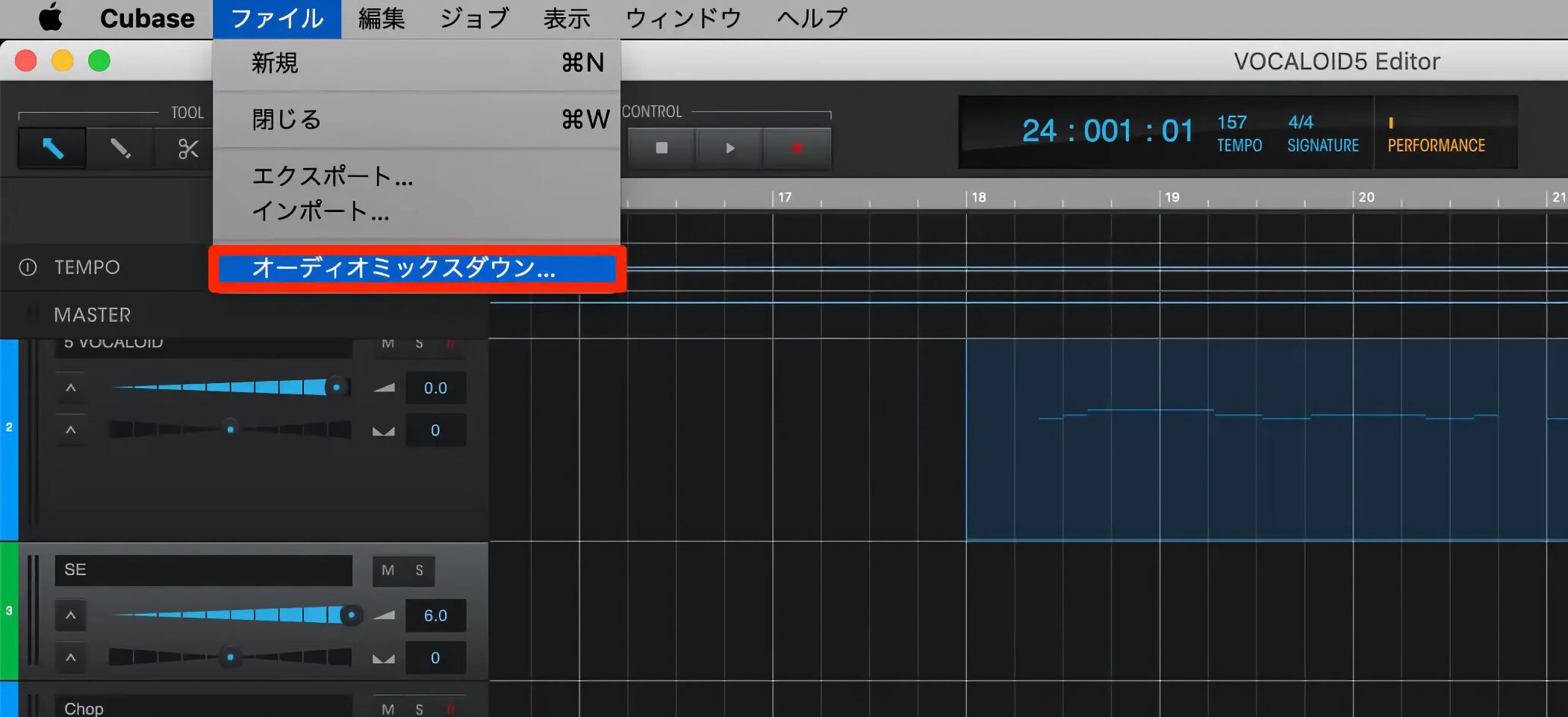
From VOCALOID 5's top menu, select File → Audio Mixdown.
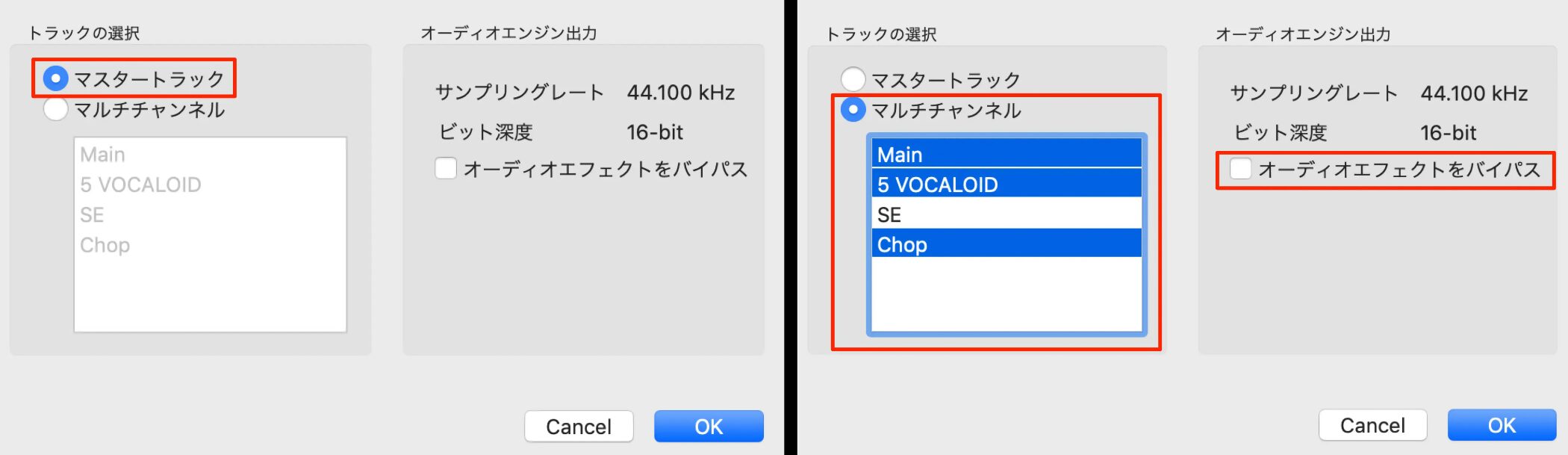
Master Channel exports all VOCALOID 5 tracks as a single audio file.
Multi Channel exports the selected tracks as separate audio files.
Check Bypass Audio Effects to export with the effects configured above disabled.
This is useful if you want to fine-tune effects later in your DAW.
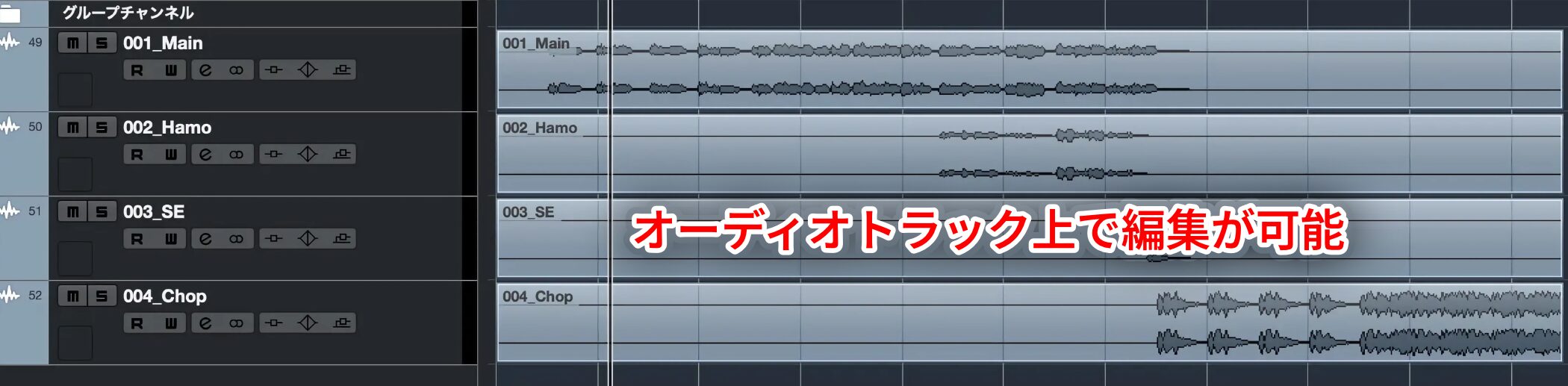
Import the exported audio files into your DAW to edit them as audio tracks.
What did you think?
We hope this has shown the product's potential, both to people interested in it and to users of earlier versions.
Use the phrase creation tools, fine adjustments to pitch and expression, lyric entry, extensive effects, and flexible routing covered here to create an almost limitless range of vocal tracks!
Frequently Asked Questions
Q1. Can I use VOCALOID 5 in Logic Pro?
Yes. VOCALOID 5 fully supports the AU plug-in format used by Logic Pro. Create a software instrument track and open VOCALOID 5 AU for seamless integration so you can start producing right away.
Q2. What voicebanks are available in VOCALOID 5?
The Standard package includes four singers: Amy, Chris, Kaori, and Ken. The Premium package adds CYBER DIVA II, CYBER SONGMAN II, VY1, and VY2 for a total of eight. Choose a voicebank to suit the language and song.
Q3. What can I do if I cannot think of a melody?
Use the more than 2,000 phrase presets and vocal sound effects built into VOCALOID 5. Importing these phrases with settings optimized for your song can help you come up with melodies.
Q4. Can I create multiple vocal tracks?
Only one instance of VOCALOID 5 can be opened in a project, but you can create multiple vocal tracks by managing parts within the VOCALOID Editor.
NEW ARTICLES
Latest English Articles