Chord progressions containing non-diatonic chords

Let's make full use of what we've learned so far to analyze a chord progression containing non-diatonic chords.
We'll use "Fly Me to the Moon (In Other Words)," which we've used in earlier explanations too.
Now, let's check the chords.

The chords sound like this.
Checking this in the piano roll gives the following.
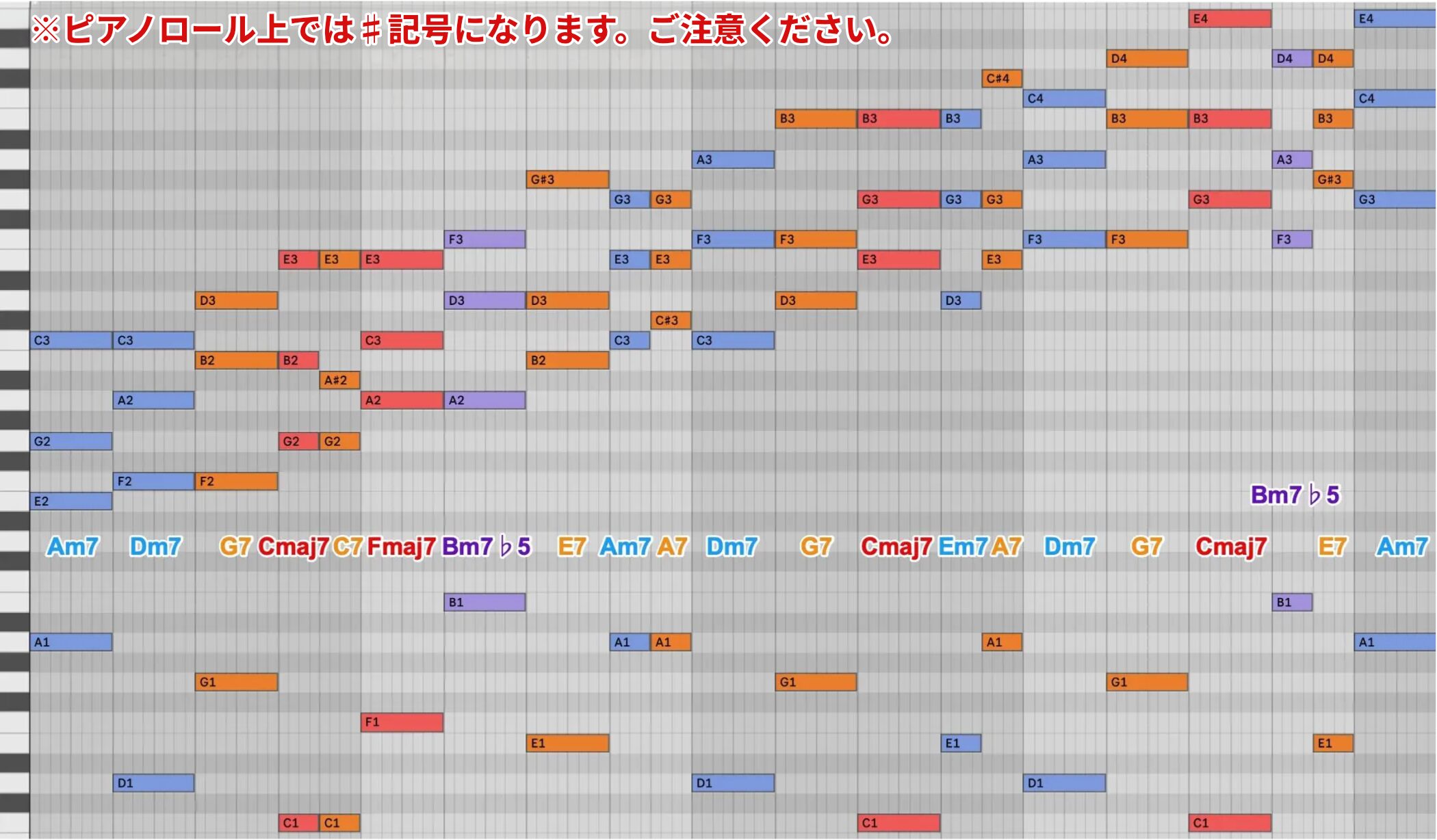
Now let's write degree names into this piano roll.

From the chords above, let's look for the non-diatonic chords.
This time we're analyzing in Key = C major.


They're the parts outside these boxes.

C7, E7 and A7 are the non-diatonic chords.
Now let's deliberately replace these chords with diatonic chords and listen.
The parts boxed in the image above
- C7→Cmaj7
- E7→Em7
- A7→Am7
were changed as shown.
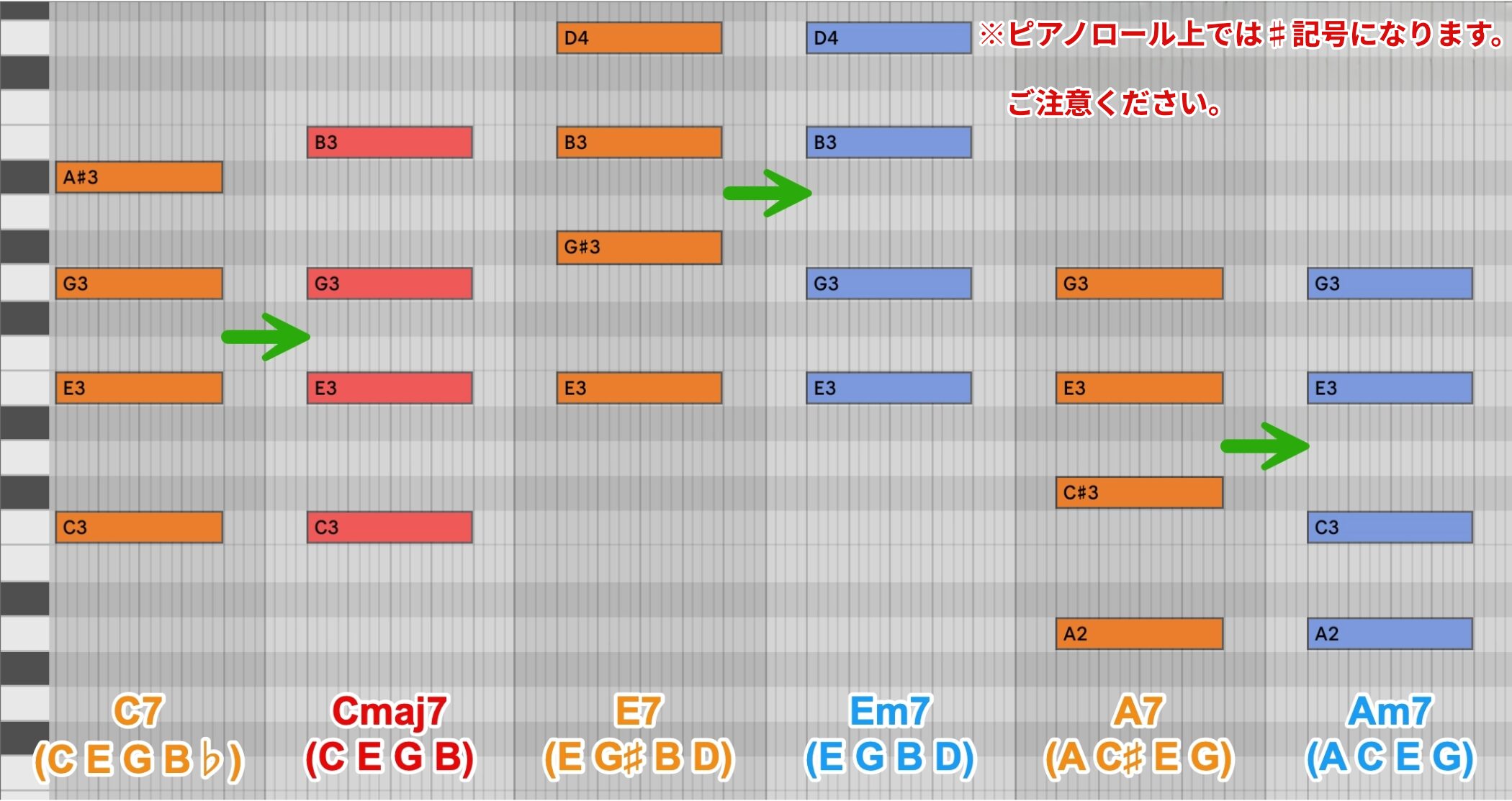

This is the result. Let's actually listen.
- Chord progression before the change
- Chord progression replaced with diatonic chords
How was that?
The atmosphere changed completely.
The original non-diatonic chords give a stronger impression, with a sense of anticipation from C7, E7 and A7 toward the next chord.
Let's recall what we covered last time.
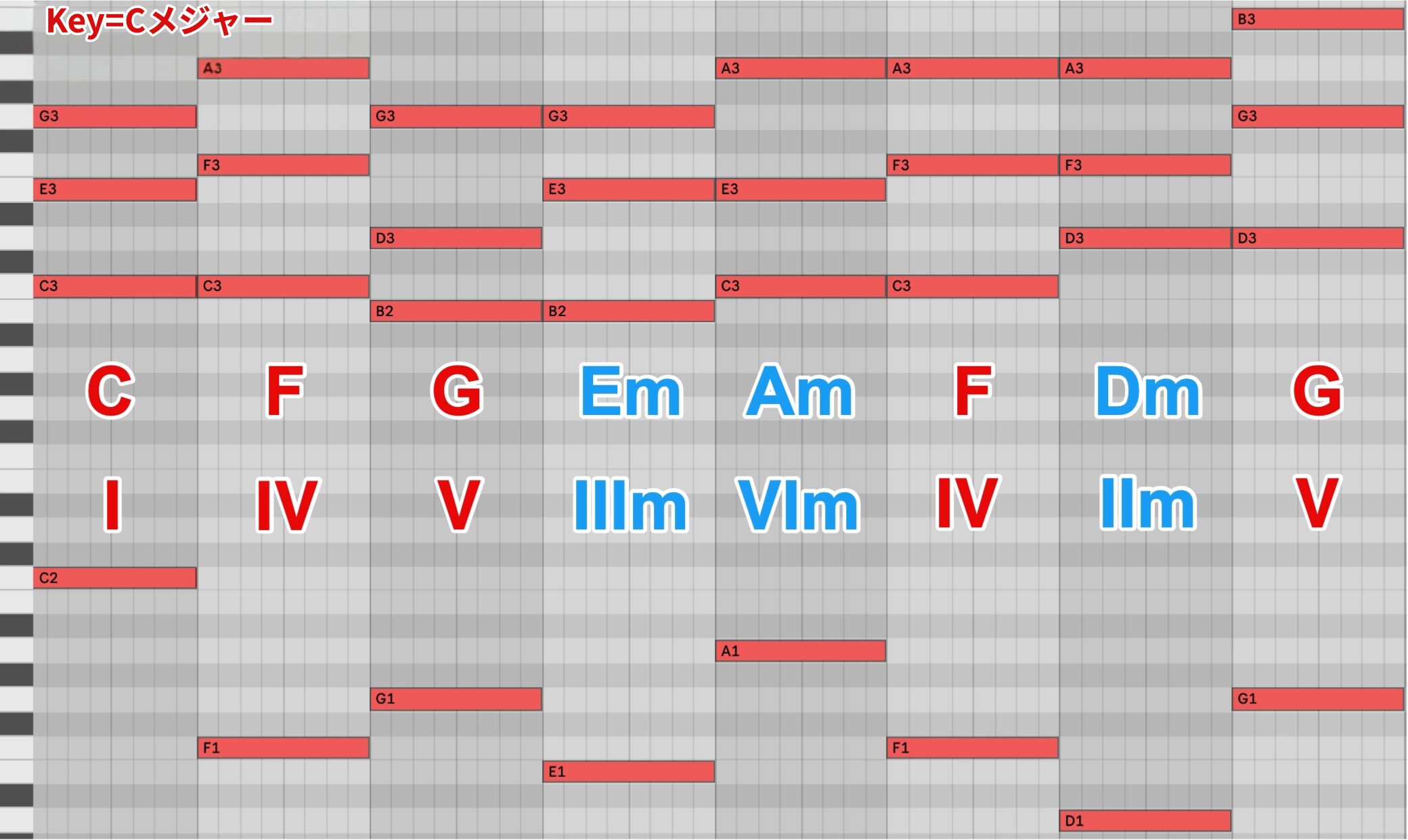
First, a progression using only the diatonic chords of Key = C major.
Below is an arrangement of this, changing "IIIm→III" and "IIm→II."
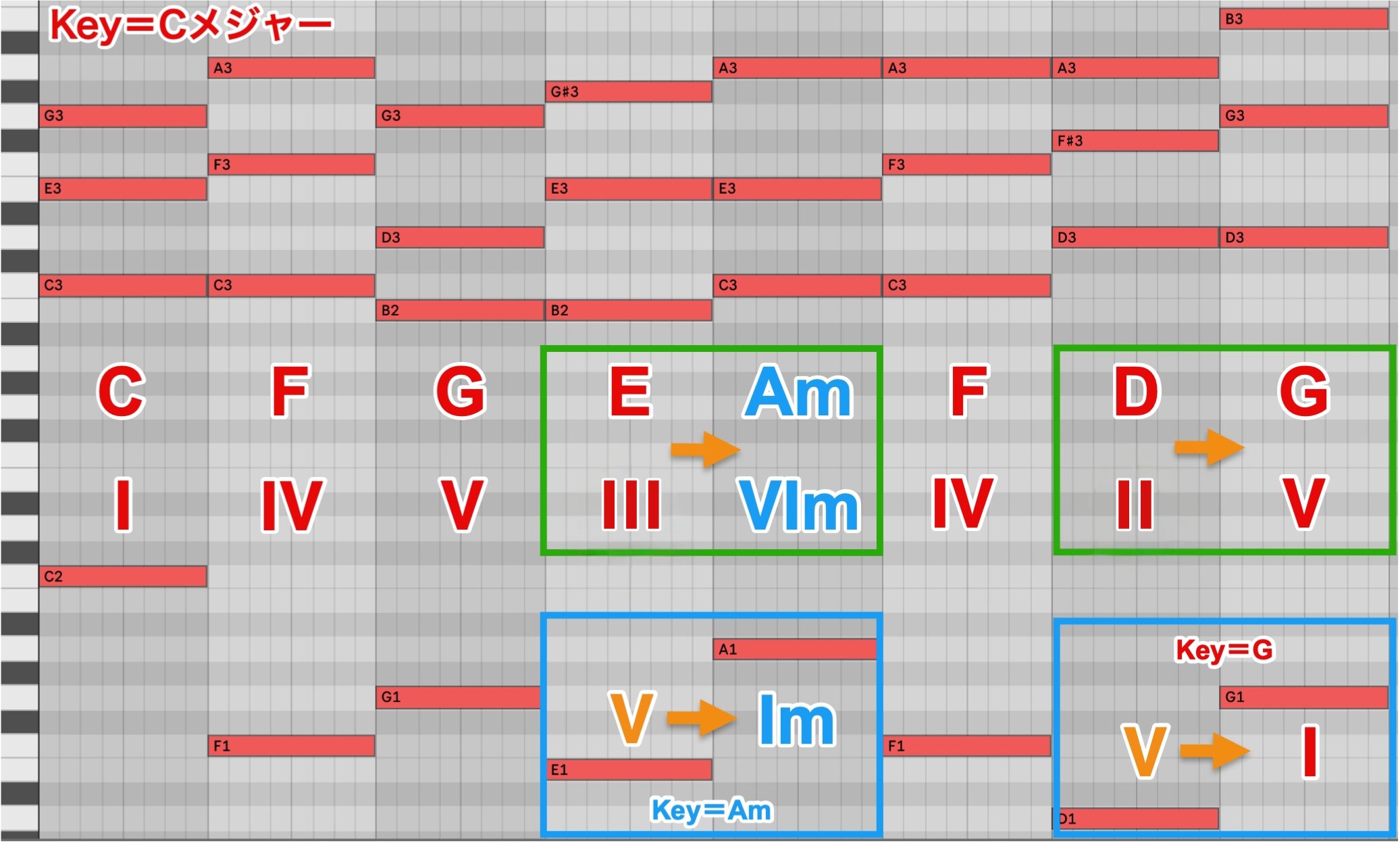
It's "the same melody," but the impression is different.
The flow from V to Im (III→VIm) came from a scale with the leading tone of the relative key (in this case A minor) added.

The II→V (D→G) part we checked at the end of last time was V→I in Key = G major.
With all this in mind, let's look again at "C7, E7, A7" in the chord progression of "Fly Me to the Moon (In Other Words)," including the "next chord" each one leads to.

- C7→Fmaj7 is V7→Imaj7 in Key = F
- E7→Am7 is V7→Im7 in Key = A minor
- A7→Dm7 is V7→Im7 in Key = D minor
You can see them this way.
It's simply last time's triad version turned into a four-note chord version.
Because they contain a tritone, they're characterized by stronger tension and a stronger pull to resolve.
About partial modulation
What we're learning now can be called one technique of "partial modulation": modulating to a different key "partially" and "temporarily."
It's also called temporary modulation.
The flow above, "C7→Fmaj7 = V7→Imaj7 in Key F,"

is like a Key = F flow strongly appearing for a moment within Key = C major or A minor.
Next time we'll dig even deeper, including a review of what we've covered so far.
Frequently asked questions
Q1. What is a secondary dominant?
A secondary dominant is a dominant 7th chord that doesn't belong to the original key, used temporarily to emphasize a particular chord. For example, C7→Fmaj7 functions as V7→Imaj7 in Key = F, creating a partial change of key.
Q2. What are the benefits of using non-diatonic chords?
Using non-diatonic chords creates tension and anticipation in a song and makes the resolution to the next chord more powerful. Expressiveness improves dramatically compared with progressions using only diatonic chords, drawing in the listener's ear.
Q3. What's the difference between partial modulation and full modulation?
Partial modulation temporarily uses the musical functions of a different key and then returns to the original key. Full modulation, on the other hand, moves to a new key for the song as a whole. Secondary dominants function as a partial modulation technique.
NEW ARTICLES
Latest English Articles