Interview with Film and TV Composer Hideakira Kimura

For the sixth installment of Pathways into the Music Industry, we interviewed Hideakira Kimura, a composer of scores for film and television.
Kimura has written the music for many well-known productions, including the TV dramas "Kounodori" and "Soshite, Daremo Inakunatta." He shared plenty of behind-the-scenes stories and insights into the rarely discussed world of scoring, so please read on!
Thank you for making time for us despite your busy schedule. First, what kind of work is the scoring that you do?
Hideakira Kimura (hereafter Kimura: ) "Gekiban" is short for "gekichu banso ongaku," meaning incidental music. It refers to the music that accompanies visual works such as films, TV dramas and anime.
We would like to ask how you came to do this work. We heard you were born in Tokyo and then grew up in the United States.
Kimura: That's right. Right after I was born, we moved to the US because of my parents' work. Later we returned to Japan, and after high school I went on to Waseda University.
What got you into music?
Kimura: In my second year of high school, there was a music class where we were told to try forming a band. It was a slightly unusual school where the final exam was a live performance, and at the time I was really into HYDE of L'Arc-en-Ciel, so I decided to take up the guitar. That was the start. One of my classmates happened to be a great player, so he taught me.
Back then, you were not yet thinking of making a living from music?
Kimura: From around junior high school, I wanted to become a civil servant, so music was purely a hobby. I went to Waseda University because I wanted to study law and politics. Even in university, I kept music strictly as a hobby, with a statute book in one hand (laughs).
I see. So how did you end up devoting yourself to music?
Kimura: After I had a job offer lined up, I went on a graduation trip with university friends, and I kept vaguely thinking, "I want to play guitar." I started to feel that even if I took the job and settled into that life, I would probably always want to play guitar. I had more or less finished studying law, so I wanted to study music as an academic subject too, and that is how it happened.
So you discovered your path in music after your post-graduation plans were already set. Were you interested in scoring back then?
Kimura: From around junior high, I liked soundtracks more than songs, and I would listen while picturing scenes from the films. In university I composed as a hobby and often had friends listen to my pieces, and even then I somehow felt I was not the frontman type but more of a craftsman, someone with a trade. Scoring fit that perfectly.
You then went on to Berklee College of Music. There are many music schools in Japan, so why Berklee?
Kimura: Mainly because I had always loved Western films, and I was a big fan of Steve Vai at the time. Juilliard is very tough unless you have had specialized training since childhood, and since I could not read music at all back then, Japanese music colleges also seemed difficult. So going to Berklee was a fairly natural choice.
Steve Vai "Now We Run"
Even so, getting into such a prestigious music college must have been quite hard.
Kimura: Yes. I spent two years at a vocational music school in Japan building a certain foundation before enrolling. Because I loved the guitar, there was a time when I aimed to be a studio musician, but a teacher at that school advised me that I was better suited to composing than performing, and I think that was one of the reasons I set my sights on being a composer.
I see. What did you study at Berklee?
Kimura: I was in the Contemporary Writing and Production department, where I learned the full range of knowledge and skills needed for today's music. I was practically a beginner at computer-based production, but I bought the "Berklee Mac," which came with a complete set of gear, and studied with it.
I imagine the classes were very demanding.
Kimura: Every day was busy: studying all kinds of music from small to large ensembles, lots of homework and practical exams. In music theory, we even studied specialized topics that are barely covered on Wikipedia.
After studying music thoroughly there, you returned to Japan. How did you then start working in music?
Kimura: I planned to return to Japan after graduating and kept thinking about how to find work there. While I was thinking I should join some management company, I noticed that many of the soundtracks I loved were by Yu Takami. I was hoping to join his agency, Miracle Bus, when a university friend who worked at a record label invited me to take part in a competition for a vocal song. That project happened to be a Miracle Bus project, and the song I submitted was chosen as a B-side.
Manami: "Kono Mama, Zutto"
Amazing. Beyond your ability, it seems a lot of encounters and coincidences came together.
Kimura: That's right. This led me to start entering competitions for vocal songs, but I remember struggling for about the first year: I submitted around 100 songs and none were picked. I loved Western music, so I think I was not good at the so-called "tear-jerking melodies" peculiar to Japanese pop.
Meanwhile, someone from TBS who was at the agency on another matter happened to hear my demo, and that led to me scoring a two-hour TV movie. In a way that was also a coincidence, and it was decided out of the blue.
So that was your first scoring job.
Kimura: But that did not mean lots of work started coming in. Competitions were still hard to win, and I struggled a great deal after that too.
Still, I kept steadily taking on small jobs, and in 2013 I got my first serialized drama. That was when I was finally able to officially join the agency.
TBS drama "Sennyu Tantei Tokage"
From there you became a full-fledged film and TV composer. How does scoring work come to you?
Kimura: In various ways: through the agency, by a director naming me personally, and sometimes through competitions, just like vocal songs.
So there are competitions in scoring too.
Kimura: Mostly for things like a drama's main theme or a news program theme.
The world of scoring seems to have a very narrow entrance.
Kimura: It is work where trust matters a lot, such as how fast you can write and whether you can reliably deliver what is ordered, so I think it is a tough field for new composers. Talent and effort are essential, of course, but luck and a track record also matter.
Once you are assigned a project, how does production proceed?
Kimura: Taking a drama as an example, the proposal is sent first, so I read through it and then attend a meeting. There, I share the vision with the director and producer, and then go home and start composing.
Do you work from a specific list of the kinds of music they want?
Kimura: In industry jargon, that is called a "music menu," but recently there often isn't one, and in that case you have to think ahead about what music will probably be needed. Also, when production starts, the script often is not finalized and there is frequently no footage, so how well you can grasp the intentions of the director and producer becomes crucial.
How many pieces do you write for a drama?
Kimura: About 25, I would say. For anime you need roughly twice that, but unlike dramas, you usually compose once materials such as the footage and script are ready.
Either way, that is a lot of music. In what order do you write the pieces?
Kimura: I start with the main theme. It is the key music of the production, so I often agonize over it. When nothing comes to me, I sometimes write music for other scenes first to solidify the image.
Then I submit what I have finished, and while it is being reviewed, I work on another piece, and so on. The production period is about a month and a half in total.
You mentioned "thinking ahead" earlier. Are there times when pieces you wrote that way are not used?
Kimura: Yes. When another piece I wrote ends up being used in that scene, I reflect, "So this is the kind of music they wanted," and apply that next time.
So the ability to read what is needed is important. With such short production periods, is there anything you are careful about?
Kimura: I make sure to get enough sleep and to eat properly. I also take care to set up a good working environment: I pay attention to my chair and desk and try to make my workspace as relaxing as possible.
What music equipment do you use?
Kimura: Since I have used it since my Berklee days, my main DAW is Logic, running on a Mac Pro. For plug-ins, I use Komplete as my core and a variety of orchestral libraries.
Do you choose different ones depending on the ensemble?
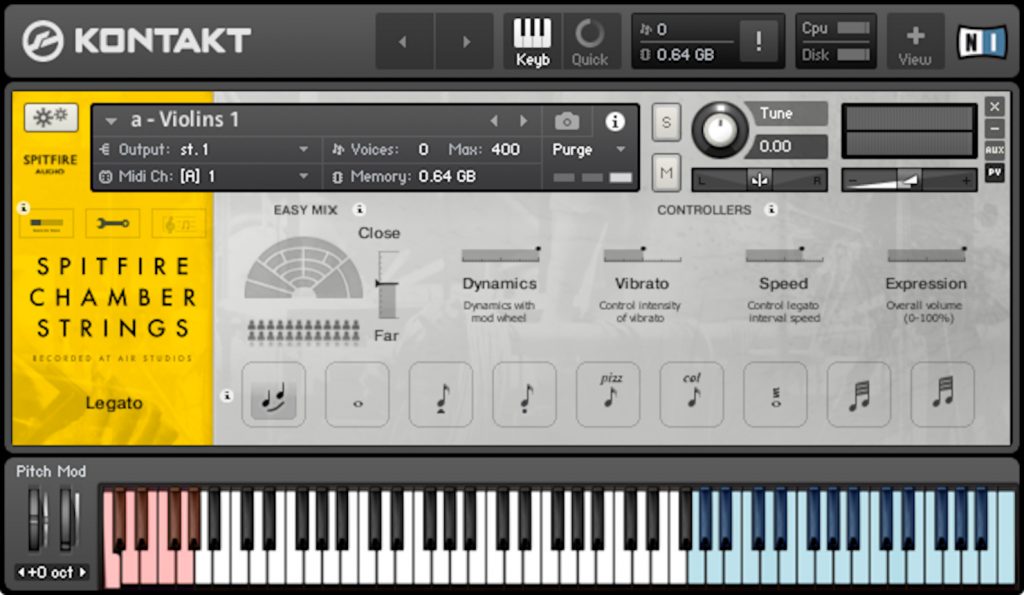
Kimura: Yes. For section sounds, I use "SPITFIRE CHAMBER STRINGS." I also often use SPITFIRE for woodwinds and brass. For solo parts, I like to use "Bohemian Violin."
What synths do you use?
Kimura: I use various ones. I often use Massive and the synths that come with Logic. A production technique I use a lot is applying Logic's built-in Auto Filter to synths. A synth playing constantly can often become too busy, so I use a filter to control how much sound comes through. It also helps keep the music from getting in the way of dialogue.
I am sure you are careful about many things when scoring, but is there anything you consider absolutely essential?
Kimura: The main theme really is important. How well it expresses the world of the production, and whether it is memorable at first listen and sticks in your ear, are extremely important, I think. It needs to be catchy enough that viewers know "this is the climax" as soon as it plays.
Also, I try to take on some kind of challenge or new approach every time, so that I never repeat what I did before.
You work on productions and music in many genres. What kind of music do you usually listen to?
Kimura: Mainly Western rock. I like listening to Nothing But Thieves, Royal Blood, Sigur Rós and others.
Many people probably want to make a living as a film and TV composer like you. What kind of talent is in demand now?
Kimura: For young composers, I don't think music that is "the orchestra" or "the classic score" is in much demand. In recent years, the combination of visuals and music has grown, and the distance between picture and music has narrowed. Rather than writing music for the picture, the idea of creating a single work together with the picture is probably becoming more important. I think the reason artists such as Yasutaka Nakata and RADWIMPS have recently been scoring films is that originality and distinctive work are in demand.
I see, that ties back to what you said about grasping intentions.
Kimura: That said, the quality of your demo is also extremely important, so it really is a very tough world.
When you were aiming to become a film and TV composer, was there anything you are glad you did?
Kimura: I often compose logically, so I am glad I studied music theory properly. Also, the impression of a piece surprisingly often changes completely with the rhythm, so I made a point of building up my bag of tricks from many directions. I think analyzing songs you love is also important.
Outside of music, is there anything you found useful?
Kimura: Studying for entrance exams (laughs).
That is an unexpected answer (laughs).
Kimura: I also just like studying, and I think it was good that I developed the ability to manage a schedule with an eye on the future. Knowing what you have to do by when in order to achieve something is a very important skill in production too.
Not just exam study: all kinds of life experience can pay off in unexpected places. The fact that I connected with my current agency through a university friend is one example, and actively engaging with people from many worlds, not just online, often helps later on, so I think it matters.
Do you have any advice for people who want to become film and TV composers?
Kimura: I think you should decide on your goal, what you want to become, and then build your own brand properly. On top of that, effort is of course necessary, and luck matters too. There is also the question of whether what you love will be accepted by the public.
But these days, there are many ways to make a connection if you want to, such as approaching composers you admire directly on social media or sending demos to various agencies.
Also, for a film and TV composer, what matters is how well you can write music viewers can relate to. As I said earlier, I think you need to gain all kinds of life experience and develop the ability to relate to the work more deeply than anyone.
Thank you very much.
Hideakira Kimura's Recommended Software
Explore Our Other Articles

Music Theory: Beginner Course
A music theory course for beginners. We check everything in the DAW's piano roll too, so even if you cannot read sheet music, you can learn the fundamentals of music theory with confidence and enjoyment. With the goal of actually being able to compose, we explain things in what we believe is the best order, without overload.
How to Use Logic Pro: Beginner Course
Lesson articles for beginners using Apple's Logic Pro. Also covers the recent Logic Pro X. We explain basic usage, operations and tips with videos. If you are new to composing on a computer, please use this course as your introduction.
How to Use Logic Pro: Advanced Course
A collection of intermediate and advanced content for Apple's Logic Pro. Also covers the latest Logic Pro X. Once you have mastered the basics, use this course to take your skills further.
About the author

Interview and text: momo (Mamoru Tanoue)
Born in 1995. A Digital Performer user. After graduating from music school, moved from Fukuoka to Tokyo as a composer.
Made a debut as a writer in August 2017, composing and arranging for Tsukicro's "STARDUST".
With the motto "songs that touch the heart", a multi-player who handles everything from lyrics and composition to arrangement and recording.
Also active as the composer and arranger for the art unit "Shiro".
Twitter ID: @momo_tanoue
"Shiro" Website: https://www.shiro.space/
"Shiro" Twitter ID: @shiro_unit
NEW ARTICLES
Latest English Articles